






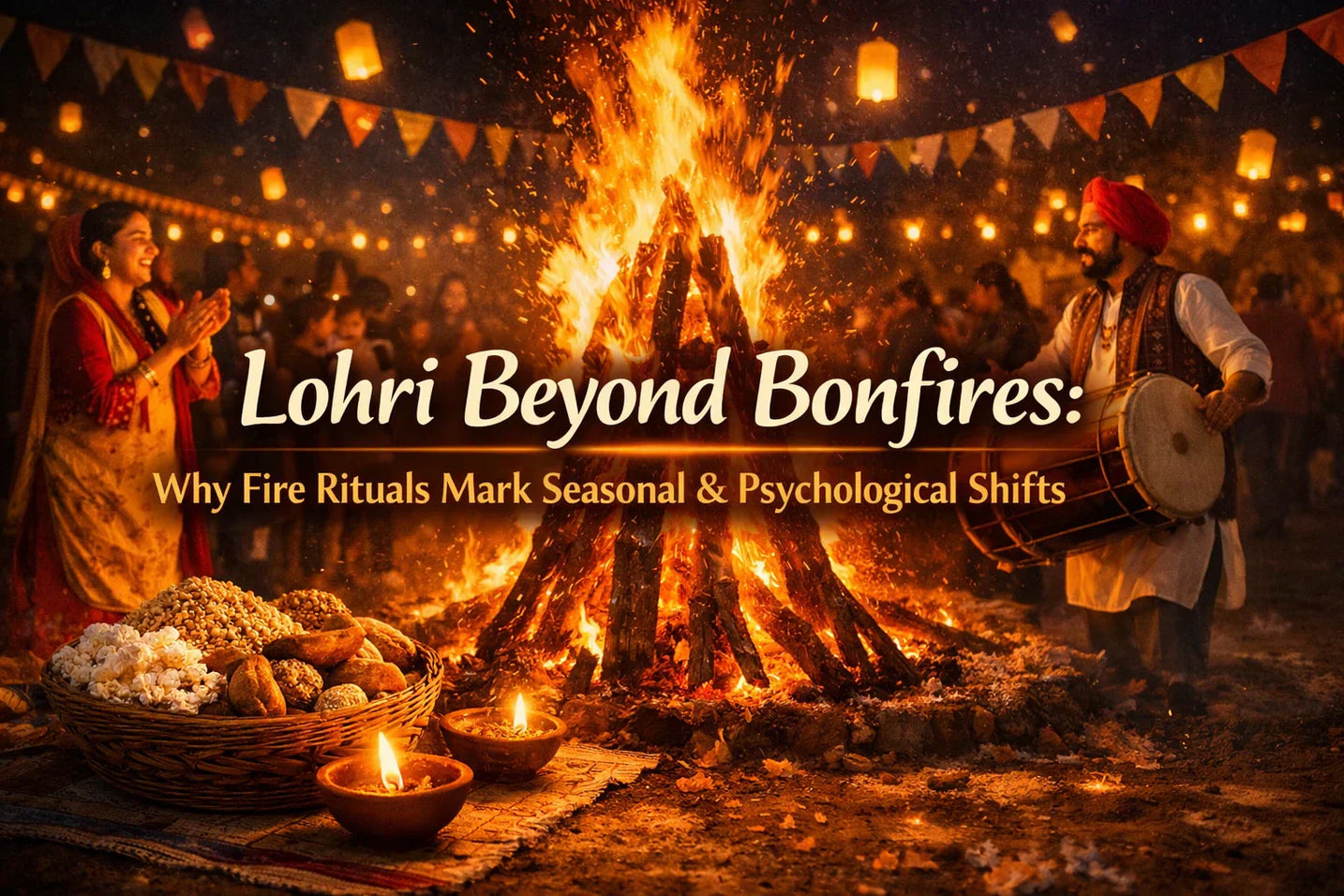
🔥 Lohri Beyond Bonfires: Why Fire Rituals Mark Seasonal & Psychological Shifts
Every year in mid-January, as winter reaches its quiet peak, communities across North India gather around fire. Songs are sung, grains are offered, warmth is shared, and stories repeat themselves — often without being questioned. Lohri is usually explained as a harvest festival, a celebration of crops, or a cultural gathering. But these explanations barely touch the surface.
Lohri is not just a festival of joy. It is a ritual of transition. It marks a turning point — not only in climate, but in human psychology. The fire at the center of Lohri is not decorative. It is deliberate. And the timing is not arbitrary.
To understand Lohri fully, one must look beyond celebration and into how ancient societies responded to seasonal pressure, emotional stagnation, and the need for collective recalibration. Lohri survives not because of nostalgia, but because it addresses a problem that still exists today — how to move the human system out of inertia and into renewal.
🌾 Lohri Is Not a Celebration — It Is a Threshold
Lohri does not mark abundance. It marks endurance. It occurs when winter has not yet loosened its grip, when the cold is still present, when the body feels heavy, and when motivation often declines. This timing is critical.
Ancient cultures did not wait for comfort to celebrate. They marked moments of transition — thresholds where effort was still required, but change had begun. Lohri sits precisely at this edge.
The days begin to lengthen subtly. The sun’s warmth has not fully returned, but its direction has shifted. This is not victory — it is orientation. Lohri acknowledges that shift and asks the human system to respond consciously rather than passively.
Fire becomes the symbol of this response. Not as destruction, but as activation.
🔥 Why Fire Appears Across Cultures at Seasonal Turning Points
Fire rituals appear globally at moments of seasonal transition — from solstice bonfires in Europe to Agni-based rites in India. This is not coincidence. Fire serves three fundamental purposes at once:
- It restores warmth to bodies stressed by cold
- It creates communal gathering during isolation-heavy seasons
- It provides a psychological cue for change
In winter, human systems slow down. Movement decreases. Diets become heavier. Social interaction reduces. These are natural responses to cold — but left unchecked, they turn into stagnation.
Fire interrupts that stagnation. Visually, thermally, and symbolically.
The Lohri bonfire is not about burning something away. It is about signaling that dormancy has served its purpose — and continuation of dormancy now becomes harmful.
🧠 Seasonal Psychology: Why January Feels Heavier Than We Admit
Modern psychology confirms what traditional systems already understood — seasonal environments shape mental states. January carries accumulated fatigue. The nervous system has endured weeks of reduced sunlight, limited mobility, and social withdrawal.
This often manifests as:
- Lower motivation
- Increased rumination
- Emotional dullness or irritability
- A sense of being “stuck”
Ancient societies did not label this as depression or laziness. They recognized it as a seasonal condition requiring intervention — not medication, but ritualized disruption.
Lohri provided that disruption through fire, sound, movement, and shared attention.
The ritual does not ask people to introspect deeply. It asks them to gather, to offer, to witness, and to warm themselves — physically and psychologically.
🌞 Lohri and the Subtle Shift of the Sun
Lohri occurs just before Makar Sankranti, marking the sun’s transition into Capricorn and the beginning of Uttarayana — the northward journey of the sun.
This transition was never understood as a sudden change. It was gradual, almost invisible at first. But ancient observers respected subtlety.
They knew that waiting for obvious warmth was too late. Alignment had to begin before comfort returned.
Lohri acts as a preparatory ritual. It tells the human system: “The direction has changed. Now your orientation must follow.”
This is why Lohri emphasizes fire rather than water, warmth rather than cleansing, and community rather than isolation.
🌽 Why Offerings Matter: Food as Seasonal Intelligence
The items offered into the Lohri fire are not random. Sesame, jaggery, peanuts, and grains are winter foods — warming, grounding, and sustaining.
These offerings represent what has carried the body through the hardest part of winter. By offering them to fire, the ritual acknowledges their role and signals a shift toward lighter movement ahead.
This is not sacrifice. It is transition.
The message is subtle but powerful: what sustained you through survival may not serve you during renewal.
Fire transforms these items — just as the season transforms the human system.
👥 Community as Regulation, Not Entertainment
Lohri is communal for a reason. Winter isolates. Cold reduces social engagement. Left alone, the mind turns inward excessively.
Community gatherings around fire restore external orientation. They regulate nervous systems collectively — laughter, rhythm, shared focus.
This is not entertainment. It is regulation.
Modern society often dismisses such gatherings as “cultural leftovers.” In reality, they were psychological technologies — low-cost, high-impact systems for maintaining mental equilibrium.
🔁 Ritual Repetition: Why Lohri Happens Every Year
Lohri is not a one-time lesson. It repeats because seasonal pressure repeats.
Each year, winter creates the same conditions — physical slowdown, emotional heaviness, cognitive rigidity. And each year, the human system must be reminded to shift before stagnation hardens.
Rituals work not because they are dramatic, but because they are predictable.
The Lohri fire does not surprise. It reassures. It tells the body and mind: “You’ve been here before. You know how to move forward.”
🔥 Lohri’s Quiet Instruction
Lohri does not shout its message. It does not promise reward. It does not demand belief.
It simply creates conditions where change becomes easier than resistance.
Fire warms. Community stabilizes. Offerings reorient. And the human system, without being forced, begins to turn.
That is why Lohri has survived centuries — not as a relic, but as a working system.
In a world that still struggles with seasonal fatigue, emotional inertia, and fragmented attention, Lohri’s logic remains quietly relevant.
Not as a festival to consume — but as a threshold to cross consciously.
🧭 Lohri vs Makar Sankranti: Two Rituals, One Direction
Lohri and Makar Sankranti are often spoken about together, yet they serve different psychological purposes. Lohri comes first — and that order matters. Lohri prepares the system. Sankranti formalizes the transition.
Lohri works at the level of release and activation. It loosens stagnation, warms the body, and gently breaks inertia. Makar Sankranti, which follows, emphasizes discipline, restraint, and conscious alignment. Without Lohri, Sankranti can feel abrupt. Without Sankranti, Lohri can remain symbolic.
Together, they form a complete transition sequence: first disruption, then direction. Fire first. Discipline next. Ancient systems understood that change requires both emotional readiness and behavioral structure.
🔥 Fire as a Psychological Reset, Not a Religious Act
In modern thinking, rituals are often reduced to belief systems. But fire rituals predate organized religion. Fire was humanity’s earliest regulator — of temperature, safety, and time. Its presence calmed nervous systems long before words or philosophies existed.
Standing near fire slows breathing. Watching flame movement steadies attention. Warmth signals safety to the body. These effects are neurological, not symbolic.
Lohri’s fire works because it bypasses intellect. It does not ask participants to understand. It allows the body to feel the shift first. This is why Lohri remains effective even for those who do not consciously “believe” in it.
🕯️ Why Burning Is About Transformation, Not Destruction
A common misinterpretation is that offerings are “destroyed” in the Lohri fire. In traditional thinking, nothing is destroyed — it is transformed. Solid becomes heat, smoke, ash. Visible becomes invisible. Static becomes dynamic.
This mirrors the internal process the ritual encourages. Heavy emotions, rigid habits, and accumulated fatigue are not eliminated. They are metabolized. The fire does not erase winter; it prepares the system to move beyond it.
This is why Lohri never involves violent symbolism. The fire is controlled, contained, and communal. Transformation happens within boundaries — just as healthy change happens within structure.
🧠 Why Modern Life Still Needs Seasonal Rituals
Technology has flattened seasons, but biology has not changed. Bodies still respond to light, temperature, and rhythm. Minds still tire under monotony. Attention still scatters under prolonged stress.
What modern society lacks is not knowledge — it is pause. Rituals like Lohri created scheduled interruptions where behavior was altered without explanation or justification.
In a world driven by constant productivity, Lohri legitimizes stopping — not to rest indefinitely, but to reset orientation. This is why its relevance has quietly increased rather than faded.
🌿 Lohri Without Bonfires: Applying the Logic Today
Urban environments and modern lifestyles may not allow traditional bonfires. Yet the logic of Lohri can still be applied consciously.
- Reducing sensory overload for a day
- Choosing warming, grounding food intentionally
- Gathering socially without distraction
- Marking the shift from inertia to action
These are not symbolic acts. They are behavioral resets. Lohri’s wisdom lies in its adaptability — not its form.
❓ Frequently Asked Questions (FAQs)
Why is fire central to Lohri rituals?
Fire provides warmth, regulation, and psychological activation during peak winter. It signals transition before comfort fully returns.
Is Lohri only a harvest festival?
No. While linked to agriculture, Lohri primarily marks a seasonal and psychological turning point rather than crop abundance.
Why is Lohri celebrated before Makar Sankranti?
Lohri prepares the system emotionally and physically. Sankranti follows with discipline and alignment.
Does Lohri have relevance beyond North India?
Yes. The principles behind Lohri apply to any environment experiencing winter inertia and seasonal transition.
Is Lohri a religious requirement?
No. It functions as a cultural and psychological ritual rather than a faith-based obligation.
Can Lohri be practiced without traditional rituals?
Yes. Its logic can be applied through conscious routine shifts, warmth, and social regulation.
Why are sesame and jaggery used?
They are warming foods that support the body during winter while symbolizing continuity and nourishment.
What is the deeper meaning of offerings?
Offerings acknowledge what sustained survival and signal readiness to transition beyond it.
🌟 Conclusion 🔚
Lohri as a Living System, Not a Memory
Lohri is not preserved because of tradition alone. It survives because it works. It addresses inertia before it becomes stagnation. It warms before warmth returns. It gathers before isolation deepens.
Its fire does not promise change — it prepares the system for it. Its rituals do not demand belief — they invite participation. And its timing reminds us that alignment must begin before comfort arrives.
In a modern world struggling with burnout, seasonal fatigue, and fragmented attention, Lohri offers a quiet but powerful lesson: change does not begin with motivation. It begins with orientation.
That is why fire still matters. And that is why Lohri continues — not as nostalgia, but as necessity.
🙏 हर हर महादेव 🙏





Leave a comment