












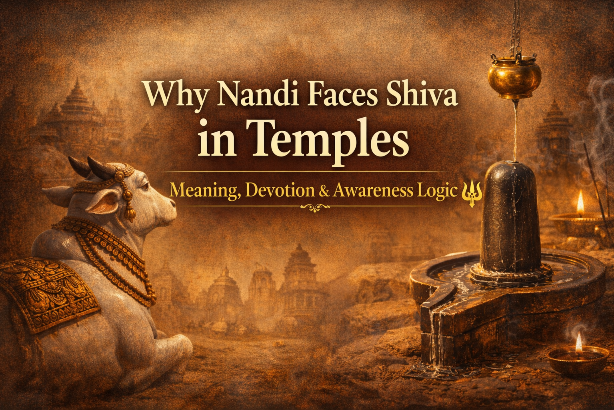
Why Nandi Faces Shiva in Temples: Meaning, Devotion & Awareness Logic 🐂🔱
In almost every Shiva temple across India, one silent presence remains constant—Nandi, the sacred bull, seated firmly and gazing directly toward the Shiva Lingam. Devotees instinctively bow before Nandi before approaching Shiva, yet few pause to reflect on why Nandi is always positioned facing Shiva and never turned away.
This placement is not architectural coincidence, nor is it mere decoration. In Hindu temple design, every direction, posture, and symbol carries deliberate meaning. Nandi’s unwavering gaze toward Shiva is a profound spiritual teaching expressed without words.
To understand why Nandi faces Shiva, one must move beyond mythology alone and enter the realms of devotion, discipline, awareness, and inner orientation. Nandi is not simply Shiva’s vehicle—he is a mirror of the ideal devotee.
Nandi: More Than a Vehicle of Shiva ✨
In popular imagery, Nandi is often described merely as the vahana, or vehicle, of Lord Shiva. While this is true at a surface level, it does not capture Nandi’s deeper spiritual role.
Nandi represents strength, stability, patience, and unwavering dedication. The bull, in Indian culture, symbolizes grounded power—energy that is controlled, disciplined, and purposeful rather than impulsive.
By choosing Nandi as his companion, Shiva establishes an important spiritual principle: raw strength must be guided by awareness. Nandi’s role is not movement but stillness; not action but attention.
Why Nandi Always Faces Shiva 🕉️
Nandi’s constant orientation toward Shiva represents single-pointed devotion. He does not look around, seek distraction, or shift his attention. His gaze remains fixed on Shiva at all times.
This posture symbolizes what true devotion looks like—not emotional display, but steady awareness. In spiritual practice, the mind is often restless, pulled in multiple directions. Nandi teaches the opposite quality: focus without force.
Facing Shiva, Nandi becomes a living reminder that spiritual progress depends not on movement, but on orientation—where one’s attention is directed.
Nandi as the Gatekeeper of Awareness 🌱
In most Shiva temples, Nandi is positioned directly between the devotee and the Shiva Lingam. This placement is deeply symbolic.
Before one can approach the formless consciousness represented by the Lingam, one must cultivate the qualities Nandi embodies—discipline, humility, and attentiveness.
Nandi thus functions as a silent gatekeeper, reminding devotees that access to higher awareness requires inner preparation, not entitlement.
The Posture of Stillness and Inner Strength ✅
Nandi is almost always depicted seated, calm, and composed. This posture reflects controlled power rather than aggressive strength.
In spiritual terms, this represents mastery over instincts. The bull, often associated with raw energy and desire, is shown here as completely aligned and tranquil.
This transformation of instinct into awareness mirrors the spiritual journey itself—where impulses are not suppressed but refined.
Why Devotees Whisper Wishes into Nandi’s Ears 🕉️
In many temples, devotees whisper their wishes into Nandi’s ears, believing that he conveys them to Shiva.
Symbolically, this practice teaches restraint. Wishes are not shouted or demanded; they are offered quietly, with humility.
Nandi does not respond, react, or promise outcomes. He listens. This listening itself is the lesson—true devotion begins with silence and trust.
Nandi and the Discipline of Waiting 🔱
Nandi does not rush toward Shiva, even though he is closest to him. He waits—patiently, eternally.
This waiting reflects one of the most difficult spiritual disciplines: surrendering impatience. Spiritual insight cannot be forced; it unfolds in its own time.
Nandi’s stillness teaches that proximity to the divine is not measured by physical closeness, but by inner readiness.
Devotion Without Demand 🙏
Perhaps the most powerful message conveyed by Nandi’s posture is devotion without expectation.
Nandi does not ask Shiva for rewards, boons, or recognition. His fulfillment lies in simply being present and attentive.
This form of devotion—free from transaction—represents the highest spiritual attitude.
Nandi as the Symbol of the Disciplined Mind 🧠
In spiritual symbolism, animals often represent instinctual forces within the human mind. The bull, powerful and energetic by nature, symbolizes raw strength, desire, and momentum. When uncontrolled, this energy can become restless and destructive. When disciplined, however, it becomes a source of immense stability.
Nandi represents this disciplined state of the mind. His stillness is not weakness; it is mastery. By facing Shiva without wavering, Nandi demonstrates how the mind, when trained and aligned, becomes a steady instrument of awareness rather than a source of distraction.
This is why Nandi is placed before the Shiva Lingam. Before one approaches higher consciousness, the mind must first learn to sit, observe, and remain attentive.
Nandi and the Dissolution of Ego ⚡
One of the deepest teachings embedded in Nandi’s posture is the dissolution of ego. Ego thrives on recognition, movement, and reaction. Nandi displays none of these.
He does not turn to acknowledge devotees. He does not demand attention. His entire being is oriented toward Shiva alone.
This orientation reflects the spiritual truth that ego dissolves naturally when attention shifts away from the self and toward awareness itself. Nandi does not fight the ego; he simply outgrows it.
Why Nandi Never Turns His Back on Shiva 🕉️
In temple iconography, turning one’s back on the deity is considered disrespectful. Symbolically, it represents turning away from awareness.
Nandi’s unwavering direction teaches constancy. Even when the devotee leaves the temple, Nandi remains—watching, waiting, and facing Shiva.
This constancy reflects the ideal spiritual state: awareness that does not fluctuate with circumstance, emotion, or environment.
Nandi vs the Restless Mind ❇️
The ordinary human mind is constantly pulled outward—toward desire, fear, memory, and anticipation. Nandi represents the opposite tendency.
He does not chase stimuli. He does not react impulsively. He remains inwardly anchored.
In this sense, Nandi is not separate from the devotee. He is the mind as it could be—calm, grounded, and oriented toward truth.
Nandi in Shaiva Philosophy 🔱
In Shaiva traditions, devotion is not blind surrender; it is conscious alignment. Nandi embodies this alignment perfectly.
He does not dissolve into Shiva, nor does he seek to dominate. He remains distinct yet completely aligned.
This relationship reflects the ideal balance between individuality and unity—being present without losing oneself, devoted without dependency.
The Silent Teaching of Temple Architecture 🛕
Temple architecture itself reinforces Nandi’s lesson. The devotee enters the temple, pauses before Nandi, and then approaches the Lingam.
This sequence mirrors the inner journey: first discipline, then devotion, then awareness.
Skipping Nandi symbolically means skipping preparation—attempting to reach awareness without cultivating steadiness.
Frequently Asked Questions (FAQs) ❓
1. Is Nandi worship mandatory before Shiva?
It is not mandatory, but symbolically meaningful. Nandi represents readiness of mind before approaching Shiva.
2. Why is Nandi always calm and seated?
To represent controlled strength and inner stillness.
3. Does Nandi hear devotees’ wishes?
Symbolically, yes. The act teaches humility, silence, and trust rather than literal transmission.
4. Is Nandi only associated with Shiva?
Yes, because his symbolism aligns directly with Shaiva philosophy of awareness and restraint.
🌼 Conclusion 🔚
Nandi as the Ideal Devotee
Nandi faces Shiva because devotion is ultimately about direction, not distance.
His stillness teaches discipline. His gaze teaches focus. His silence teaches surrender.
In every Shiva temple, Nandi sits as a reminder that before one seeks the divine, one must first steady the mind.
By observing Nandi, the devotee is invited to become like him—not physically, but inwardly—strong yet calm, devoted yet aware, present without demand.
🙏 Har Har Mahadev 🙏





Leave a comment