













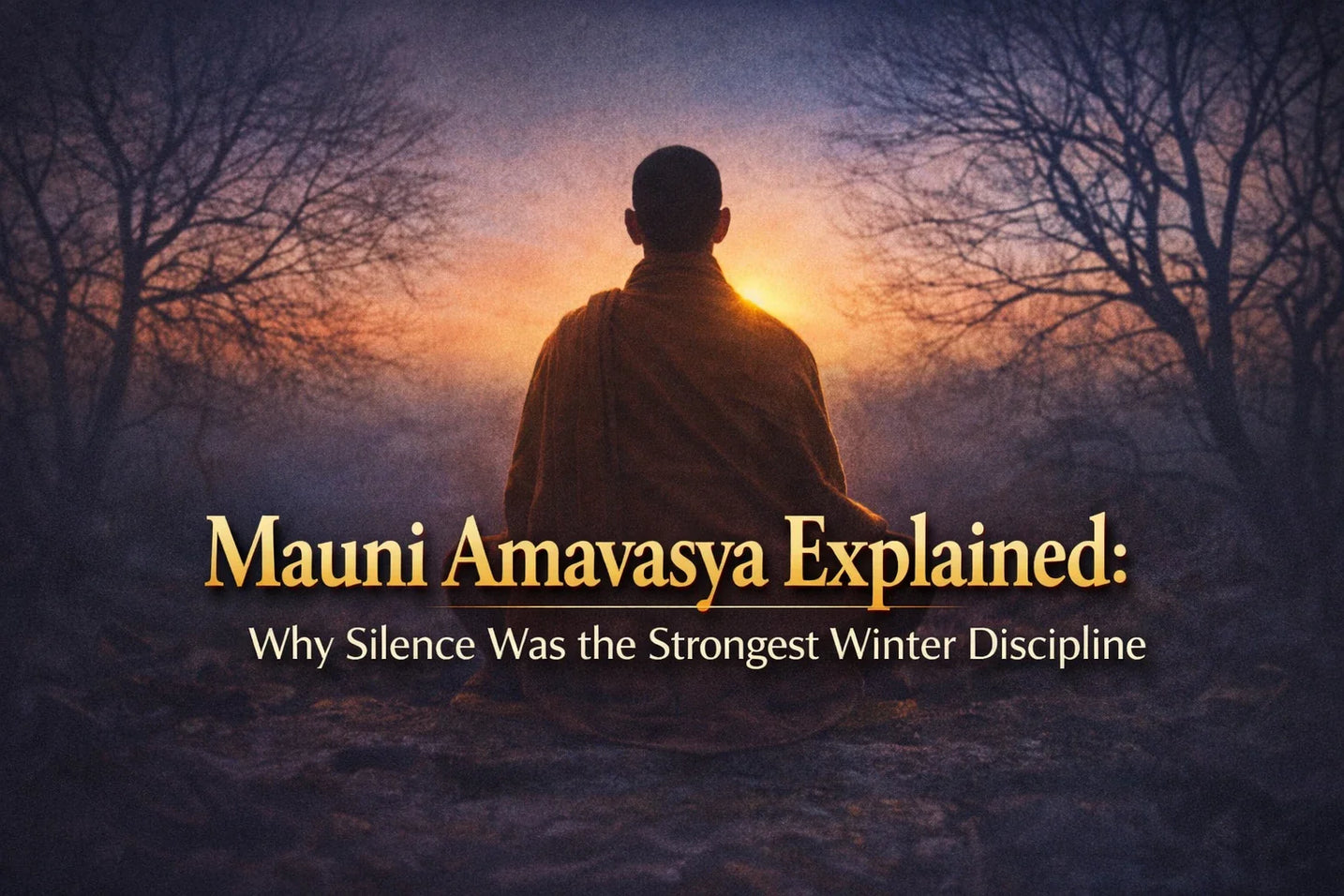
🌑 Mauni Amavasya Explained: Why Silence Was the Strongest Winter Discipline
Mauni Amavasya is often reduced to a single instruction: remain silent. In popular understanding, it appears as a rigid religious observance—an austere day where speech is avoided for merit, purity, or spiritual points. But this surface interpretation misses the deeper intelligence behind the practice. Mauni Amavasya was never designed as punishment, denial, or dramatic withdrawal. It was designed as containment.
In traditional systems, winter was understood as a season of internal accumulation. The body slows down, digestion weakens, and mental activity turns inward. When this inward movement is not managed consciously, it often manifests as restlessness, anxiety, overthinking, and emotional volatility. Mauni Amavasya emerged as a corrective response—not to suppress life, but to stabilize it.
Silence, in this context, was not symbolic. It was functional. Speech consumes mental energy. Expression triggers reaction. Conversation stimulates memory, identity, and emotional charge. In winter, when the nervous system is already taxed by cold, reduced sunlight, and routine fatigue, excessive stimulation creates imbalance. Mauni Amavasya introduced a deliberate pause in this cycle.
This is why silence was chosen over more aggressive disciplines. Fasting affects the body. Ritual affects belief. Silence affects the nervous system directly. By reducing verbal output, the mind is prevented from constantly externalizing itself. Attention naturally turns inward, not through effort, but through absence of outlet.
Importantly, Mauni Amavasya was never meant to isolate people from responsibility. Work continued. Household duties remained. Life was not abandoned. What changed was the quality of engagement. Action occurred without commentary. Observation replaced reaction. The mind was allowed to settle without being pulled outward repeatedly.
This is the first key to understanding Mauni Amavasya correctly: it was not about not speaking. It was about not scattering awareness.
❄️ Winter, the Nervous System, and the Need for Containment
Ancient traditions did not separate psychology from seasonality. Long before modern neuroscience spoke about circadian rhythm or seasonal affective patterns, Indian systems recognized that winter alters mental behavior. Reduced daylight, heavier food, and decreased movement slow external activity but intensify internal noise.
When expression remains unchecked during this phase, the mind loops. Thoughts repeat. Worries magnify. Emotional reactions sharpen. Mauni Amavasya functioned as a circuit breaker—interrupting this loop without confrontation.
Silence reduces stimulus load. Without constant verbal engagement, the brain downshifts. The sympathetic nervous system relaxes. Mental energy that is usually spent on narration becomes available for observation. This is not mystical—it is neurological.
That is why Mauni Amavasya was positioned during the Magh month, at the deepest point of winter discipline. It was never random. It was placed precisely where containment was most needed.
🧠 Silence as Training, Not Escape
A common modern mistake is to treat silence as avoidance. People assume that if one does not speak, one is withdrawing from reality. Mauni Amavasya teaches the opposite. Silence here is not escape—it is training.
When speech is paused, unresolved impulses surface. The urge to explain, justify, argue, or narrate becomes visible. This visibility is the point. Mauni Amavasya reveals how much identity is tied to expression.
Traditional systems valued this exposure. Instead of encouraging suppression, they encouraged witnessing. The practitioner was not instructed to control thoughts aggressively. They were instructed to allow stillness to create clarity naturally.
This is also why Mauni Amavasya was observed periodically, not continuously. It was a reset, not a lifestyle. A single day of silence, when practiced with awareness, recalibrated the system for weeks.
Seen through this lens, Mauni Amavasya becomes deeply practical. It trains restraint without force, awareness without analysis, and stability without withdrawal. These are skills—not beliefs.
🌕 Why Mauni Amavasya Comes Before Magh Purnima
In traditional sequencing, Mauni Amavasya is not an isolated observance. It is deliberately placed before Magh Purnima, and this order reveals the larger psychological design. Amavasya represents withdrawal, reduction, and containment. Purnima represents fullness, clarity, and integration. One prepares the ground; the other reflects maturity.
Silence on Mauni Amavasya clears excess mental noise. By the time Magh Purnima arrives, the mind is not overloaded with unresolved reactions. Awareness becomes receptive rather than cluttered. This sequencing mirrors natural learning cycles: first reduce interference, then allow understanding to consolidate.
When this order is reversed—seeking clarity without prior containment—the result is often confusion or spiritual bypassing. Traditional systems avoided this mistake by embedding discipline before expression.
🤫 Silence vs Suppression: A Crucial Difference
One of the most damaging misunderstandings around Mauni Amavasya is the belief that silence equals repression. Suppression involves force. Silence, as designed here, involves absence of unnecessary output.
Suppression tightens the nervous system. Silence relaxes it. When speech is forced to stop while inner agitation remains unchecked, tension increases. But when speech pauses naturally—supported by routine, simplicity, and reduced stimulation—the mind settles without resistance.
This is why classical observance emphasized calm activity rather than dramatic austerity. Silence worked only when the body was steady and the mind was not provoked.
📵 Why Modern “Digital Detox” Misses the Point
Modern culture has attempted to recreate silence through digital detoxes—no phone days, social media breaks, notification fasts. While well-intentioned, these efforts often miss the deeper logic of Mauni Amavasya.
Digital detox focuses on external restriction. Mauni Amavasya focused on internal containment. One removes devices; the other reduces identity projection. Without addressing the urge to narrate, explain, and react, removing technology alone rarely stabilizes the mind.
This is why people often feel restless during detox periods. The stimulus changes, but the habit of outward discharge remains. Mauni Amavasya addressed this habit directly by pausing speech itself—the most primal form of externalization.
🧭 How Mauni Amavasya Complements Other January Disciplines
January festivals form a coherent psychological sequence when understood together:
- Makar Sankranti — realigns routine with seasonal movement
- Mauni Amavasya — stabilizes attention through silence
- Ekadashi — trains impulse regulation through dietary restraint
- Magh Purnima — integrates clarity into action
Each discipline addresses a different layer of behavior. Together, they form a complete system of seasonal mental hygiene. Removing one weakens the whole.
🏠 Applying Mauni Amavasya in Modern Life
Mauni Amavasya does not require isolation or monastic withdrawal. Its essence can be practiced within modern responsibilities.
Practical application includes:
- Limiting speech to necessity for one full day
- Avoiding opinion-sharing, arguments, and explanations
- Maintaining routine work without commentary
- Reducing stimulation—news, debates, entertainment
The goal is not perfection. The goal is observation. What urges arise when speech pauses? Where does identity push to express itself? These insights are the real outcome of the practice.
❓ Frequently Asked Questions (FAQs)
Is Mauni Amavasya about complete silence?
No. It is about minimizing unnecessary speech. Essential communication is allowed.
Can silence increase anxiety?
Only when practiced without grounding. When combined with routine and simplicity, it reduces anxiety.
Is this practice religious?
Its structure is psychological. Belief is not required to experience its effects.
How often should one observe Mauni Amavasya?
Traditionally once a year during Magh. The impact lies in consistency, not frequency.
Is journaling allowed during Mauni Amavasya?
Yes. Silent reflection is considered supportive, not contradictory.
🔚 Conclusion 🎯
Silence as Preventative Strength
Mauni Amavasya was never designed to impress others or test endurance. It was designed to protect the mind during a season when excess stimulation creates instability. Silence here is not absence—it is containment.
In a world that equates expression with authenticity, Mauni Amavasya offers a counter-truth: stability often grows in quiet. By reducing outward discharge, the system learns to hold experience without fragmentation.
This is why the practice has survived centuries of cultural change. Not because it is symbolic—but because it works.
🙏 हर हर महादेव 🙏





Leave a comment