






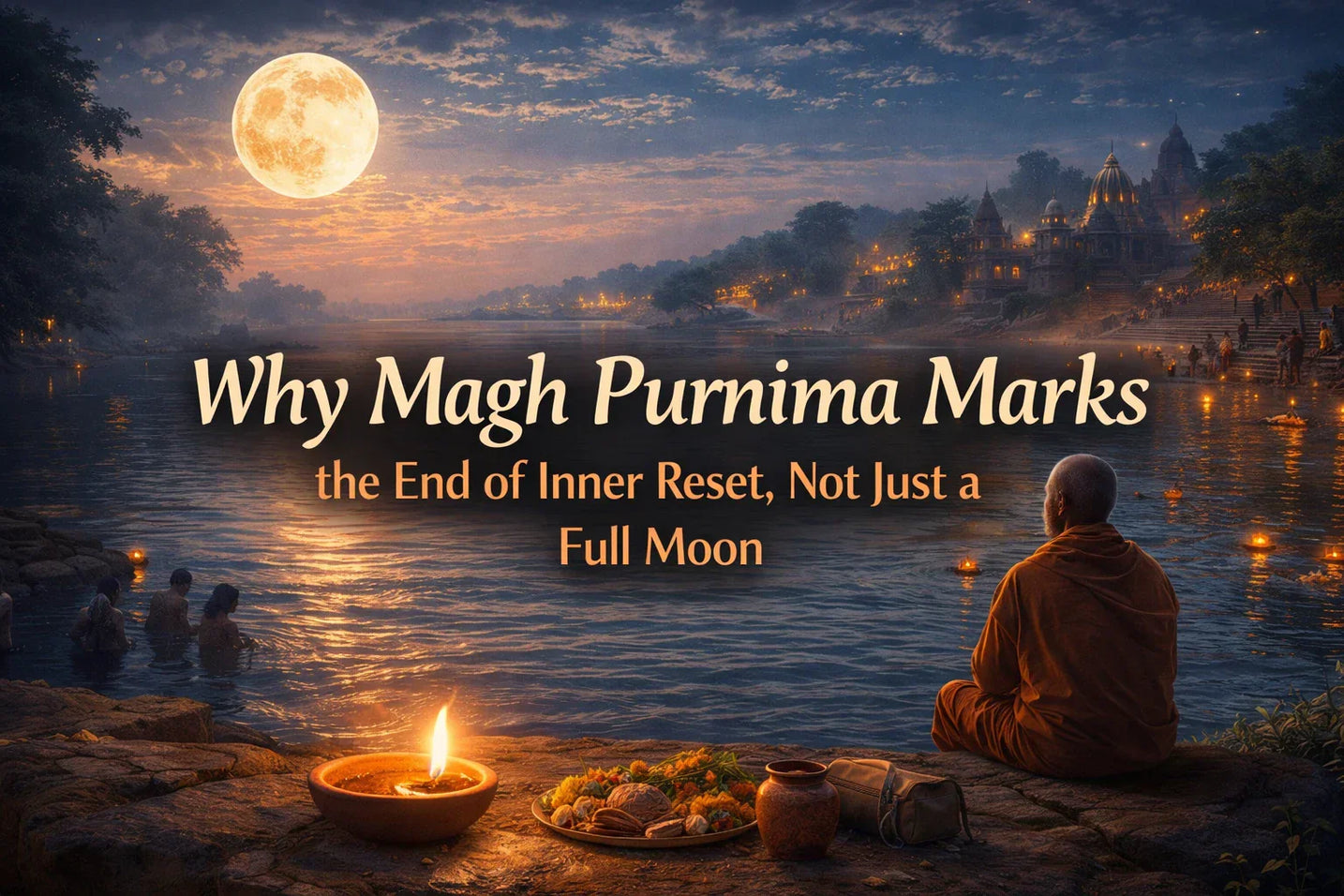
🌕 Why Magh Purnima Marks the End of Inner Reset, Not Just a Full Moon
Most festivals are remembered for what they begin — new vows, fresh rituals, hopeful intentions. Magh Purnima stands apart because it marks what must end. It is not a celebration of momentum, but a pause that asks a deeper question: What has actually settled?
In traditional Indian systems, Magh Purnima was never treated as “just another full moon.” It arrived after weeks of inner discipline initiated during Uttarayana, refined through Makar Sankranti, and stabilized by repetitive restraint. This full moon did not demand effort — it demanded assessment.
Where modern thinking glorifies constant renewal, ancient systems understood something uncomfortable: without closure, renewal collapses. Magh Purnima exists precisely to prevent that collapse.
🌓 Full Moon as Integration, Not Amplification
Today, full moons are often discussed as moments of manifestation, emotional intensity, or energetic peaks. This interpretation is recent — and incomplete.
Traditionally, the full moon represented completion of a cycle, not expansion of desire. The moon reflects light; it does not generate it. Likewise, Magh Purnima reflects the quality of discipline cultivated over the preceding weeks.
If restraint was genuine, clarity appears. If routines were inconsistent, agitation surfaces. The full moon does not create disturbance — it reveals coherence or the lack of it.
This is why Magh Purnima was positioned after periods of effort. It was not a starting point, but a mirror.
🧠 Why Ancient Systems Valued Completion Over Excitement
Modern culture rewards beginnings: new plans, new habits, new identities. Very little attention is given to completion — allowing patterns to settle without interference.
Ancient disciplines recognized that the nervous system does not stabilize through novelty. It stabilizes through repetition followed by stillness.
Magh Purnima functioned as that stillness. No new vows were encouraged. No dramatic rituals were required. What mattered was containment — holding what had already been practiced without adding more.
This is why simplicity dominates Magh Purnima observances. Less stimulation. Less indulgence. Less performance. Not as denial — but as consolidation.
🔄 The Inner Reset Cycle: Why It Must End Properly
Every reset follows a predictable psychological arc:
- Initiation brings motivation
- Discipline brings friction
- Repetition brings fatigue
- Stillness brings integration
Most people abandon the cycle before the final stage. They mistake fatigue for failure and seek a new beginning instead.
Magh Purnima prevents this mistake. It teaches that fatigue does not mean something is wrong — it means something is settling.
By honoring this phase, ancient traditions ensured that discipline matured into stability rather than burnout. The reset ended not with excitement, but with quiet confidence.
🌊 Why Magh Month Emphasizes Restraint Over Reward
Magh Purnima cannot be understood without understanding the nature of the Magh month itself. Magh was never celebrated as a month of achievement. It was treated as a period of holding.
After the symbolic upward movement of the Sun during Uttarayana, the human tendency is to accelerate — more plans, more activity, more ambition. Ancient systems saw this impulse as risky.
Growth without containment creates instability. Magh therefore slowed the system deliberately.
Diet was simplified. Social excess was reduced. Speech was measured. Routine was emphasized over novelty.
This was not withdrawal from life. It was refinement of engagement.
Magh Purnima arrives as the closing seal of this restraint cycle. If the month trained steadiness, the full moon tested whether steadiness had truly formed.
🛁 Snan on Magh Purnima: Regulation, Not Purification
Ritual bathing on Magh Purnima is often misunderstood as symbolic cleansing of sins. This interpretation reduces a sophisticated practice into moral theatre.
Traditionally, snan during Magh was about nervous-system regulation. Cold water exposure — especially at dawn — resets physiological rhythms that have slowed during winter.
More importantly, snan introduced voluntary discomfort without danger. The body experienced intensity, yet remained safe. This teaches the nervous system a critical lesson: discomfort does not equal threat.
Magh Purnima snan was never meant to be dramatic. No urgency. No competition. No spectacle.
It marked the final repetition — the last reinforcement — before discipline relaxed naturally.
🤫 Silence, Simplicity, and Why Less Was Considered Complete
One striking feature of Magh Purnima observances is their quietness. There is no loud celebration, no emotional climax, no demand for expression.
This is intentional.
Ancient systems understood that when discipline has done its work, silence becomes informative. Noise would interfere with integration.
Silence allows internal signals to surface: fatigue, clarity, resistance, confidence. These signals determine whether discipline has stabilized or merely been endured.
Magh Purnima therefore favored:
- Simple meals
- Minimal speech
- Reduced stimulation
- Completion of ongoing vows
Nothing new was added. Completion itself was the ritual.
🎁 Daan on Magh Purnima: Releasing Excess, Not Seeking Merit
Charity during Magh Purnima is often framed as accumulation of spiritual merit. But historically, daan served a different psychological function.
After weeks of restraint, attachment subtly increases. The mind begins to protect effort, identity, and progress. This creates rigidity.
Daan dissolves this rigidity. By giving something away at the moment of completion, the practitioner reinforces a powerful truth: stability does not come from holding — it comes from circulation.
This prevents discipline from turning into ego. The cycle ends without clinging.
Magh Purnima daan therefore completes the reset by restoring flexibility — not by rewarding effort.
🔁 Why Inner Reset Fails Without a Closing Phase
Modern habit-building often fails for one simple reason: there is no closure.
People start routines enthusiastically, push through friction, then abandon them abruptly. The nervous system never registers completion — only exhaustion.
Magh Purnima solves this. It tells the system:
- The effort phase is complete
- Stability has been tested
- Routine may now soften naturally
This prevents rebound. Habits dissolve gently instead of collapsing violently.
What remains is not discipline — but capacity. And capacity is what carries growth forward.
📉 Why Modern “Resets” Fail Without a Closing Ritual
January has become synonymous with “new beginnings” in the modern world — new goals, new habits, new identities. Yet despite enthusiasm, most resets collapse within weeks. The reason is not lack of motivation. It is lack of closure.
Ancient systems understood something modern habit culture overlooks: the nervous system needs an ending before it can sustain a beginning. Without closure, effort turns into strain. Strain turns into fatigue. Fatigue turns into abandonment.
Magh Purnima functions as that missing psychological endpoint. It does not push growth forward. It stabilizes what has already been built.
By marking the end of restraint, the mind is released from pressure without losing structure. This is why Magh Purnima comes after Sankranti and Pongal — not as celebration, but as consolidation.
🧠 Common Misconceptions About Magh Purnima
Over time, Magh Purnima has accumulated layers of misunderstanding. These misconceptions weaken its relevance and distort its purpose.
Misconception 1: It is only a bathing festival.
Snan is a tool, not the purpose. Without restraint before it, bathing becomes symbolic rather than regulatory.
Misconception 2: It is about earning punya.
The original framework emphasized balance, not reward. Merit language came later.
Misconception 3: It is optional.
In traditional cycles, Magh Purnima was essential. Skipping closure destabilized the entire reset.
When stripped of superstition and restored to logic, Magh Purnima reveals itself as one of the most psychologically intelligent observances in the calendar.
🌱 What Actually Changes After a Proper Magh Purnima Reset
Those who observe Magh Purnima with understanding often report subtle but lasting shifts — not emotional highs, but internal reorganization.
Decisions feel less reactive. Discipline feels lighter. Cravings lose urgency. Effort no longer feels like pressure.
This is not transformation. It is stabilization.
Stability is what allows growth to continue without collapse. Magh Purnima does not promise progress. It protects capacity.
❓ Frequently Asked Questions (FAQs)
Is Magh Purnima religious or psychological?
It is both, but its structure is psychological. Religion preserved the practice; psychology explains its effectiveness.
Do I need to fast strictly on Magh Purnima?
No. Traditional practice emphasized simplicity, not deprivation. Strain weakens the reset.
What if I miss Magh Purnima?
The principle still applies. Closure can be recreated consciously through reflection, reduction, and completion.
Is Magh Purnima connected to astrology?
Indirectly. Lunar cycles affect mental rhythm, which Magh Purnima regulates behaviorally rather than predictively.
Why is it quieter than other festivals?
Because integration requires silence. Noise interrupts consolidation.
🌕 Conclusion 💫
Why Magh Purnima Is the Missing Key to January Balance
Magh Purnima was never meant to impress, excite, or entertain. It was designed to complete.
In a world obsessed with beginnings, it reminds us that endings matter just as much. Without closure, effort collapses. Without consolidation, growth becomes fragile.
Magh Purnima closes the inner reset cycle — not with celebration, but with steadiness. Not with reward, but with release.
Its relevance has not diminished. If anything, it has grown stronger in a time where mental overload, habit failure, and burnout are common.
Those who understand its logic do not chase change. They build capacity. And that is why Magh Purnima still matters.
🙏 हर हर महादेव 🙏





Leave a comment