


🌞 Makar Sankranti Meaning & Ritual Logic: Why Til, Daan, and Snan Matter
Makar Sankranti is one of the rare Indian festivals that is not defined by mythology alone, but by movement — the movement of the Sun, the movement of seasons, and the movement of human awareness from inertia toward discipline. Unlike festivals rooted in specific legends or deities, Makar Sankranti marks a cosmic transition that has been observed for thousands of years through astronomy, agriculture, and seasonal psychology.
Celebrated when the Sun enters Capricorn (Makara Rashi), this transition symbolically represents the shift from the Sun’s southward journey to its northward ascent, known traditionally as Uttarayana. In classical understanding, this movement was not merely celestial. It reflected a gradual increase in light, warmth, clarity, and vitality — both in nature and within human life.
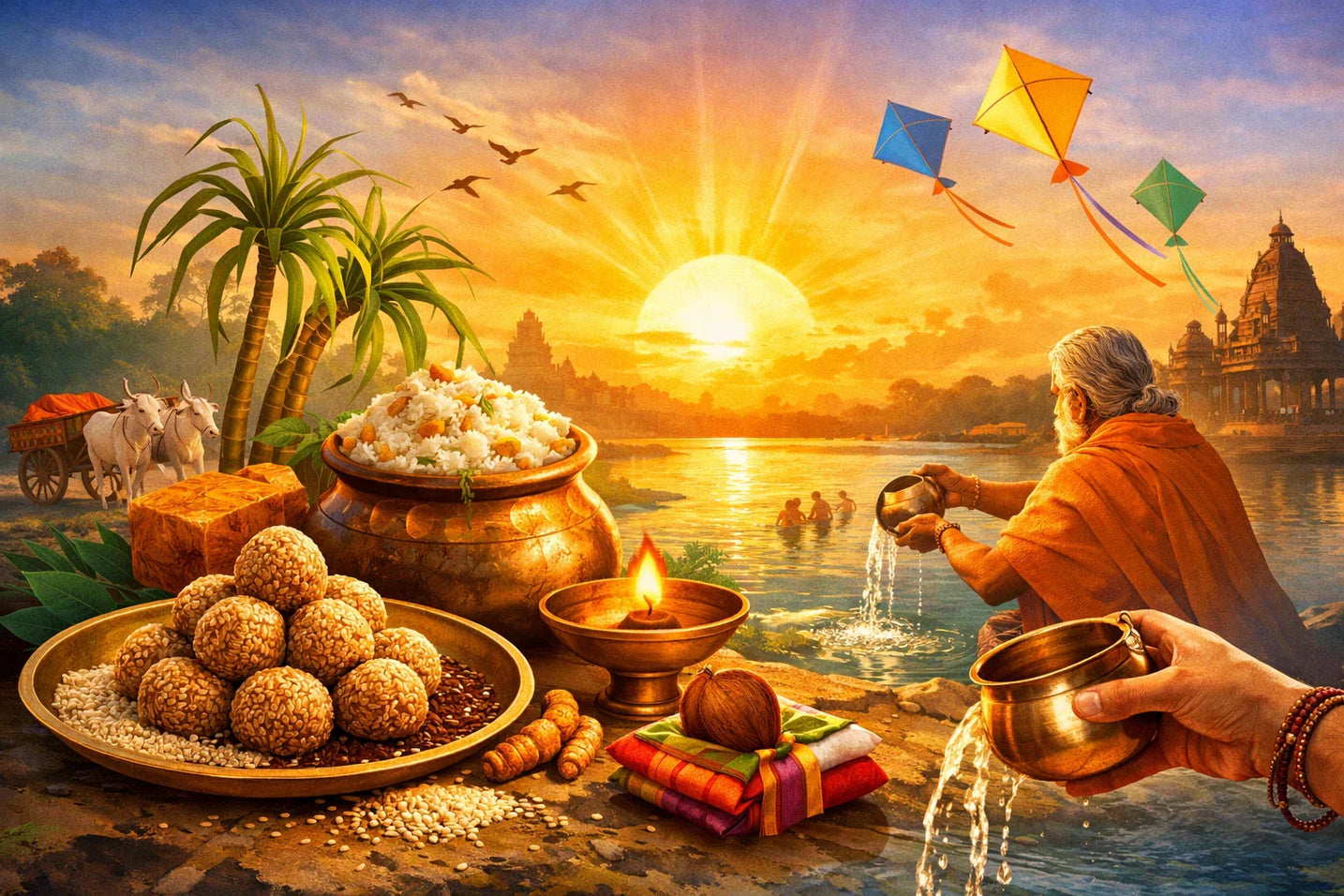
What makes Makar Sankranti unique is its emphasis on restraint rather than celebration, awareness rather than indulgence, and continuity rather than spectacle. Rituals like til consumption, daan (charitable giving), and snan (ritual bathing) were never meant as isolated customs. They formed a coherent system designed to realign the human body, mind, and behavior with changing seasonal forces.
🌍 Why Makar Sankranti Is a Fixed-Date Festival
Most Hindu festivals follow the lunar calendar, shifting dates every year. Makar Sankranti stands apart because it is solar-based. It is anchored to the Sun’s actual movement rather than moon phases. This makes it one of the most astronomically consistent festivals, usually falling on January 14th or 15th.
Ancient Indian astronomers understood that solar transitions directly influence climate, crop cycles, and human physiology. The Sun’s entry into Capricorn signaled the slow retreat of extreme cold and the beginning of a more life-supportive phase. This shift was subtle, not dramatic — and the festival reflects that subtlety.
Instead of fireworks or loud celebrations, the emphasis was on preparation. The human system was encouraged to recalibrate itself through diet, discipline, generosity, and routine — aligning behavior with nature rather than resisting it.
🧠 Seasonal Psychology: Why January Demands Inner Reset
From a psychological standpoint, late winter often carries accumulated fatigue. Shorter days, cold weather, reduced mobility, and heavier diets slow both physical and mental rhythms. Traditional systems recognized this long before modern psychology or chronobiology.
Makar Sankranti functioned as a conscious checkpoint — a reminder that while nature begins to shift, human habits must shift deliberately. The rituals associated with this day were never magical solutions. They were behavioral cues designed to restore balance gradually.
Til (sesame) warmed the system internally. Snan reset the nervous system through discipline. Daan redirected attention away from accumulation toward circulation. Together, these practices helped prevent stagnation — physical, emotional, and psychological.
🔥 Til: Why Sesame Is Central to Sankranti Rituals
Sesame seeds appear across almost every regional expression of Makar Sankranti — til-gul in Maharashtra, til laddoos in North India, ellu-bella in Karnataka. This is not coincidence. Sesame has long been associated with warmth, nourishment, and stability.
In traditional dietary logic, winter is a season of accumulation. The body stores energy, but circulation slows. Sesame, being oil-rich and warming in nature, was believed to support internal lubrication and metabolic steadiness. Its inclusion in ritual food symbolized the importance of gentle nourishment over excess.
Symbolically, til also represents continuity. Tiny seeds carrying immense potential, they reflect the festival’s deeper message: small, consistent actions matter more than dramatic gestures.
🤝 “Til-Gul Ghya”: The Social Logic of Sweetness
The famous phrase “Til-gul ghya, god god bola” is often translated casually as a greeting. In reality, it encodes a social ethic. The combination of til (bitter warmth) and jaggery (sweetness) reflects how relationships should be handled — with honesty tempered by kindness.
Makar Sankranti occurs after months of inward focus. Social interactions can become strained during prolonged winters. This ritualized sweetness acted as a reset, encouraging softer speech, reconciliation, and conscious communication as the season turned.
It was not about pretending problems didn’t exist, but about choosing civility and restraint over emotional harshness.
🚿 Snan: Discipline Over Purification
Ritual bathing during Makar Sankranti is often misunderstood as symbolic cleansing. Traditional interpretations place greater emphasis on discipline than purity. Bathing at sunrise during winter requires commitment, alertness, and intentional effort.
Cold exposure, when approached mindfully, was seen as a way to awaken the system, sharpen attention, and reinforce self-command. It was not about discomfort for its own sake, but about reminding the body and mind that awareness precedes comfort.
Snan marked a conscious transition — from passive endurance of winter toward active participation in the coming seasonal shift.
🎁 Daan: Circulation, Not Charity
Daan during Makar Sankranti was never transactional. It was not performed to gain merit points or divine favor. Instead, it reflected an understanding of circulation — that what stagnates decays, and what moves remains alive.
Winter encourages hoarding — of food, warmth, resources. Daan counterbalanced this instinct by encouraging release. Giving during a time of perceived scarcity trained the mind toward trust rather than fear.
Items traditionally given — food, clothes, grains — were practical, not symbolic. The act reinforced social cohesion while reminding individuals that stability is strengthened through shared responsibility.
🌾 Regional Expressions, One Core Philosophy
From Pongal in Tamil Nadu to Uttarayan in Gujarat, from Khichdi in Uttar Pradesh to Magh Bihu in Assam, Makar Sankranti wears many cultural forms. Yet beneath these expressions lies the same philosophical core: alignment with seasonal truth.
Each region adapted rituals based on climate, agriculture, and social structure, but the intent remained consistent — reset discipline, encourage generosity, restore balance, and prepare for gradual growth.
This adaptability is why Makar Sankranti remains relevant. It is not rigid. It evolves with context while preserving its foundational logic.
🌞 Makar Sankranti and the Science of Seasonal Transition
Long before modern research began studying circadian rhythms, seasonal affective patterns, and hormonal changes, traditional systems observed that human physiology responds subtly to solar movement. Makar Sankranti marks the period when daylight begins to increase, even though cold may persist for several weeks. This gradual increase in sunlight influences mood regulation, metabolic activity, and energy levels.
Rather than celebrating the end of winter abruptly, Makar Sankranti acknowledges transition. It accepts that change is slow and requires cooperation. The rituals associated with this festival encourage behaviors that gently stimulate the body and mind without shock — warm foods instead of heavy feasts, disciplined routines instead of indulgence, generosity instead of accumulation.
This makes the festival remarkably aligned with modern understandings of sustainable habit formation. Sudden resolutions often fail, while small, consistent adjustments endure. Makar Sankranti embodies this principle through lived tradition rather than theory.
🧭 Why Makar Sankranti Is About Direction, Not Destiny
A common modern misconception is to interpret Makar Sankranti as a fortune-shifting day. Traditional understanding places emphasis elsewhere. The Sun’s movement into Capricorn symbolized responsibility, discipline, and structure — not sudden rewards.
Capricorn energy has always been associated with long-term effort, accountability, and realistic progress. The festival reflects this by encouraging practical changes rather than symbolic wishes. Eating differently, waking earlier, bathing despite discomfort, and giving without expectation all reinforce the same lesson: direction matters more than prediction.
In this sense, Makar Sankranti does not promise transformation. It invites participation. The Sun changes direction, but human awareness must choose to follow.
⚠️ Common Misinterpretations of Makar Sankranti Rituals
Over time, many rituals associated with Makar Sankranti have been reduced to symbolic gestures devoid of context. Til sweets become seasonal snacks, snan becomes optional symbolism, and daan is sometimes replaced by performative charity.
These interpretations are incomplete because they isolate rituals from their behavioral intent. The value of til lies not in sweetness but in warmth and moderation. The value of snan lies not in purification but in discipline. The value of daan lies not in display but in circulation.
When rituals are performed without understanding, their stabilizing effect weakens. The festival becomes aesthetic rather than functional. Traditional systems always emphasized understanding over blind repetition.
🪔 Makar Sankranti in Modern Life: How to Apply Its Logic Today
Makar Sankranti does not require abandoning modern life to remain relevant. Its logic adapts seamlessly when understood correctly. The essence of the festival can be applied through intentional lifestyle adjustments rather than ritual perfection.
Simple actions — maintaining consistent sleep schedules, reducing excess consumption, practicing mindful generosity, and creating routines that encourage steadiness — align closely with Sankranti’s original intent. These are not religious acts; they are acts of alignment.
In a world driven by acceleration and constant stimulation, Makar Sankranti offers a counterbalance: slow strengthening rather than rapid change.
🎯 Why This Festival Still Matters
Makar Sankranti survives not because of nostalgia, but because its principles remain relevant. Human systems still respond to light, routine, discipline, and generosity. Seasonal transitions still influence behavior. And stability still requires conscious effort.
This festival does not demand belief. It invites observation. Those who engage with its logic notice gradual improvements — not dramatic miracles, but steadier rhythms of life.That is its quiet power.
❓ Frequently Asked Questions (FAQs)
Why is Makar Sankranti celebrated every year on nearly the same date?
Because it follows the solar calendar and marks the Sun’s entry into Capricorn, unlike lunar festivals that shift annually.
Is Makar Sankranti a religious festival or a seasonal observance?
It is primarily a seasonal observance rooted in astronomy, agriculture, and behavioral discipline, later integrated into religious practice.
Why is til considered important during Makar Sankranti?
Til is warming and stabilizing in nature, traditionally used to support the body during late winter and encourage moderation.
What is the real purpose of ritual bathing on Makar Sankranti?
The focus is discipline and alertness rather than purification, reinforcing control over comfort and routine.
Why is charity emphasized during this festival?
Daan counterbalances the instinct to hoard during winter and reinforces circulation of resources and responsibility.
Does Makar Sankranti bring good luck?
Traditionally, it was not about luck but about aligning behavior with seasonal reality and long-term stability.
Can Makar Sankranti be observed without rituals?
Yes. Understanding and applying its principles of discipline, moderation, and generosity is considered sufficient.
How is Makar Sankranti different from other harvest festivals?
It is solar-based and emphasizes personal discipline alongside agricultural transition.
Why is Capricorn important in this festival?
Capricorn symbolizes responsibility, structure, and long-term effort — themes reflected in Sankranti practices.
Is Makar Sankranti still relevant in modern times?
Yes. Its logic aligns closely with modern understandings of habit formation, seasonal psychology, and sustainable living.
🙏Conclusion 🔚
A Festival of Quiet Strength
Makar Sankranti is not a celebration of arrival, but of orientation. It acknowledges that growth begins not when conditions change, but when awareness responds appropriately to change.
Through til, snan, and daan, the festival teaches restraint without denial, generosity without excess, and discipline without rigidity. It reminds us that stability is cultivated slowly, through consistent action rather than dramatic intent.
In a world obsessed with speed and spectacle, Makar Sankranti stands quietly — offering clarity, structure, and continuity to those willing to listen.
🙏 हर हर महादेव 🙏





Leave a comment