

















🔱 Rudraksha and Sphatika as an Energy System: How Dual Vibrations Influence the Human Mind and Body
There are certain spiritual tools that survive centuries not because they are fashionable, but because they quietly continue to work. Rudraksha and Sphatika belong to this rare category. Long before modern psychology tried to explain stress, focus, emotional imbalance, or mental fatigue, these two natural elements were already being used—not as symbols, but as functional companions to inner life.
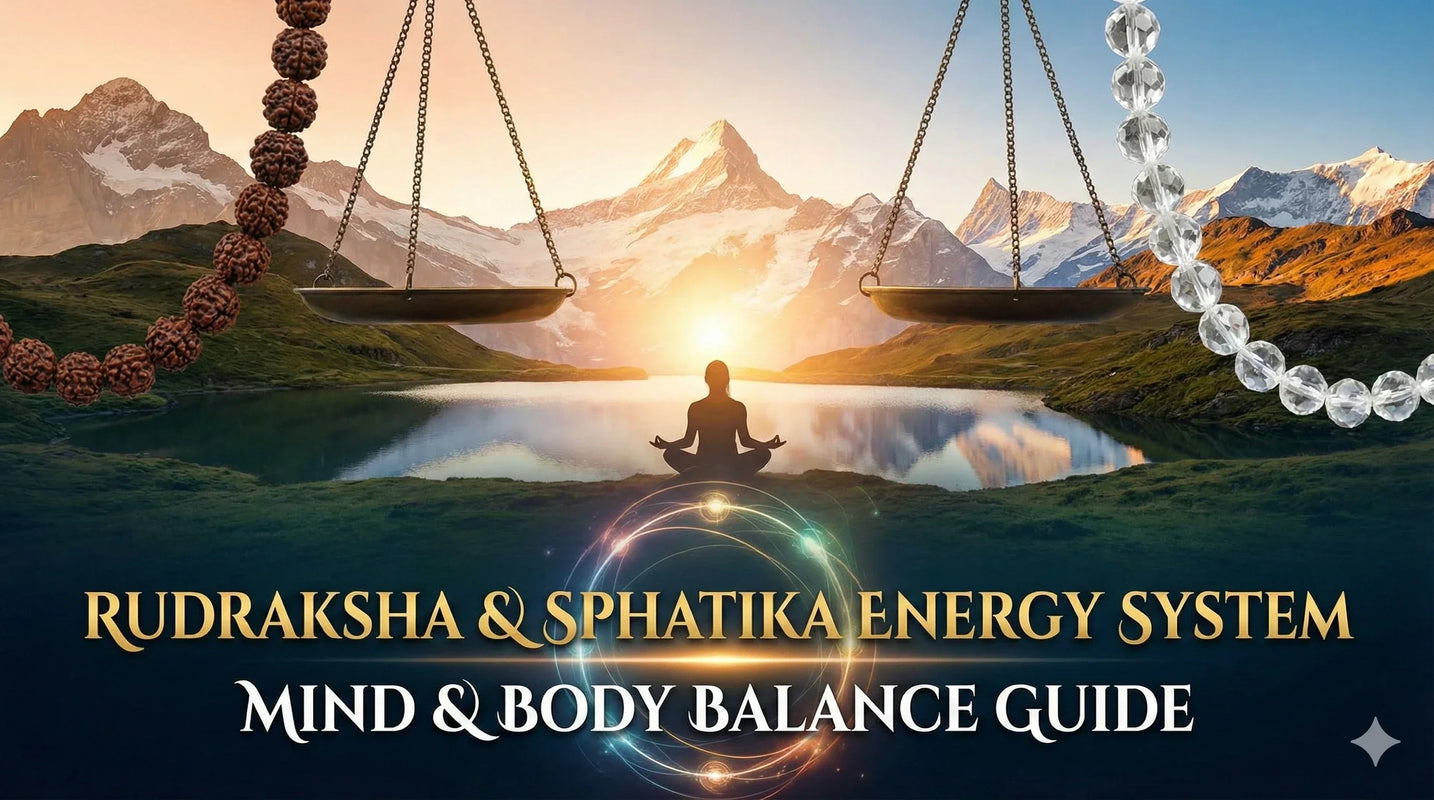
Yet in today’s world, Rudraksha and Sphatika are often reduced to superficial identities. One is labeled as “powerful,” the other as “cooling.” One is associated with intensity, the other with calm. This fragmented understanding misses the deeper truth: Rudraksha and Sphatika were never meant to be understood in isolation. Together, they form a balanced energy system that mirrors how the human mind and body actually function.
This is not a belief-based discussion. This is an experiential, structural, and long-term perspective on balance.
To understand this system, we must move beyond ritual explanations and enter a space where biology, psychology, and lived spiritual experience intersect. The human system does not operate in extremes. It operates through regulation. And any tool that genuinely supports inner growth must respect this principle.
🧠 The Human System Was Never Designed for Constant Intensity
Modern life has conditioned the human mind to remain in a continuous state of alertness. Notifications, responsibilities, emotional pressures, decision overload, and constant stimulation have created a baseline of mental tension that most people now mistake for normal.
In such a state, the nervous system is rarely allowed to return to equilibrium. Even moments of rest are filled with mental noise. This chronic imbalance is the reason why many people feel mentally exhausted without having done anything physically demanding.
Spiritual tools that rely on activation, stimulation, or emotional intensity often fail in this environment. They add force to a system that is already overstretched. What the modern human system needs is not more energy—but better regulation of the energy it already has.
This is where the Rudraksha–Sphatika combination becomes profoundly relevant.
⚖️ Why Balance Is More Important Than Power
Power is attractive. It promises fast results, noticeable sensations, and dramatic experiences. But power without balance is unstable. In both psychological and physiological terms, stability always precedes sustainable strength.
Rudraksha is often misunderstood as a tool of power. In reality, its primary role is regulation of awareness. It helps organize mental activity rather than amplify it. Sphatika, on the other hand, does not suppress or energize—it stabilizes.
When these two are combined, something subtle but significant happens. The system no longer swings between extremes of overthinking and emotional dullness. Instead, it begins to settle into a functional middle ground.
Balance does not feel dramatic—but it changes everything.
🧿 Rudraksha: The Anchor of Awareness
Rudraksha is a natural seed with a complex internal structure. Unlike synthetic materials, it carries organic irregularities that interact with the human bio-electrical field over time. This interaction is not aggressive. It is grounding.
People often expect Rudraksha to make them feel energized. Instead, what many experience is increased presence. Thoughts become fewer, but clearer. Mental loops lose their grip. Awareness becomes more centralized.
This is not stimulation. It is organization.
Awareness becomes steady, not scattered.
❄️ Sphatika: The Stabilizer of Emotional Heat
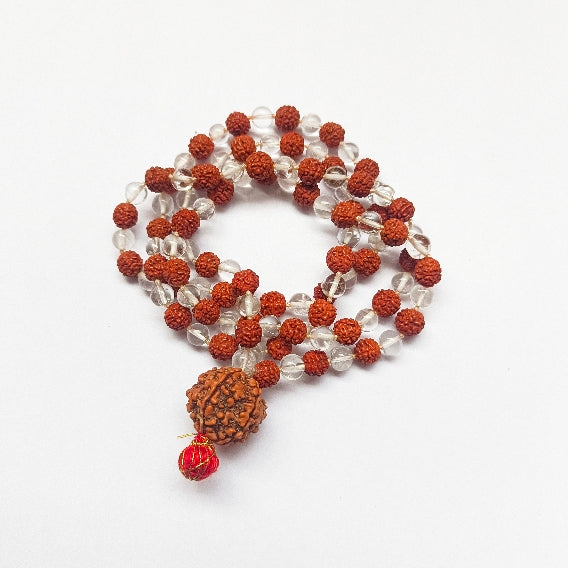
Sphatika, or clear quartz crystal, operates on a different principle. Its crystalline lattice structure allows it to absorb and redistribute subtle energetic fluctuations. Emotionally, this translates into reduced volatility.
Sphatika does not numb emotion. It cools excess emotional charge. This is why it has traditionally been used in meditation and japa practices—it allows stillness without mental fog.
When emotional heat reduces, clarity naturally increases. Decisions feel less pressured. Reactions slow down. Inner silence becomes accessible without force.
Stability is not absence of emotion—it is freedom from overwhelm.
🔍 When Two Forces Meet: Regulation, Not Amplification
The most important misunderstanding people have about combining spiritual tools is the assumption that effects will multiply. In reality, the Rudraksha–Sphatika system does the opposite. It refines rather than amplifies.
Rudraksha ensures awareness does not drift. Sphatika ensures awareness does not overheat. Together, they create a feedback loop that stabilizes the mind–body relationship.
This is why the effects of this combination are often described as subtle but permanent. Once regulation sets in, the system does not easily return to chaos.
What changes slowly, lasts longer.
🧠 The Bio-Electrical Nature of the Human Mind and Body
To truly understand why Rudraksha and Sphatika influence the human system, one must first understand a simple but often ignored fact: the human body is not only biochemical, it is bio-electrical. Every thought, every emotion, every muscular movement is transmitted through electrical impulses.
The nervous system functions through electrical signaling. The brain operates on measurable electrical frequencies. Even the heart generates its own electromagnetic field. This means the human body is constantly interacting with its environment at a subtle electrical level, whether consciously perceived or not.
Natural materials, especially those formed organically over long periods of time, interact with this bio-electrical system very differently than synthetic or artificial substances. They do not impose force; they introduce resonance.
Rudraksha and Sphatika do not change the body — they help the body regulate itself.
🌿 Why Natural Seeds and Crystals Behave Differently
Unlike machine-made objects, natural seeds and crystals carry internal irregularities. These irregularities are not flaws; they are what make interaction possible. The human system itself is not uniform — it is adaptive, responsive, and dynamic.
Rudraksha, being a seed, contains layers of organic density. These layers influence how micro-electrical currents move across the skin and nervous system when worn consistently. The interaction is gradual, not immediate.
Sphatika, on the other hand, is crystalline. Its geometric lattice structure gives it a stabilizing quality. It absorbs fluctuations and redistributes them evenly, which is why it has been associated with calmness and clarity across cultures.
Organic complexity meets crystalline stability — and balance emerges.
⚖️ The Feedback Loop Between Thought, Emotion, and Body
Most people underestimate how tightly thoughts, emotions, and physical sensations are connected. A stressful thought increases heart rate. A tense emotion tightens muscles. A fatigued body generates negative thoughts.
This creates a feedback loop. Once activated, the loop sustains itself even in the absence of real external threat. Over time, this loop becomes the default state of being for many individuals.
The Rudraksha–Sphatika system works by gently interrupting this loop. Rudraksha reduces the fragmentation of thought. Sphatika cools emotional intensity. As the loop weakens, the system naturally returns toward equilibrium.
Breaking the loop restores choice.
🧿 Why Sensations Are the Wrong Measurement
One of the biggest reasons people misunderstand spiritual tools is their reliance on sensation as proof. Tingling, warmth, emotional highs — these are often mistaken for effectiveness.
However, the most meaningful changes rarely come with strong sensations. Instead, they appear as behavioral shifts: calmer responses, clearer thinking, improved patience, and reduced internal conflict.
Rudraksha and Sphatika are not designed to impress the senses. They are designed to reorganize internal functioning.
When chaos disappears, silence feels ordinary — but it is powerful.
🌍 Modern Stress and the Failure of Intensity-Based Spirituality
In earlier times, spiritual intensity may have been necessary to shake individuals out of inertia. Today, inertia is not the problem. Overload is.
Meditation techniques that push forcefully, rituals that demand emotional intensity, and practices that glorify exhaustion often worsen imbalance rather than heal it.
The Rudraksha–Sphatika system represents a different approach — one that aligns with the needs of modern life. It does not require isolation, extreme discipline, or withdrawal. It integrates quietly into daily existence.
Sustainable spirituality must fit into life, not escape from it.
🧠 Emotional Regulation Without Emotional Suppression
There is a critical difference between regulating emotions and suppressing them. Suppression denies experience. Regulation allows experience without being overwhelmed.
Sphatika supports this process by reducing emotional volatility. Rudraksha supports it by keeping awareness present. Together, emotions can be felt fully without hijacking behavior.
Over time, this creates emotional resilience — the ability to recover quickly from stress rather than avoid it.
Resilience is not toughness. It is flexibility.
🔍 Why Long-Term Change Feels Ordinary
Lasting transformation rarely feels dramatic. Once balance becomes natural, it stops being noticeable. This is why people sometimes underestimate the depth of change they have undergone.
They simply find themselves reacting less, thinking more clearly, and feeling less exhausted by everyday challenges. Life does not become easier — but the internal response becomes stronger.
This ordinariness is a sign of success, not failure.
When balance becomes normal, struggle stops defining life.
🕉️ Awareness as a Functional State, Not a Spiritual Ideal
Awareness is often romanticized as a spiritual achievement, something reserved for advanced practitioners or seekers who withdraw from ordinary life. In reality, awareness is a functional state of the human system. It is the condition in which perception, emotion, and response are aligned rather than scattered.
When awareness is fragmented, even simple tasks feel exhausting. The mind jumps ahead, emotions react prematurely, and the body follows tension patterns without conscious choice. This fragmentation is not a personal failure; it is a predictable result of continuous overstimulation.
Rudraksha supports awareness by reducing this fragmentation. It does not create heightened attention in the dramatic sense; it creates coherence. Sphatika supports awareness by preventing emotional overload from hijacking perception.
Awareness is not intensity — it is alignment.
🌿 The Role of Grounding in Psychological Stability
Grounding is often misunderstood as a vague spiritual concept. Psychologically, grounding refers to the ability to remain connected to the present moment without dissociation or emotional flooding.
A grounded system processes information sequentially rather than chaotically. Thoughts arise and pass without stacking. Emotions surface without spiraling. The body maintains posture and breath without excessive tension.
Rudraksha plays a central role in grounding because of its organic density and tactile presence. It provides a subtle sensory anchor that reinforces presence without demanding attention.
Grounding allows awareness to stay where life is actually happening.
❄️ Cooling the Inner Environment Without Numbing It
Emotional heat is one of the most underestimated sources of mental fatigue. Continuous emotional activation — even positive excitement — drains cognitive resources over time.
Sphatika acts as a cooling medium for this inner environment. It does not dampen feeling; it stabilizes intensity. This distinction matters. A cooled system can feel deeply without becoming reactive.
This is why Sphatika has been traditionally associated with clarity rather than emotional detachment. It creates space within experience rather than distance from it.
Cooling restores perspective.
🧠 Decision Fatigue and the Cost of Mental Noise
Decision fatigue is a modern epidemic. The human brain was never designed to make hundreds of micro-decisions daily. Each unresolved thought, each emotional dilemma, each internal debate consumes energy.
When mental noise accumulates, decision quality declines. Choices become reactive, impulsive, or avoidant. Over time, this erodes confidence and clarity.
By reducing mental fragmentation, Rudraksha lowers cognitive load. By stabilizing emotional charge, Sphatika prevents urgency from distorting judgment.
Clear decisions emerge when noise dissolves.
⚖️ Stability Does Not Mean Stillness
One of the most persistent fears around balance-oriented spirituality is the assumption that stability leads to passivity. This fear is understandable but misplaced.
Stability does not reduce action; it refines it. When internal conflict decreases, energy becomes available for purposeful movement. Action becomes intentional rather than compulsive.
Individuals who integrate the Rudraksha–Sphatika system often find that they act more effectively with less effort. Momentum becomes sustainable rather than forced.
Stability strengthens action.
🌍 Integration Into Daily Life Without Ritual Dependency
One of the quiet strengths of this system is its ability to integrate into daily life without ritual dependency. There is no requirement to constantly think about the tools being worn.
In fact, the system works best when attention shifts away from the tools and toward life itself. Over time, the tools become background supports rather than focal points.
This integration is essential for long-term effectiveness. Spiritual tools that demand constant attention often create psychological dependence rather than independence.
True support strengthens autonomy.
🧿 The Subtle Transformation of Identity
As internal regulation improves, identity begins to shift subtly. People become less defined by emotional extremes and more anchored in consistent values.
This does not erase personality. It clarifies it. Preferences remain, ambitions remain, creativity remains — but emotional volatility loses its authority.
Such transformation is often recognized only in hindsight, when individuals realize how differently they now respond to situations that once overwhelmed them.
Clarity reshapes identity quietly.
🧠 Time, Patience, and the Biology of Sustainable Change
One of the greatest misunderstandings in modern self-development—spiritual or otherwise—is the underestimation of time. People often expect meaningful internal change to follow the same timeline as external results. This expectation ignores how deeply conditioned the human nervous system is.
Biological systems do not rewire overnight. Neural pathways, emotional habits, and stress-response patterns develop over years. Any method that claims instant transformation either works superficially or relies on temporary stimulation.
The Rudraksha–Sphatika system respects biological timing. It does not attempt to override natural adaptation processes. Instead, it supports gradual recalibration—allowing the mind and body to settle into stability rather than being pushed into it.
Change that respects biology becomes permanent.
🌿 Why Consistency Outperforms Intensity
Consistency is often mistaken for mediocrity. In reality, consistency is the only reliable pathway to lasting internal regulation. Intensity can create experiences; consistency creates structure.
Rudraksha and Sphatika require very little active effort. Their influence accumulates quietly through regular contact. This makes them especially effective for people who struggle to maintain strict routines or disciplined practices.
By removing the burden of effort, the system allows regulation to occur without resistance. Over time, the absence of struggle itself becomes transformative.
What works without effort works for life.
⚖️ Regulation vs Control: A Crucial Distinction
Control relies on force. Regulation relies on feedback. Control suppresses symptoms; regulation addresses underlying patterns.
Many people attempt to control their thoughts and emotions through discipline alone. While discipline has value, excessive control often backfires, leading to internal conflict and burnout.
The Rudraksha–Sphatika system supports regulation rather than control. It allows thoughts and emotions to arise while preventing them from escalating into chaos.
Regulation creates freedom without rebellion.
🧿 Emotional Recovery as a Measure of Progress
One of the clearest indicators of internal balance is emotional recovery time. Life inevitably presents challenges, disappointments, and conflicts. The difference lies not in whether emotions arise, but in how quickly the system returns to baseline.
Users of the Rudraksha–Sphatika system often report faster emotional recovery. Stressful events no longer linger internally for days. Emotional waves pass without leaving residue.
This resilience is not emotional detachment. It is emotional fluidity.
Resilience is measured by recovery, not avoidance.
🌍 Relationships and the Ripple Effect of Inner Balance
Internal regulation does not remain confined within the individual. It extends outward into relationships, communication, and social dynamics.
When emotional reactivity decreases, conversations become clearer. Listening improves. Conflict de-escalates more easily. Boundaries become firmer without becoming rigid.
Many individuals notice improvements in relationships not because others change, but because their own responses become more grounded.
Inner balance reshapes outer experience.
🧠 The Silent Strength of Psychological Stability
Psychological stability rarely attracts attention. It does not demand recognition. Yet it forms the foundation of effective leadership, creativity, and sustained performance.
A stable mind is not rigid; it is adaptable. It absorbs pressure without distortion. It responds without panic. It rests without guilt.
The Rudraksha–Sphatika system cultivates this silent strength by supporting the nervous system rather than overwhelming it.
Stability is the invisible advantage.
🌿 Why the Absence of Drama Is a Sign of Success
Modern narratives often equate growth with dramatic breakthroughs. In reality, the most reliable transformations are quiet.
When balance becomes natural, it stops drawing attention. The system simply functions better. This ordinariness can feel anticlimactic, but it is deeply liberating.
Life continues—with its challenges and uncertainties—but the internal response becomes stable enough to handle them.
When nothing feels overwhelming, everything becomes manageable.
🔍 Preparing for Deeper Integration
As this system becomes integrated, individuals often feel less need to seek constant improvement strategies. Growth shifts from accumulation to refinement.
This stage is marked by simplicity. Fewer practices. Clearer priorities. More trust in the body’s natural regulatory capacity.
Rudraksha and Sphatika do not replace self-awareness. They support it—quietly, patiently, and without demand.
True integration feels effortless.
🧠 Wearing Without Obsession: The Right Relationship With Spiritual Tools
One of the subtle traps in spiritual practice is attachment to the tool itself. When attention becomes fixed on whether something is “working,” awareness often shifts away from lived experience. Ironically, this weakens the very regulation the tool is meant to support.
Rudraksha and Sphatika function best when worn without obsession. Their role is supportive, not central. Once integrated, they should fade into the background of daily life, allowing the individual to engage fully with work, relationships, and responsibilities.
This is a critical distinction. Tools that demand constant attention create dependence. Tools that work quietly create independence.
Support systems are meant to strengthen the user, not replace self-awareness.
🌿 Authenticity Over Symbolism
In many modern contexts, Rudraksha and Sphatika are reduced to symbols—markers of spirituality rather than instruments of regulation. This symbolic use often disconnects them from their original functional purpose.
Authentic use does not require public display, strict identity labels, or performative behavior. It requires consistency, patience, and honesty about one’s internal state.
When used authentically, these tools do not inflate ego or spiritual identity. They reduce unnecessary self-referential thinking.
True spirituality simplifies identity.
⚖️ Balance as a Dynamic Process
Balance is not a fixed state achieved once and maintained effortlessly forever. It is a dynamic process that responds to changing circumstances, stressors, and life phases.
There will be periods of greater mental pressure, emotional upheaval, or external challenge. During these times, the Rudraksha–Sphatika system acts as a stabilizing baseline rather than a cure-all.
By providing continuity amid change, the system reduces the amplitude of internal fluctuations. The highs become less overwhelming, and the lows become more navigable.
Balance adapts; it does not resist change.
🧿 Common Myths That Distort Understanding
Several myths continue to cloud realistic expectations around Rudraksha and Sphatika. These myths persist because they promise certainty in an uncertain process.
One common myth is that stronger sensations indicate stronger effectiveness. Another is that more beads or combinations produce better results. In reality, excess often creates confusion rather than clarity.
The effectiveness of this system depends on compatibility and regulation, not quantity or intensity.
More is rarely better; appropriate is.
🌍 Cultural Wisdom Meets Modern Psychology
Traditional cultures often understood balance intuitively. Tools like Rudraksha and Sphatika were integrated into daily life without excessive theorizing.
Modern psychology, though framed differently, echoes similar principles: nervous system regulation, emotional resilience, cognitive clarity, and stress adaptation.
When viewed through this lens, the Rudraksha–Sphatika system appears less mystical and more practical. It supports principles that science is only beginning to articulate fully.
Ancient insight and modern understanding converge at regulation.
🧠 Why Self-Observation Matters More Than Instruction
No guide, however detailed, can replace self-observation. Each individual’s nervous system, emotional patterns, and life context are unique.
Rudraksha and Sphatika invite observation rather than compliance. Subtle changes in response, mood, and clarity become meaningful only when noticed consciously.
This inward attention strengthens autonomy and reduces dependence on external validation.
Observation turns experience into understanding.
🌿 When Regulation Becomes Natural
As regulation becomes internalized, the need for active effort diminishes. Emotional responses stabilize. Mental clarity persists even under pressure.
At this stage, the tools no longer feel like interventions. They feel like companions—present, but unobtrusive.
This naturalization marks the success of the system. The goal is not perpetual reliance, but restored balance.
The best support systems eventually disappear into normalcy.
🔍 Moving Toward Completion
As this exploration nears its conclusion, the emphasis shifts from explanation to integration. The principles discussed are not meant to remain abstract.
Rudraksha and Sphatika offer a model of balance that can be lived rather than analyzed. Their greatest contribution is not belief, but experience.
What remains is to address the most common practical questions and clarify lingering doubts.
Understanding deepens when questions are answered honestly.
📿 Practical Clarifications Before Common Questions
Before moving into frequently asked questions, it is important to address a few practical clarifications that often remain unspoken. These clarifications are not rules, but observations drawn from long-term use and consistent patterns.
First, authenticity matters. Natural Rudraksha and pure Sphatika behave differently from treated, artificial, or imitation materials. The internal structure of natural materials is what allows regulation to occur gradually. Visual perfection is not a reliable indicator of functional quality.
Second, wearing comfort matters more than adherence to rigid traditions. If the beads feel intrusive, heavy, or distracting, the nervous system may resist integration. Comfort supports continuity, and continuity supports regulation.
A system that fits naturally into life works better than one that feels imposed.
⚖️ Daily Life, Work, and Modern Responsibilities
A common concern among working professionals and householders is whether spiritual tools interfere with productivity or ambition. The experience of long-term users suggests the opposite.
By reducing internal friction, the Rudraksha–Sphatika system often improves efficiency. Tasks require less mental resistance. Focus becomes steadier. Emotional exhaustion reduces at the end of the day.
Rather than pulling attention inward excessively, the system supports outward engagement with greater clarity.
Balance improves participation, not withdrawal.
🧠 Individual Differences and Personal Adaptation
No two individuals respond in exactly the same way. Personality, emotional history, stress levels, and lifestyle all influence adaptation.
Some people notice changes within weeks. Others recognize transformation only after months, often in hindsight. Neither experience is superior. Both indicate regulation unfolding at a pace appropriate to the individual system.
This variability is not a flaw; it is evidence of genuine interaction rather than standardized effect.
True systems adapt to the user, not the other way around.
❓ Frequently Asked Questions(FAQs)
Is it safe to wear Rudraksha and Sphatika together every day?
Yes. When authentic and worn comfortably, the combination is safe for daily use. It supports regulation rather than dependency or overstimulation.
Do I need mantra chanting for the combination to work?
Mantra chanting can deepen focus, but it is not required. The energetic interaction functions independently through consistent contact and adaptation.
Can beginners use Rudraksha and Sphatika together?
Yes. Beginners often benefit the most because the system supports balance gently without demanding intense practices or prior experience.
Will this combination change my personality or emotions?
It does not change personality. It reduces emotional noise, allowing natural traits and responses to express more clearly and calmly.
How long should I continue wearing it?
There is no fixed duration. Many individuals continue long-term because the system integrates seamlessly into daily life.
Why don’t I feel dramatic sensations?
Because regulation is subtle. The absence of dramatic sensation often indicates that balance is developing without force.
🌟 Final Conclusion 🌟
Balance as the Most Sustainable Form of Strength
Rudraksha and Sphatika, when understood together, represent a complete energy system rooted in balance rather than intensity. They do not seek to overwhelm the human system with stimulation or emotion. They work quietly, patiently, and consistently.
In a world driven by speed, pressure, and excess information, such balance is not a luxury—it is a necessity. Emotional regulation, mental clarity, and nervous system stability form the foundation of meaningful growth, whether spiritual or practical.
This system does not promise instant transformation. It offers something more valuable: a stable inner environment in which clarity can grow naturally and life can be lived with greater ease and awareness.
Balance does not announce itself — it sustains everything quietly.
🙏 हर हर महादेव 🙏





Leave a comment