




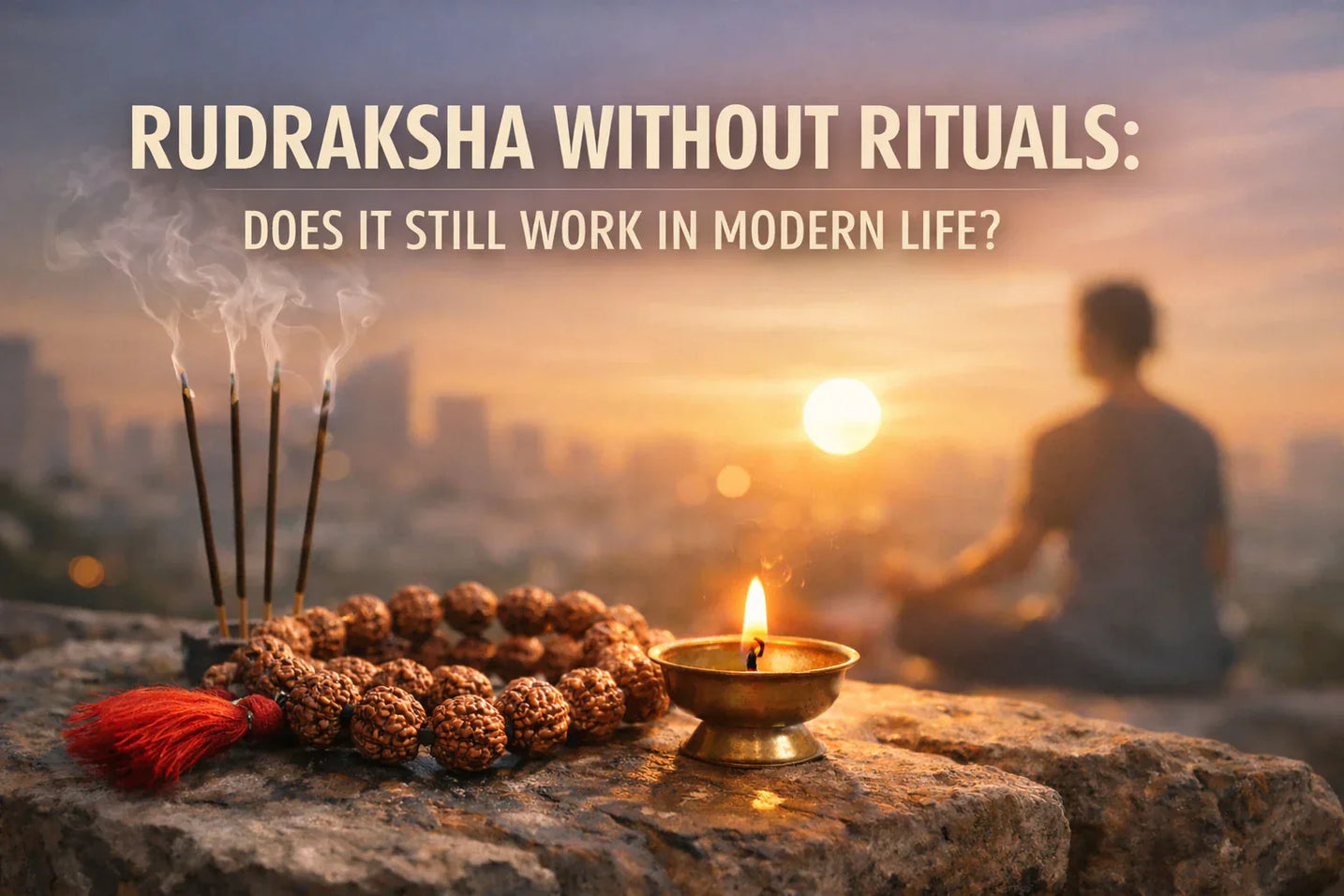
🧿 Rudraksha Without Rituals: Does It Still Work in Real Life?
For many people today, wearing Rudraksha does not bring peace — it brings confusion. Not because the bead is ineffective, but because the wearer is caught between tradition and reality. On one side are centuries-old practices rooted in ritual, discipline, and structure. On the other side is modern life — unpredictable schedules, professional pressure, travel, emotional overload, and limited mental space.
This conflict creates a silent question in the minds of sincere seekers: “If I cannot follow all the rituals properly, am I doing something wrong by wearing Rudraksha at all?”
Some respond to this question with guilt. Others respond with avoidance. Many stop wearing Rudraksha altogether, not because they lack faith, but because they fear disrespecting something sacred.
To answer whether Rudraksha works without rituals, we must first dismantle fear-based understanding and rebuild clarity — not by rejecting tradition, but by understanding what tradition was actually designed to do.
🕯️ How Rituals Slowly Became a Source of Fear
Rituals were never meant to intimidate. In their original context, they existed to create rhythm. They slowed the body, focused the mind, and prepared the nervous system for inward attention. In simple, community-based lifestyles, rituals were not an extra responsibility — they were woven naturally into daily life.
Over time, as lifestyles changed, rituals were preserved in form but disconnected from context. Instructions survived, but explanations faded. What remained were lists of do's and don’ts, stripped of their original purpose.
When people follow rules without understanding intention, fear replaces awareness. Rituals become tests instead of supports. Missing a step feels like failure rather than feedback.
This fear-based relationship is the first thing that blocks any genuine interaction with Rudraksha.
🧠 What Rituals Were Actually Designed to Regulate
At a deeper level, rituals worked on three things: attention, breath, and emotional containment. Lighting a lamp, sitting still, chanting slowly — these actions shifted the nervous system from outward engagement to inward awareness.
The ritual itself was never the power. The regulated state it created was the power.
When rituals are rushed, performed mechanically, or done under pressure, this regulation does not occur. The body remains tense, the mind remains scattered, and the ritual loses its purpose even if every step is followed perfectly.
Rudraksha responds to regulation, not performance.
⏱️ Why Modern Life Cannot Support Old Structures in the Same Way
Modern life is fragmented. Attention is constantly interrupted. Work does not follow fixed hours. Emotional processing is delayed or suppressed to meet responsibilities. Expecting people to follow elaborate daily rituals in such conditions often creates inner conflict rather than balance.
This does not mean modern people are less spiritual. It means the environment has changed.
Tradition was never meant to break people. It was meant to support them. When structure no longer fits the environment, adaptation becomes necessary — not abandonment.
🧘 Awareness Is Not the Same as Discipline
One of the biggest misunderstandings around Rudraksha is confusing discipline with rigidity. Discipline means consistency of awareness. Rigidity means forcing behavior regardless of internal state.
Rudraksha aligns with discipline, not rigidity.
A person who wears Rudraksha mindfully, notices their stress, rests when exhausted, and adjusts behavior honestly is practicing deeper discipline than someone following rituals mechanically while ignoring inner chaos.
📿 Does Rudraksha Stop Working Without Rituals?
Rudraksha does not function like a machine that shuts down when rituals are missed. It interacts continuously with the nervous system, emotional state, and lifestyle of the wearer.
When people say Rudraksha is “not working,” it is rarely because rituals are missing. It is more often because the wearer is overwhelmed, emotionally disconnected, or expecting dramatic effects without internal readiness.
Rudraksha reflects the state of the wearer. It does not override it.
🌿 Respect Without Anxiety: The Missing Understanding
Respect does not come from fear. It comes from sincerity. Wearing Rudraksha respectfully does not require perfection — it requires honesty.
Simple acts like keeping the bead clean, wearing it consciously, and acknowledging its presence are often enough to create alignment. Forced rituals performed with resentment or anxiety do the opposite.
When fear is removed, sensitivity often returns.
🌍 The Conflict Between Inner Life and External Demands
Modern life rewards output, responsiveness, and speed. Most people are trained to override internal signals in order to meet external expectations. Hunger is postponed, rest is delayed, emotions are suppressed, and reflection is considered a luxury. Over time, this creates a disconnect between inner experience and outer behavior.
When Rudraksha is introduced into such a life, it does not magically resolve this conflict. Instead, it highlights it. The bead does not numb inner signals; it sharpens awareness of them. This is why some people feel discomfort or restlessness when they begin wearing Rudraksha without adjusting how they live.
The discomfort is not punishment. It is feedback.
🧠 Why Intention Alone Is Not Enough
Many people believe that intention is the only requirement for spiritual tools to work. While intention is important, it is not sufficient on its own. Intention without behavioral alignment creates tension rather than harmony.
If a person intends peace but lives in constant overstimulation, the nervous system remains conflicted. Rudraksha does not bypass this conflict. It brings it into conscious awareness.
This is why some wearers report feeling more aware of stress after wearing Rudraksha. The bead is not increasing stress; it is reducing dissociation.
🍽️ Food, Lifestyle, and the Burden of Moral Anxiety
Food-related anxiety is one of the most common sources of confusion among Rudraksha wearers. Many people worry that eating certain foods automatically invalidates their spiritual practice.
This anxiety often stems from moral framing rather than physiological understanding. Food affects the body primarily through digestion, energy levels, and inflammation. Its spiritual impact is indirect and contextual.
When food choices are driven by fear rather than awareness, they increase tension. This tension affects the nervous system far more than the food itself.
Rudraksha does not respond to moral perfection. It responds to physiological and emotional regulation.
🧑💼 Work Pressure, Missed Practices, and Silent Frustration
Many sincere seekers struggle with the gap between spiritual aspiration and professional reality. Long work hours, deadlines, travel, and responsibility leave little room for structured practice.
When people try to force rituals into already overloaded schedules, frustration builds. Missed practices then become sources of self-judgment rather than neutral feedback.
Rudraksha does not require constant ceremonial attention. It requires the wearer to notice when overload is occurring and respond intelligently.
Ignoring exhaustion while maintaining outward ritual is one of the fastest ways to dull sensitivity.
🌱 Minimalism as a Spiritual Strategy
In overstimulated lives, minimalism is not laziness — it is strategy. Reducing unnecessary complexity allows the nervous system to recover.
For many people, a brief moment of stillness, a conscious breath, or quiet acknowledgment of the Rudraksha is more regulating than long practices performed mechanically.
Minimalism preserves continuity. Excess often leads to burnout.
🧭 Non-Religious Wearers and Cultural Fear
An increasing number of people wear Rudraksha without identifying strongly with religious structures. They may be drawn to its grounding effect rather than its symbolism.
These individuals often carry cultural fear — fear of disrespect, fear of doing something wrong, fear of unseen consequences.
Rudraksha does not discriminate based on belief systems. It interacts with the human nervous system. Respectful awareness matters more than religious identity.
When fear is replaced with understanding, the relationship becomes stable.
🔄 Long-Term Wearing Without Ritual Dependency
Over long periods, people who wear Rudraksha without rigid ritual dependency often report steadier, quieter effects. The absence of pressure allows sensitivity to develop gradually.
Those who rely heavily on ritual for reassurance often fluctuate between intensity and disappointment. When rituals are missed, confidence collapses.
True stability emerges when the wearer trusts awareness rather than rules.
🧘 The Difference Between Respect and Reverence
Respect involves care, cleanliness, and sincerity. Reverence involves fear of violation. Many people confuse the two.
Rudraksha responds well to respect. Reverence driven by fear creates tension and withdrawal.
Understanding this difference allows the wearer to remain relaxed while still honoring the object.
🌿 When Simplicity Restores Sensitivity
Sensitivity is not forced. It emerges when the system feels safe.
By removing ritual anxiety, simplifying practice, and responding honestly to fatigue and stress, many people rediscover the grounding quality they initially sought.
This return of sensitivity often surprises those who believed they needed more effort rather than less fear.
🧠 Discipline Revisited: Why Force Weakens Sensitivity
In many spiritual discussions, discipline is portrayed as endurance — the ability to continue regardless of inner resistance. While endurance has value in certain contexts, it is often misunderstood when applied to spiritual tools like Rudraksha.
True discipline is not about overriding signals. It is about responding to them intelligently. When the body signals exhaustion, discipline means resting. When the mind signals overload, discipline means simplifying. Ignoring these signals in the name of spiritual effort creates internal contradiction.
Rudraksha tends to amplify this contradiction. It does not reward force; it responds to coherence between intention and action.
🧩 Why Many People Misread Discomfort as Spiritual Failure
Discomfort is often interpreted as failure because people expect spiritual tools to feel immediately pleasant. This expectation is shaped by marketing language and incomplete understanding.
In reality, discomfort frequently indicates increased awareness. When dissociation reduces, sensations become clearer. Emotional tension that was previously ignored becomes noticeable.
Rudraksha does not create discomfort. It reduces the layers that were hiding it. Without this understanding, people abandon the practice prematurely or blame themselves unnecessarily.
🌿 Emotional Honesty as the Real Foundation
Emotional honesty is one of the least discussed yet most critical factors in spiritual engagement. Suppressing emotions to appear composed creates internal pressure that blocks regulation.
Rudraksha does not support suppression. It supports acknowledgment. When wearers allow themselves to feel tired, irritated, confused, or overwhelmed without judgment, the system begins to settle.
This settling is often mistaken for weakness. In reality, it is stabilization.
🕰️ Long-Term Consistency Without Burnout
Many people can maintain intense practice for short periods. Very few can sustain it without burnout. Long-term consistency requires adaptability.
Rudraksha supports long-term consistency when it is integrated into life rather than imposed on it. Some days involve stillness, others involve movement. Some days allow awareness, others require rest.
This variability does not weaken the practice. It preserves it.
🔄 The Trap of Comparing Spiritual Effort
Comparison silently erodes confidence. Seeing others perform elaborate rituals or maintain strict routines often triggers self-doubt.
However, spiritual practice is not comparative. Nervous systems differ. Life circumstances differ. What regulates one person may overwhelm another.
Rudraksha responds to individual alignment, not social benchmarks.
🧘 Why Silence Often Works Better Than Instruction
Instruction provides direction, but silence allows integration. Many wearers experience clarity not during ritual, but during quiet moments when they stop trying to “do” spirituality.
Rudraksha often feels most supportive when attention softens. This is why people sometimes report deeper calm during walks, travel pauses, or simple breathing rather than during structured practices.
The bead responds to presence, not performance.
🌱 How Letting Go Restores Trust
Letting go of rigid expectations often restores trust in one’s own experience. When people stop monitoring whether they are “doing it right,” sensitivity returns.
This trust allows the wearer to notice subtle shifts — improved grounding, steadier attention, reduced emotional reactivity — without needing dramatic confirmation.
Rudraksha works quietly. Trust allows quiet work to be noticed.
🧭 Spiritual Maturity Is Measured by Ease, Not Effort
As spiritual maturity grows, effort reduces. Practices become simpler, not more complex. Awareness becomes integrated, not scheduled.
Rudraksha fits naturally into this maturity. It does not demand escalation. It supports stabilization.
When people stop trying to earn spiritual outcomes, they often begin to experience them.
🌿 The Subtle Shift That Changes Everything
The most important shift is moving from fear to curiosity. Instead of asking, “Am I breaking a rule?” the wearer begins to ask, “What am I noticing?”
This curiosity opens space for learning rather than judgment. It aligns the nervous system with observation rather than control.
In this space, Rudraksha functions as it was always meant to — as a companion to awareness, not a test of devotion.
🧘 When Spiritual Tools Stop Feeling Spiritual
A moment arrives for many wearers when Rudraksha stops feeling special. There is no dramatic sensation, no emotional surge, no clear sign that something meaningful is happening. This phase often triggers doubt.
In reality, this moment marks a transition. The tool is no longer being experienced as an external object. It is beginning to merge with daily awareness. What once felt distinct now feels ordinary — not because it has lost value, but because it has integrated.
This is where many people mistakenly believe something has gone wrong. They start adding rules, rituals, or intensity in an attempt to revive sensation. In doing so, they interrupt a natural settling process.
🌿 Integration Is Quieter Than Expectation
Integration rarely announces itself. It shows up as reduced reactivity, steadier focus, and greater tolerance for discomfort. These changes are subtle and often overlooked because they do not match dramatic expectations.
Rudraksha supports integration, not spectacle. When worn without fear and without excessive control, its influence blends into everyday functioning.
The quieter the relationship becomes, the deeper it usually is.
🧠 Why Over-Doing Blocks Perception
Over-doing creates noise. Noise makes subtle regulation difficult to perceive. When people constantly evaluate, analyze, or judge their spiritual practice, attention stays outward-facing.
Rudraksha responds best when attention softens. This is why periods of relaxed wearing often feel more supportive than phases of intense monitoring.
Less effort often leads to more clarity.
🧭 The Natural End of Ritual Dependency
As understanding matures, dependency on ritual naturally fades. This does not indicate loss of respect. It indicates internalization of the original purpose.
The qualities rituals were meant to cultivate — steadiness, awareness, presence — begin to operate without external prompts.
At this stage, Rudraksha becomes less about practice and more about alignment.
🌱 A Mature Relationship With Rudraksha
A mature relationship with Rudraksha is free from fear, guilt, and performance pressure. It is grounded in observation, honesty, and adaptability.
Such a relationship survives missed days, changing lifestyles, and imperfect routines. It does not collapse when structure shifts.
This maturity is what allows Rudraksha to remain relevant in real life — not as an obligation, but as a stabilizing presence.
❓ Frequently Asked Questions (FAQs)
Does Rudraksha require daily puja to work?
No. Daily puja is a supportive practice, not a requirement. Rudraksha responds more to awareness, regulation, and lifestyle alignment than to ritual frequency.
Can I wear Rudraksha even if I miss rituals or mantras?
Yes. Missing rituals does not deactivate Rudraksha. What matters is how regulated and present the wearer is, not ritual consistency.
Does eating certain foods cancel Rudraksha’s effect?
Food affects energy through digestion and nervous system impact, not morality. Fear and guilt around food often disturb regulation more than the food itself.
Why do I feel nothing even after wearing Rudraksha for months?
Subtle integration often replaces noticeable sensation over time. Reduced reactivity and steadiness are common signs of effect that are easily overlooked.
Is it disrespectful to wear Rudraksha casually?
Respect is reflected in sincerity and awareness, not rigidity. Casual wearing with presence is more respectful than forced ritual performed under fear.
Can non-religious people wear Rudraksha?
Yes. Rudraksha interacts with the human nervous system and awareness, not religious identity. Respectful intent matters more than belief structure.
🧘 Final Conclusion ✨
Rudraksha Works Through Awareness, Not Fear
Rudraksha was never meant to burden the wearer with anxiety. It was meant to support steadiness, awareness, and inner regulation. Rituals were created to help people reach this state — not to replace it.
When rituals turn into rules, fear replaces clarity. When fear replaces clarity, sensitivity fades. What many people interpret as Rudraksha “not working” is often the result of tension, guilt, and unrealistic expectation.
A mature relationship with Rudraksha is simple, honest, and adaptable. It survives modern life not because it is rigid, but because it is intelligent. Awareness keeps it alive. Fear shuts it down.
When worn with sincerity rather than pressure, Rudraksha does not need elaborate rituals to function. It needs presence.
🙏 हर हर महादेव 🙏





Leave a comment