
























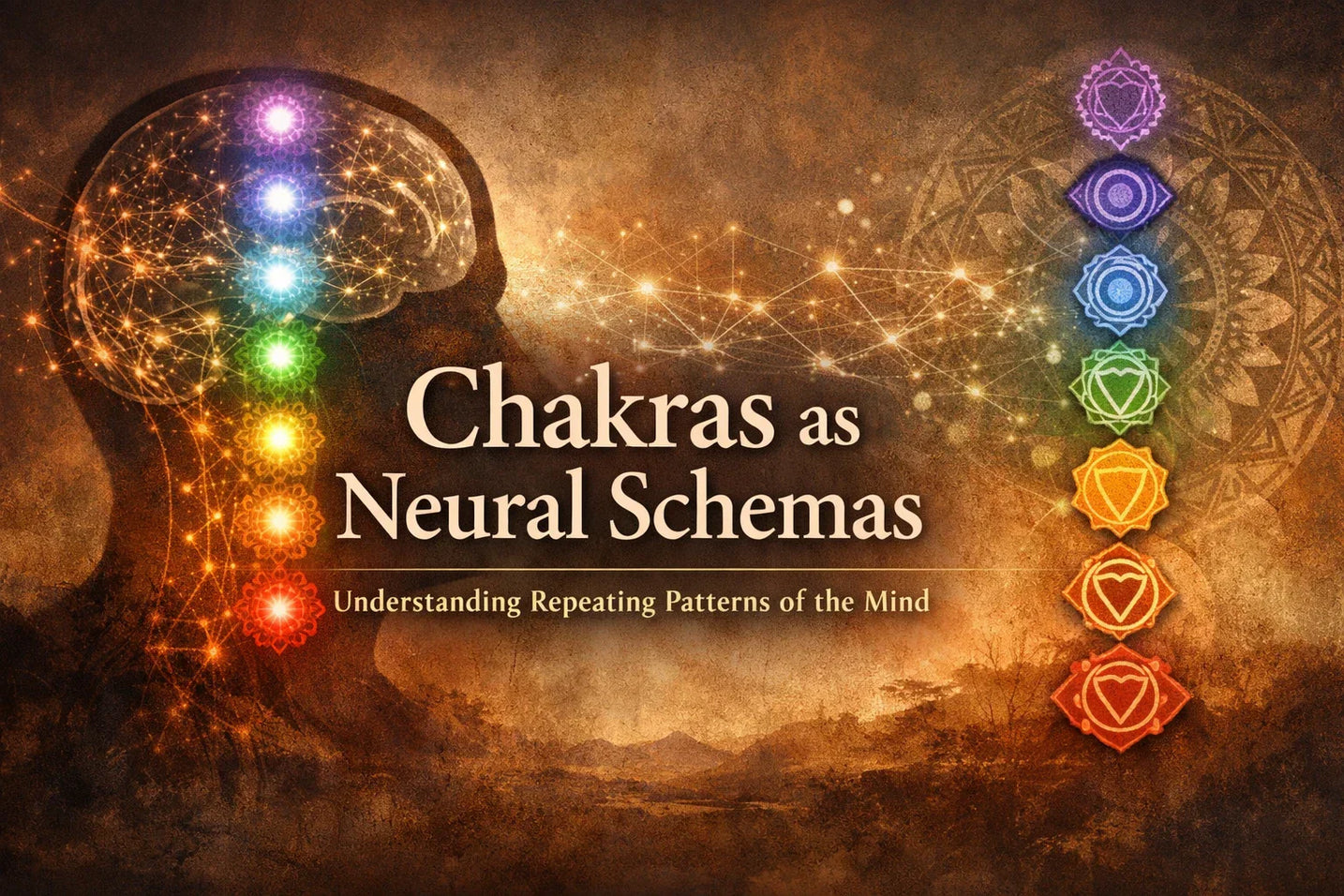
🛞 Chakras as Neural Schemas: Why Awareness Alone Doesn’t Break Old Patterns
For many people on a spiritual path, one frustration quietly repeats itself: “I understand my patterns, but I still react the same way.” Despite meditation, discipline, ritual, or study, the same emotional loops return — fear resurfaces, control tightens, attachment reappears, silence replaces expression. This is not a failure of awareness. It is a misunderstanding of how the mind stores experience.
Traditional chakra models describe where imbalance appears. Modern psychology explains why it persists. When these two perspectives are integrated correctly, a missing layer becomes visible: chakras do not merely represent energy centers — they also reflect deep neural schemas, the mental templates through which experience is interpreted and repeated.
This article does not reinterpret chakras as mystical anatomy, nor does it reduce them to symbolism. Instead, it bridges ancient insight with modern cognitive understanding to explain why growth often feels slow, circular, or incomplete — and why effort without structural change rarely lasts.
🔁 What a Neural Schema Really Is (And Why It Controls Behavior)
In cognitive psychology, a schema is a deeply ingrained mental framework formed through repeated experience. It is not a belief you consciously choose. It is a pattern the nervous system defaults to under pressure. Schemas determine how safety, attachment, authority, trust, expression, meaning, and identity are perceived — often before conscious thought has time to intervene.
Schemas form early, solidify through repetition, and activate automatically. When triggered, they bypass logic and override intention. This is why insight alone rarely changes behavior. Awareness recognizes the pattern, but the schema still governs reaction.
What ancient systems observed intuitively, modern neuroscience confirms: under stress, the brain reverts to its most familiar pathways. Growth therefore does not come from understanding alone, but from gradually rewiring response. This is where chakras function as more than symbolic centers — they map where specific schemas tend to anchor.
This is why traditional frameworks associated these automatic survival and safety schemas with the Root Chakra (Muladhara) — the center governing stability, threat perception, and baseline security. You may explore this further in our detailed breakdown of how the Root Chakra shapes unconscious safety responses and behavioral reflexes, where psychological conditioning and ancient mapping intersect.
📍 Why Chakras Behave Like Schema Containers
Chakras were never meant to describe floating energy points detached from lived experience. In classical traditions, they represented domains of function — survival, emotion, power, connection, expression, perception, and identity. Each domain corresponds precisely with modern schema categories studied in psychology.
When life repeatedly challenges a particular domain, the associated schema strengthens. Over time, it becomes less flexible. The chakra does not “block” energy; the schema narrows interpretation. The result feels like imbalance, but the root is cognitive, emotional, and behavioral conditioning.
This explains a common paradox: two people with the same spiritual knowledge respond completely differently under pressure. Their awareness may be equal. Their schemas are not.
This functional mapping becomes clearer when examining how emotional and relational schemas stabilize over time. In particular, the Sacral Chakra (Svadhisthana) closely mirrors how emotional memory, attachment patterns, and pleasure–avoidance responses are conditioned and stored. You can explore this connection in our in-depth analysis of how the Sacral Chakra governs emotional conditioning and behavioral flexibility, bridging psychology with classical chakra logic.
🧩 Why Healing Feels Fragmented Without Schema Awareness
Most spiritual practices focus on states — calm, clarity, devotion, surrender. Schemas operate on traits — the automatic way one reacts when calm is absent. This mismatch creates frustration. A person may feel balanced in stillness, yet reactive in conflict. Peace exists, but does not generalize.
Without addressing schemas, practices become episodic. They soothe, but do not stabilize. The mind resets temporarily, then returns to default. This is not regression; it is structural inertia.
Traditionally, this is why discipline, repetition, and long-term containment were emphasized over dramatic experiences. Stability was built slowly, allowing schemas to loosen through lived consistency rather than forced change.
This fragmentation becomes especially evident in the Heart Chakra (Anahata), where schemas related to trust, emotional boundaries, and relational discernment are activated. Our detailed exploration of how the Heart Chakra governs compassion without reactivity and connection without emotional overload explains why inner peace often survives meditation but collapses in real human interaction.
🧠 Awareness vs Reconditioning: The Missing Step
Awareness is the beginning of change, not its completion. To move beyond repetition, the nervous system must experience new outcomes consistently. This requires environments, routines, and supports that reinforce alternative responses until they become familiar.
This is where ancient tools were misunderstood. They were never shortcuts. They were anchors — subtle, repetitive cues that supported re-patterning over time. Their effectiveness depended not on intensity, but on duration and alignment with daily life.
When used correctly, such supports do not “fix” a chakra. They create conditions under which a schema can soften. Growth then emerges naturally, without force or urgency.
🧱 Root-Level Schemas: Why Safety Patterns Are the Hardest to Change
At the foundational level of human behavior lie safety schemas — deep assumptions about survival, stability, and predictability. These schemas are not philosophical ideas; they are neurological survival maps formed through early experiences of uncertainty, inconsistency, or lack of support. Once established, they operate silently in the background, shaping reactions long before conscious thought appears.
This is why patterns related to security feel so stubborn. Even after intellectual insight, the nervous system continues to scan for threat. Financial anxiety, fear of loss, over-planning, or rigid routine are not character flaws; they are protective responses formed around earlier instability. These patterns persist because awareness alone does not recalibrate the body’s memory of uncertainty — the system remains oriented toward prevention rather than possibility.
Traditional grounding frameworks addressed this level of conditioning through consistency, not stimulation. Stability was rebuilt by reinforcing predictable rhythm and responsibility over time. Within this context, supports such as a 7 Mukhi Rudraksha were historically approached as long-term stabilizers — not as tools for attracting wealth, but as quiet anchors associated with material responsibility and sustained effort. Their role was to accompany disciplined routine, gradually reducing fear-based decision-making and restoring trust in structured action rather than impulsive control.
Traditional systems emphasized containment rather than confrontation at this level. Stability was rebuilt through repetition, predictability, and steady rhythm — not emotional processing. Over time, consistent structure teaches the nervous system that safety can be maintained without hypervigilance. Only then does flexibility emerge.
🌊 Emotional Schemas: Why Attachment Repeats Even After Healing
Emotional schemas govern how connection, pleasure, and loss are interpreted. These patterns are formed through repeated relational experiences — closeness followed by withdrawal, affection tied to approval, or emotional expression met with inconsistency. Once formed, the mind begins to equate intensity with connection and absence with threat.
This explains why attachment patterns often return despite years of inner work. The individual may understand emotional triggers intellectually, yet the schema still associates fulfillment with emotional charge. Calm feels empty. Neutrality feels unsafe. As a result, relationships oscillate between indulgence and withdrawal.
Ancient disciplines did not attempt to eliminate desire. They refined it. Emotional regulation was cultivated through moderation, rhythm, and restraint — allowing feeling without letting it dictate identity. When emotional schemas soften, connection becomes spacious rather than consuming, and creativity flows without volatility.
🔥 Authority & Control Schemas: The Hidden Root of Burnout
Schemas related to authority, control, and self-worth govern how responsibility is carried. When these schemas are rigid, individuals either over-identify with performance or withdraw from responsibility altogether. Confidence becomes conditional. Effort feels heavy. Burnout follows not from work itself, but from the psychological weight attached to it.
These patterns are often mistaken for ambition or discipline. In reality, they reflect unresolved questions of worth: “Am I enough if I stop proving?” Until this schema loosens, effort remains compulsive rather than directed. Power becomes exhausting instead of stabilizing.
Traditional approaches emphasized disciplined action without emotional overinvestment. Responsibility was practiced without self-judgment. Over time, action became reliable rather than reactive. When control schemas dissolve, confidence stabilizes — not because success increases, but because self-worth decouples from outcome.
💚 Trust & Boundary Schemas: Why Compassion Becomes Draining
Schemas related to trust and boundaries determine how openness is managed. When distorted, compassion turns into overextension or withdrawal. Giving becomes compulsive. Receiving feels unsafe. Emotional exchange loses balance.
This is why many people feel emotionally exhausted despite good intentions. Their schema equates care with self-sacrifice or distance with safety. The result is relational imbalance rather than connection.
Classical teachings framed compassion as strength guided by discernment. Emotional responsibility was emphasized over emotional intensity. When trust schemas mature, relationships stabilize. Care becomes sustainable. Boundaries emerge naturally without guilt or defense.
🗣️ Expression Schemas: Why the Voice Gets Blocked
Schemas governing expression shape how truth is spoken or withheld. These patterns form when expression is met with dismissal, conflict, or misunderstanding. Over time, the mind associates speech with risk and silence with safety.
Even after confidence grows internally, expression may remain inhibited. Thoughts stay unspoken. Truth becomes rehearsed rather than shared. This is not lack of clarity; it is schema-based caution.
Traditional systems restored expression through consistency rather than confrontation. Mindful speech, reflective silence, and disciplined communication rebuilt trust in expression itself. When this schema softens, speech becomes clear, measured, and free from urgency.
👁️ Meaning Schemas: When Insight Becomes Overthinking
Schemas related to meaning and perception govern how information is interpreted. When overactive, they produce overanalysis, doubt, or rigid belief systems. Insight becomes heavy. Intuition loses grounding.
This explains why some individuals feel mentally restless despite deep knowledge. The schema seeks certainty where openness is required. Thought multiplies, but clarity diminishes.
Traditional disciplines emphasized grounding before insight. Perception was refined through patience rather than stimulation. When meaning schemas stabilize, understanding becomes functional instead of overwhelming.
🕊️ Identity Schemas: Why Surrender Feels Threatening
At the highest level lie identity schemas — assumptions about who one is beyond roles, achievements, or beliefs. These schemas resist change not because they are wrong, but because they provide coherence.
Attempts to “let go” prematurely often destabilize identity rather than liberate it. This leads to detachment, escapism, or confusion mistaken for transcendence.
Traditional systems approached surrender as maturation, not erasure. Identity softened gradually as stability below increased. Awareness expanded without fragmentation. When identity schemas loosen naturally, surrender feels grounding rather than disorienting.
🧠 Why Structural Change Outlasts Insight
Insight reveals patterns. Structure reshapes them. Without structural reinforcement, awareness fades under pressure. This is why lasting growth is slow, repetitive, and often unremarkable.
Ancient systems prioritized lived consistency over peak experience. Stability was built daily. Over time, schemas softened without force. Growth did not come from breaking patterns, but from outgrowing them.
❓ Frequently Asked Questions (FAQs)
Are chakras really psychological patterns rather than energy centers?
Traditional chakra systems describe functional domains of human experience, while modern psychology explains how repeated experiences form neural schemas. Viewing chakras as schema containers does not reject spirituality; it explains why certain emotional and behavioral patterns repeat even after awareness develops.
Why does awareness alone fail to change long-standing habits?
Awareness recognizes a pattern, but habits are governed by conditioned neural responses. Under pressure, the nervous system defaults to familiar pathways. Lasting change requires repeated exposure to new outcomes, not insight alone.
Does this mean meditation and spiritual practices are ineffective?
No. Meditation and discipline are essential, but they work best when combined with structural consistency. Practices stabilize the mind temporarily; structure ensures that stability carries into daily life.
Why do emotional and attachment patterns keep repeating?
Attachment patterns are governed by emotional schemas formed through early and repeated relational experiences. Until these schemas soften through lived consistency and moderated response, emotional reactions tend to resurface automatically.
How is discipline different from suppression?
Suppression resists experience, while discipline provides predictability. Discipline reduces chaos by creating rhythm and containment, allowing the nervous system to feel safe enough to change.
Can tools like Rudraksha or malas change neural patterns?
Such tools are traditionally used as anchors, not cures. Their value lies in reinforcing routine, consistency, and reflection over time rather than producing immediate effects.
Why do people feel balanced in meditation but reactive in daily life?
Meditation creates a calm state, but schemas operate as traits. Without structural reinforcement, calm does not generalize under stress, causing old reactions to return.
Is chakra imbalance the same as psychological trauma?
Not exactly. Chakra imbalance reflects functional disruption, while trauma involves deeper nervous system imprinting. However, both interact, which is why repetition occurs without structural healing.
Why does surrender feel destabilizing for some people?
Surrender threatens identity schemas when foundational stability is weak. Without grounding, letting go can feel like loss of coherence rather than freedom.
What is the safest way to approach long-term change?
Long-term change stabilizes through repetition, ethical responsibility, disciplined routine, and gradual exposure to new responses. Growth emerges through consistency, not intensity.
🔚 Conclusion 🌀
From Awareness to Stability
Understanding chakras as neural schemas bridges a critical gap between spiritual insight and behavioral change. It explains why repetition persists, why effort feels heavy, and why awareness alone rarely suffices.
When growth is approached structurally — through rhythm, discipline, and responsibility — transformation stabilizes. Patterns loosen not through struggle, but through consistency.
This perspective does not reject spirituality. It completes it.
🙏 हर हर महादेव 🙏





Leave a comment