



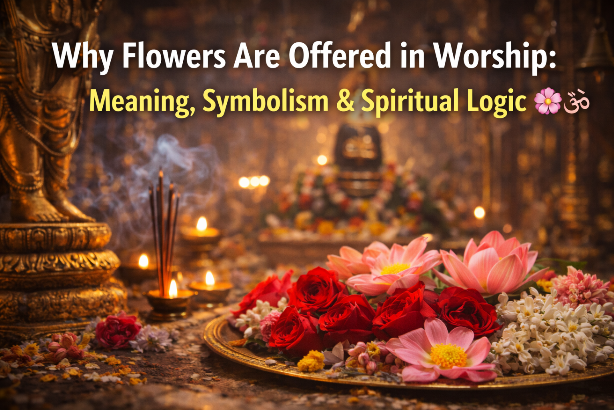
Why Flowers Are Offered in Worship: Meaning, Symbolism & Spiritual Logic Explained 🌸🕉️
Across temples, home shrines, and sacred rituals, one element appears almost universally in Hindu worship—flowers. Whether placed gently at the feet of a deity, offered during abhishek, or woven into garlands, flowers occupy a central role in spiritual practice.
Yet a fundamental question often goes unexamined: why are flowers offered in worship? Is this simply a cultural habit passed down through generations, or does this act carry a deeper spiritual and philosophical meaning?
This blog explores the symbolic, spiritual, and logical reasons behind offering flowers in worship—beyond ritual, superstition, or aesthetics. It explains why flowers are considered an appropriate offering and what they represent in the inner journey of a devotee.
Flowers in Worship: Not Decoration, but Communication 🌸
At first glance, flowers may appear to be decorative elements meant to beautify a deity or altar. However, in Hindu philosophy, worship is not about pleasing the senses of God. Deities are not dependent on fragrance, color, or form.
Instead, worship is a symbolic language—a way for the devotee to communicate inner intention. Flowers serve as a medium of expression, not embellishment.
Offering a flower is a non-verbal gesture that conveys reverence, humility, and surrender. It reflects an inner state rather than an external requirement.
Why Only Fresh Flowers Are Used 🌺
In traditional worship, only fresh, naturally blossomed flowers are considered suitable. Artificial, dried, or withered flowers are avoided.
This preference is not based on superstition but symbolism. Fresh flowers represent vitality, presence, and aliveness. They symbolize a mind that is attentive, conscious, and fully present.
Offering a fresh flower is a reminder that worship must come from a living awareness, not from habit or mechanical repetition.
Flower as a Symbol of Impermanence 🌼
One of the deepest spiritual messages conveyed by flowers is impermanence.
A flower blooms fully only to wither shortly afterward. Its beauty is brief, delicate, and temporary. By offering a flower, the devotee symbolically acknowledges the transient nature of life, youth, emotions, and material beauty.
This silent recognition of impermanence cultivates humility and detachment—key principles in spiritual growth.
Offering the Best, Not the Leftover 🌸
Flowers are often the most beautiful and appealing part of a plant. By offering flowers, devotees symbolically offer the best they have—not what is leftover or unwanted.
This reflects an inner discipline: approaching worship with sincerity, effort, and respect rather than obligation.
The act reminds the practitioner that spiritual life requires intentional giving, not casual participation.
Fragrance and the Idea of Subtle Influence 🌺
Flowers influence their surroundings quietly. Their fragrance spreads naturally without effort, noise, or force.
This quality mirrors how spiritual influence is meant to operate—subtle, gentle, and non-invasive.
By offering fragrant flowers, the devotee symbolically aspires to cultivate inner qualities that uplift others effortlessly, without dominance or display.
Why Flowers Are Placed at the Feet of the Deity 🛕
In most forms of worship, flowers are placed at the feet of the deity rather than on the head or face.
This act represents humility. The devotee does not project ego or identity upward but lowers personal pride in acknowledgment of a higher principle.
Placing flowers at the feet signifies surrender of individuality, not submission out of fear, but trust rooted in understanding.
Flowers and Emotional Expression in Worship 💭
Flowers naturally evoke emotions—peace, devotion, joy, and tenderness. In worship, they act as emotional bridges.
For many devotees, offering flowers becomes an intimate, wordless expression of feelings that cannot be articulated verbally.
This emotional engagement is not the goal of worship but an entry point—helping the mind soften before deeper awareness emerges.
Why Different Flowers Are Associated with Different Deities 🌸
Certain flowers are traditionally associated with specific deities—such as lotus with Lakshmi, bilva with Shiva, or hibiscus with Devi.
These associations arise from symbolic resonance rather than divine preference. Each flower represents certain qualities—purity, strength, detachment, or transformation—which align with the philosophical essence of the deity.
The flower thus becomes a symbolic extension of the deity’s attributes.
Flowers in Shiva–Shakti Worship: A Deeper Symbolic Balance 🔱🌺
In Shiva–Shakti philosophy, flowers represent a subtle yet powerful bridge between consciousness and energy. Shiva symbolizes still awareness, while Shakti represents movement, expression, and creation.
Flowers bloom as a result of energy transforming into beauty. By offering flowers, devotees symbolically present the refined expression of their life energy to consciousness. This act reflects harmony between inner awareness and outward expression.
In this sense, flowers are not offerings of desire but offerings of transformation—raw impulses refined into devotion.
Why Certain Flowers Are Traditionally Avoided ❌
Not all flowers are used in worship, and this selective approach is rooted in symbolic clarity rather than superstition.
Flowers with thorns, strong intoxicating scents, or excessive dryness are traditionally avoided because worship emphasizes softness, balance, and stability of mind.
The aim is not restriction but alignment—choosing elements that support calm awareness rather than agitation or distraction.
Flowers Versus Other Offerings: What Makes Them Unique 🌸
Unlike food offerings or material items, flowers do not represent possession or consumption. They are offered and left behind without expectation of return.
This quality makes flowers a pure symbol of non-attachment. The devotee does not seek reward, blessing, or outcome—only expression of reverence.
In contrast, food offerings involve nourishment, and ritual items involve utility. Flowers involve surrender.
The Act of Plucking a Flower: Awareness Before Offering 🌼
Traditional texts emphasize mindfulness even before offering flowers. Plucking a flower carelessly is discouraged.
This practice teaches respect for life and intentional action. The flower is not taken forcefully but chosen consciously.
Thus, worship begins not at the altar, but at the moment of selection—training the mind toward gentleness and responsibility.
Flowers as a Mirror of the Devotee’s Inner State 🪞
The condition of the flower offered reflects the devotee’s inner state. A fresh, clean flower represents clarity and presence.
A neglected or damaged flower symbolizes distraction or unconscious participation.
In this way, flowers quietly mirror the quality of attention brought into worship—without judgment, only reflection.
Flowers in Silent Worship and Meditation 🧘
In quieter forms of worship, offering a single flower can replace elaborate rituals.
This minimalistic approach emphasizes quality over quantity. One flower offered with full awareness holds more significance than many offered mechanically.
Such practices highlight that spiritual depth arises from presence, not performance.
Modern Relevance: Why Flower Offering Still Matters Today 🌍
In a fast-paced, consumption-driven world, offering flowers introduces a moment of pause.
It teaches respect for natural beauty, acceptance of impermanence, and the value of subtle expression.
Even today, the act remains relevant because it cultivates mindfulness—an increasingly rare quality in modern life.
Frequently Asked Questions (FAQs) ❓
1. Why are flowers preferred over artificial decorations in worship?
Because flowers symbolize life, freshness, and presence, while artificial items lack natural vitality.
2. Can a single flower be enough for worship?
Yes. Sincerity and awareness matter more than quantity.
3. Is fragrance important in flower offerings?
Fragrance symbolizes subtle influence and inner refinement, not sensory pleasure.
4. Why are flowers placed at the feet of the deity?
To express humility, surrender, and reduction of ego.
5. Is offering flowers mandatory in worship?
No. Flowers are symbolic aids, not compulsory requirements.
🔱 Conclusion 🌀
Flowers as Silent Teachers of Spiritual Truth
Flowers are offered in worship not to decorate the divine, but to educate the devotee.
They teach impermanence, humility, gentleness, and non-attachment—without words or doctrine.
Through a simple act of offering a flower, worship becomes a moment of awareness, where beauty is surrendered rather than possessed.
In this way, flowers transform worship from ritual into reflection, and devotion into understanding.
🙏 Har Har Mahadev 🙏





Leave a comment