
























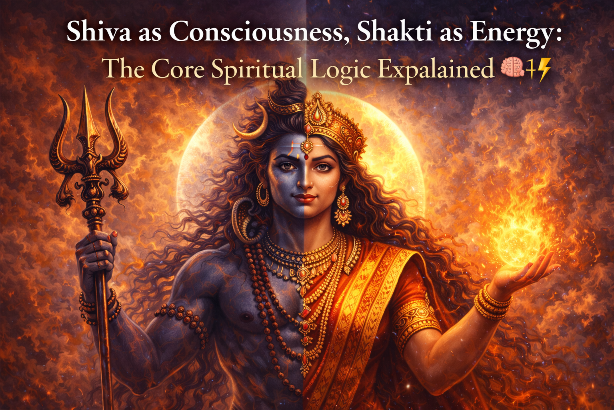
Shiva as Consciousness, Shakti as Energy: The Core Spiritual Logic Explained 🧠⚡
In Hindu philosophy, the universe is not explained through conflict or chaos, but through balance. At the heart of this balance lies a simple yet profound understanding: Shiva represents consciousness, and Shakti represents energy.
This idea is not metaphorical alone—it is the foundational logic behind creation, movement, transformation, and stillness. Everything that exists does so because awareness and energy function together.
This guide explains the Shiva–Shakti framework in its most fundamental form, free from exaggeration or superstition, while remaining spiritually authentic and beginner-friendly. It connects philosophy, symbolism, and everyday relevance into one coherent understanding.
What Does Consciousness Mean in Shiva Philosophy? 🕉️
Consciousness, in the context of Shiva, does not mean thought or emotion. It refers to pure awareness—the ability to observe without reacting.
Shiva as consciousness is silent, still, and unchanging. He does not act, desire, or interfere. He witnesses.
This witnessing awareness is essential because without it, experience would have no reference point. There would be movement, but no understanding of movement.
What Does Energy Mean in Shakti Philosophy 🌺
Shakti represents energy in all its forms—physical movement, emotional intensity, creative force, and transformative power.
She is responsible for action, expression, growth, and change. Wherever something moves, evolves, or transforms, Shakti is at work.
Without Shakti, awareness remains inactive. Without energy, consciousness cannot express itself.
Why Consciousness Alone Cannot Create 🔱
In Hindu philosophy, consciousness is never denied power—but it is also never misunderstood. Shiva, as pure consciousness, is complete, limitless, and self-sufficient. He is awareness itself: the silent witness that sees without effort, knows without thinking, and exists without needing validation. Yet this very completeness is the reason creation does not arise from consciousness alone.
Imagine a vast, still ocean with no waves. It contains all potential, all depth, all mystery—but nothing moves. Shiva exists in this state of absolute fullness. He does not lack anything, and therefore he does not need to act. Creation, however, is not born from needlessness. Creation requires movement, impulse, vibration—the will to express.
Consciousness observes, but observation alone does not produce experience. It can illuminate reality, but it does not shape it. In the same way, Shiva’s awareness can contain universes within itself, yet remain untouched by them. This is why Hindu thought never portrays Shiva as a creator acting independently. He is not inactive due to weakness; he is inactive because nothing compels him to move. Creation begins only when awareness is stirred. This stirring is Shakti.
Shakti is not separate from Shiva, nor is she lesser. She is the dynamic principle that allows the still to become expressive. Where Shiva is the canvas, Shakti is the motion that brings form. Where Shiva is silence, Shakti is sound. Where Shiva is timeless presence, Shakti is time unfolding.
Without Shakti, consciousness remains unmanifest—complete, but unexpressed. With Shakti, that same consciousness becomes experience: thought, emotion, matter, time, birth, change, and dissolution. Shakti does not disturb Shiva’s stillness; she activates it. She gives direction to awareness, without altering its truth.
This is why creation is never described as Shiva’s act alone. Creation is the result of union—when awareness allows itself to be energized. Not forced. Not compelled. But awakened.
In spiritual terms, this carries a profound lesson. Awareness within a human being—clarity, intelligence, perception—cannot shape life unless it is energized by intention, emotion, discipline, and action. A person may understand truth deeply, yet remain stuck if that understanding is not activated. Just as Shiva without Shakti remains unmoving, awareness without energy remains unrealized.
Hindu philosophy therefore does not glorify passivity, nor does it glorify blind action. It teaches alignment. Consciousness must remain clear, and energy must remain guided. When one exists without the other, imbalance arises. When they unite, creation flows naturally.
Shiva does not “create” because creation is not an effort. Creation is an expression. And expression arises only when stillness and energy meet—when consciousness allows itself to be lived.
This is the subtle truth behind why consciousness alone cannot create. Not because it is insufficient, but because it is infinite. And infinity expresses itself only when it chooses movement through Shakti. That movement is life itself.
Why Energy Alone Becomes Chaotic Without Awareness ⚠️
Energy is powerful, but power without direction does not create—it disrupts. In Hindu philosophy, Shakti represents movement, force, action, and transformation. She is the pulse behind life, the reason anything changes at all. Yet this very capacity to move, when left without awareness, becomes unstable. Energy begins to act for the sake of movement itself, not for meaning.
When energy lacks awareness, it does not know where to go or why it is moving. It rushes, reacts, expands, and exhausts itself. This is why ungrounded energy often appears as restlessness, impulsiveness, aggression, or emotional volatility. There is motion, but no wisdom behind it. Action occurs, but consequences are not understood.
In symbolic terms, this is Shakti without Shiva.
Shiva represents awareness, restraint, and witnessing intelligence. He does not suppress energy; he gives it context. Without this grounding presence, Shakti’s force loses balance. Power turns excessive. Desire becomes uncontrolled. Transformation slips into destruction—not because energy is harmful, but because it is uncontained.
This principle is deeply visible in human life. A person may possess immense drive, ambition, or emotional intensity. But without awareness, that same drive can lead to burnout, conflict, and chaos. Action taken without reflection often creates more problems than it solves. Energy begins to consume the individual instead of serving them.
Discipline arises precisely to prevent this collapse. Discipline is not denial of energy; it is intelligent channeling. Restraint is not weakness; it is awareness choosing when not to act. Awareness gives energy a rhythm. It decides when to move, when to pause, and when to transform direction.
In spiritual traditions, awareness is the axis around which energy rotates. It steadies the force of action so it does not scatter. When awareness is present, energy becomes purposeful. It builds rather than destroys. It heals rather than harms. It moves, but it also knows when to stop.
This is why Hindu philosophy never celebrates raw power alone. Power without clarity becomes ego-driven. Emotion without awareness becomes instability. Action without grounding becomes violence. Even devotion, when unbalanced by awareness, can slip into obsession or fear.
The union of Shiva and Shakti resolves this tension. Shiva does not limit Shakti; he refines her. Shakti does not overwhelm Shiva; she animates him. Together, they create movement with meaning.
On a personal level, this teaching reminds us that awareness must precede action. Before energy is released, it must be observed. When awareness leads, energy follows wisely. When awareness is absent, energy leads blindly.
This is the deeper truth behind why energy alone becomes chaotic without awareness. Not because energy is flawed—but because power, without consciousness to guide it, forgets its purpose.
The Living Equation: Shiva + Shakti = Reality 🌌
Existence itself can be understood as the interaction between consciousness and energy.
Awareness provides the field. Energy creates the movement.
This equation explains creation, preservation, and dissolution—not as separate events, but as a continuous process.
Ardhanarishvara: Where Consciousness and Energy Merge 🌓
The form of Ardhanarishvara visually expresses this logic. It shows that consciousness and energy are not two realities, but one unified truth.
This reinforces that Shiva and Shakti are inseparable—not partners, but two expressions of one existence.
Shiva–Shakti in the Human Mind: Awareness and Action 🧠
When understood inwardly, Shiva and Shakti are not distant cosmic forces—they are active principles within the human mind.
Shiva represents the capacity to pause, observe, and remain aware. Shakti represents the impulse to act, feel, and respond. Every thought, emotion, and decision arises from the interaction between these two.
If awareness is weak, action becomes impulsive. If action is suppressed, awareness becomes passive. Psychological balance emerges when awareness guides action and action expresses awareness.
This interpretation aligns naturally with modern ideas of mindful living, without making any medical or therapeutic claims.
Why Modern Life Often Feels Imbalanced 🌍
Contemporary life tends to reward constant activity—speed, productivity, and reaction—while neglecting awareness and reflection.
This imbalance mirrors Shakti without Shiva: energy without grounding.
On the other hand, excessive withdrawal or detachment reflects Shiva without Shakti: awareness without engagement.
The Shiva–Shakti framework offers a corrective lens, reminding us that clarity and movement must coexist.
Frequently Asked Questions (FAQs) ❓
1) What does it mean that Shiva is consciousness?
It means Shiva represents pure awareness—the ability to observe without reacting.
2) What does Shakti as energy represent?
Shakti represents movement, action, creativity, and transformation.
3) Can consciousness exist without energy?
Yes, but it remains inactive and unexpressed.
4) Can energy exist without consciousness?
Yes, but it lacks direction and balance.
5) Is this idea purely religious?
No. It is a philosophical framework that also applies to daily life.
6) How does Ardhanarishvara relate to this?
Ardhanarishvara visually expresses the unity of consciousness and energy.
7) Why is balance emphasized so much?
Because imbalance leads to chaos or stagnation.
8) Does this philosophy reject worldly life?
No. It encourages conscious participation, not withdrawal.
9) Is Shiva superior to Shakti?
No. Both are equal and inseparable aspects of one reality.
10) What is the core lesson of Shiva–Shakti logic?
Awareness and energy must function together for harmony.
⚡ Conclusion ❇️
Consciousness Gives Meaning, Energy Gives Form
Shiva as consciousness and Shakti as energy explain the most fundamental truth of existence: nothing meaningful happens without awareness, and nothing manifests without power.
This understanding dissolves conflict between stillness and action. It teaches that awareness is not an escape from life, and action is not a distraction from truth.
When consciousness guides energy and energy expresses consciousness, balance arises naturally—within the universe and within oneself.
🙏 हर हर महादेव 🙏





Leave a comment