


🔥 Masaan Holi in Varanasi: The Most Unique Holi in the World
In most parts of India, Holi begins with colors, laughter, music, and celebration. Streets come alive with bright gulal, children run with water balloons, and families gather to welcome spring with joy. But in the ancient city of Varanasi — the timeless city of Lord Shiva — Holi begins in a way that feels almost unbelievable.
Here, the first Holi is not played with colors. It is played with ashes.
This sacred and mysterious celebration is known as Masaan Holi — the Holi of the cremation grounds. It is one of the most fascinating, symbolic, and spiritually profound traditions in India. While it may seem unusual to outsiders, Masaan Holi carries deep spiritual meaning rooted in the philosophy of life, death, and liberation.
🕉️ Kashi – The City Where Death Is Not Feared
To understand Masaan Holi, we must first understand Kashi.
Varanasi, also known as Kashi or Banaras, is one of the oldest continuously inhabited cities in the world. For thousands of years, this city has been considered the spiritual capital of India. It is believed to be the city of Lord Shiva, the place where life and death meet, and where the cycle of birth and rebirth finds its ultimate meaning.
In Kashi, death is not seen as an end. It is seen as liberation. This unique perspective shapes the traditions, rituals, and festivals of the city — including Masaan Holi.
🔥 The Sacred Cremation Grounds of Kashi
Along the banks of the Ganga lie the famous cremation ghats of Varanasi, especially Manikarnika Ghat and Harishchandra Ghat. These are among the oldest and most sacred cremation grounds in the world.
Here, funeral pyres burn day and night without pause. Families bring their loved ones for the final rites, believing that cremation in Kashi brings liberation from the cycle of rebirth.
To many outsiders, these ghats may feel intense or overwhelming. But for the people of Kashi, they represent the ultimate truth of existence.
🌙 Where Masaan Holi Begins
Days before the colorful celebrations of Holi begin across India, something extraordinary happens at the cremation ghats of Kashi.
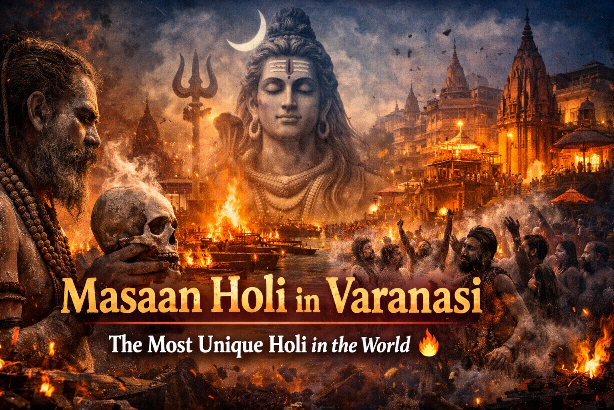
On the sacred night before Holi, the Aghori sadhus — ascetics devoted to Lord Shiva — gather at the cremation grounds. The air is filled with the sound of damru, chants of “Har Har Mahadev,” and the glow of funeral pyres.
Instead of gulal, they use ashes from the cremation pyres. This is the beginning of Masaan Holi.
🔱 The Role of Aghori Sadhus
Aghori sadhus are known for their unique spiritual practices that focus on overcoming fear, attachment, and the illusion of separation between life and death. Their philosophy teaches that everything in existence is sacred — including death.
For them, the cremation ground is not a place of sorrow but a place of truth and liberation.
Masaan Holi reflects this philosophy beautifully.
✨ Beginning of the Sacred Celebration
As night deepens and the chants grow louder, the sadhus begin their celebration. Ash is applied to the body, damrus echo across the ghats, and the atmosphere becomes charged with spiritual energy.
This Holi is not about external celebration. It is about confronting the ultimate reality of life.
And it is only the beginning of the story.
🔥 The Night of Ash and Chanting
As darkness settles over the ghats of Varanasi, the atmosphere transforms into something deeply spiritual and intense. The sound of temple bells blends with the rhythmic beats of the damru, the sacred drum associated with Lord Shiva. Chanting of “Har Har Mahadev” echoes across the river, carried by the night wind over the flowing Ganga.
At Manikarnika Ghat, funeral pyres continue to burn as they always do — silently reminding everyone of life’s ultimate truth. Yet on this night, the cremation ground does not feel heavy with sorrow. Instead, it feels alive with devotion, surrender, and acceptance.
This is the night when fear dissolves.
🌙 Why Ash Is Used Instead of Colors
In Masaan Holi, the use of ash carries deep spiritual symbolism. Ash represents the final state of the human body after death. It reminds devotees that all physical identities — wealth, status, beauty, and ego — eventually turn to ash.
Playing Holi with ash becomes a powerful spiritual message: Everything temporary fades, but the soul remains eternal.
This idea lies at the heart of Shaivite philosophy, which teaches detachment from material illusion.
🔱 Lord Shiva and the Cremation Grounds
Lord Shiva is often described as the Lord of the Cremation Grounds. Unlike other deities who reside in celestial palaces, Shiva is believed to dwell where life ends and liberation begins.
According to tradition, Shiva is beyond fear, beyond attachment, and beyond duality. Masaan Holi reflects this philosophy by celebrating in the very place most people fear — the cremation ground.
For devotees, this is not a contradiction. It is a reminder of truth.
💀 The Dance of Detachment
During Masaan Holi, Aghori sadhus and devotees dance freely, covered in ash, chanting Shiva’s name. Their celebration is not about entertainment; it is about liberation from fear and attachment.
In this moment, life and death are not seen as opposites. They are seen as parts of the same journey.
🌊 The Presence of the Ganga
The Ganga flows quietly beside the ghats, witnessing the ritual year after year. In Hindu tradition, the Ganga represents purification and spiritual release.
The combination of fire, ash, and the sacred river creates a powerful spiritual atmosphere that is unique to Kashi.
🌸 From Masaan to Rangbhari Ekadashi
Masaan Holi is only the beginning of Holi in Kashi. After the intense and deeply spiritual night at the cremation ghats, the celebration slowly transitions into the colorful and joyful Holi that the world is familiar with.
This transition is not random — it follows a beautiful spiritual sequence.
In Kashi, Holi begins in the cremation grounds and ends in the temples. It starts with ash and ends with color. It begins with detachment and ends with celebration.
This spiritual journey reflects the philosophy of Lord Shiva himself.
🌼 Rangbhari Ekadashi – The Colorful Celebration of Shiva
After Masaan Holi, the next major celebration in Kashi is Rangbhari Ekadashi. This day marks the return of Lord Shiva to Kashi with Goddess Parvati after their divine wedding.
On this day, devotees play Holi with colors inside the sacred temples of Varanasi, especially the Kashi Vishwanath Temple.
The contrast between Masaan Holi and Rangbhari Ekadashi is deeply symbolic. One represents detachment and acceptance of life’s ultimate truth, while the other represents joy, love, and celebration.
🕉️ The Philosophy Behind the Celebration
The sequence of Masaan Holi followed by Rangbhari Ekadashi reflects a powerful spiritual teaching: before celebrating life, one must understand death. Before embracing joy, one must accept impermanence.
This philosophy is unique to Kashi and makes its Holi celebration unlike any other in the world.
🌍 Why Masaan Holi Fascinates the World
Today, Masaan Holi attracts visitors, photographers, and spiritual seekers from around the globe. Many come to witness the ritual and experience the unique spiritual atmosphere of Kashi during Holi.
Despite global attention, the ritual remains deeply rooted in tradition and devotion.
Frequently Asked Questions (FAQs) ❓
1. What is Masaan Holi?
Masaan Holi is a unique Holi celebration that takes place in the cremation grounds of Varanasi. Instead of colors, ash from funeral pyres is used. This ritual reflects the spiritual philosophy of Lord Shiva and symbolizes detachment from the temporary nature of life.
2. Where is Masaan Holi celebrated?
Masaan Holi is primarily celebrated at Manikarnika Ghat and Harishchandra Ghat in Varanasi, two of the most sacred cremation grounds in India.
3. Why is Holi played with ash in Kashi?
The ash represents the ultimate truth that the physical body returns to ash. Playing Holi with ash symbolizes detachment from ego, fear, and material identity.
4. Who participates in Masaan Holi?
Aghori sadhus, Shiva devotees, and local residents participate in the celebration.
5. Is Masaan Holi dangerous or disrespectful?
No. The ritual is performed respectfully and is deeply spiritual.
6. What is the connection between Lord Shiva and Masaan Holi?
Lord Shiva is believed to reside in cremation grounds and represents detachment and liberation.
7. When does Masaan Holi take place?
It is celebrated before the main Holi festival, leading into Rangbhari Ekadashi.
8. Why does Holi in Kashi start in cremation grounds?
It reflects the philosophy that life and death are interconnected.
9. Can tourists attend Masaan Holi?
Yes, many visitors witness the celebration respectfully.
10. What makes Masaan Holi unique?
It combines spirituality, philosophy, and tradition.
✨ Conclusion 🌼
Masaan Holi is one of the most profound and unique festival traditions in the world. It begins Holi in the cremation grounds of Kashi, reminding devotees of the ultimate truth of life and the philosophy of Lord Shiva.
The journey from ash to color reflects the spiritual cycle of life, death, and renewal. Masaan Holi transforms fear into acceptance and sorrow into celebration.
🙏 हर हर महादेव 🙏





Leave a comment