



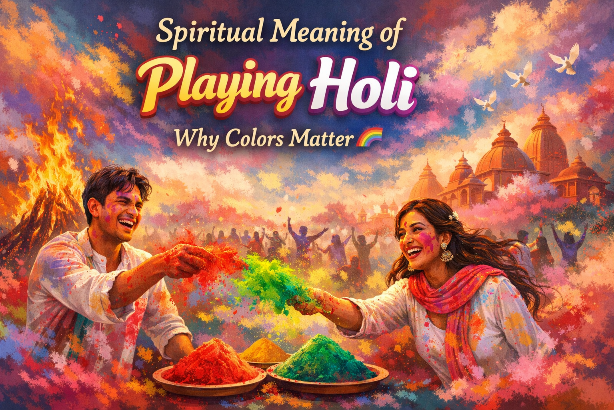
🌈 Spiritual Meaning of Playing Holi: Why Colors Matter Beyond Celebration
On the morning of Holi, something extraordinary unfolds across homes, streets, and hearts. The seriousness of everyday life dissolves. Faces are smeared with color, laughter replaces hesitation, and even long-held differences seem to fade, at least for a day. Holi feels liberating — but this liberation is not accidental. It is deeply spiritual.
While Holi is widely known as the festival of colors, its true essence lies far beyond playful fun. Playing Holi is a symbolic spiritual act rooted in centuries of philosophy, seasonal awareness, and inner transformation. Colors are not merely decorative; they are carriers of meaning, intention, and emotion.
This blog explores the spiritual meaning of playing Holi in depth — why colors are central to the festival, what they represent internally, and how Holi becomes a powerful reminder of renewal, equality, and conscious joy.
🔥 From Holika Dahan to Holi: A Spiritual Transition
The spiritual journey of Holi does not begin with colors. It begins with fire.
The night before Holi, Holika Dahan symbolizes the burning of negativity, ego, fear, and destructive tendencies. Fire represents purification — a conscious act of letting go. By the time Holi morning arrives, the inner space is considered cleansed.
Only after this symbolic cleansing does color enter the ritual.
This sequence is important. Spiritually, Holi teaches that celebration without purification is incomplete. First comes release, then comes joy. Colors represent what fills the space after negativity has been consciously burned away.
🎨 Why Colors Are Central to Holi
In spiritual philosophy, color is closely associated with energy, emotion, and expression. Colors affect the human mind instantly — they can uplift, calm, excite, or soothe. Ancient traditions understood this deeply, long before modern psychology studied color theory.
Holi uses color as a spiritual language.
When people play Holi, they are not just applying color to the body. Symbolically, they are embracing life in its full spectrum — joy, sorrow, hope, forgiveness, passion, and peace — all at once.
Holi does not ask people to choose one color. It invites them to accept all colors.
🌸 Colors as Symbols of Inner Renewal
Winter in Indian tradition is associated with stillness, introspection, and withdrawal. Spring, which Holi welcomes, represents movement, expression, and renewal.
Spiritually, playing with colors symbolizes awakening dormant energy within the self. Just as nature bursts into bloom after winter, the human spirit is encouraged to reawaken joy, creativity, and openness.
Smearing color on oneself and others becomes a symbolic declaration: “I am ready to begin again.”
🤝 Holi and the Spiritual Idea of Equality
One of the most profound spiritual meanings of Holi lies in its ability to dissolve social identity.
On Holi, distinctions of caste, status, wealth, age, and background temporarily lose relevance. When faces are covered in color, no one looks the same. Titles disappear. Hierarchies soften.
This is not accidental.
Spiritually, Holi reflects the idea that beneath external identity, all human beings share the same essence. Color equalizes because it removes the markers that divide.
For one day, the world is reminded that differences are surface-level — just like color that washes away.
💗 Forgiveness and Emotional Release
Holi has traditionally been a time for reconciliation. Old conflicts are forgotten, strained relationships are softened, and people approach each other with humility and laughter.
Spiritually, this aspect of Holi is crucial.
Playing Holi encourages emotional release. The act of laughing, touching color to another person, and being touched in return breaks emotional rigidity. It allows people to let go of resentment, pride, and emotional heaviness.
In this sense, Holi becomes a collective healing ritual.
🌞 The Joy of Conscious Celebration
Unlike festivals rooted in austerity or restraint, Holi celebrates joy openly. But this joy is not indulgent — it is conscious.
Spiritually, joy is not seen as the opposite of discipline. It is seen as a natural expression of inner balance. Holi reminds people that spirituality does not always mean silence or seriousness. Sometimes, spirituality means laughter, playfulness, and presence.
Playing Holi becomes an act of mindfulness — being fully present in color, sound, movement, and connection.
🌿 Natural Colors and Harmony with Nature
Traditionally, Holi colors were made from flowers, herbs, and natural sources. These natural colors symbolized harmony with nature and respect for the environment.
Spiritually, this reflects the idea that joy should not come at the cost of balance. Celebration and responsibility were meant to coexist.
Using natural colors was a way of aligning human celebration with the rhythms of the natural world.
🌈 Holi as a Reminder of Impermanence
One of the most subtle spiritual teachings of Holi lies in the temporary nature of color.
Colors fade. They wash away. They do not last.
This impermanence mirrors life itself. Holi gently reminds people not to cling too tightly — neither to joy nor to sorrow. Everything changes. Everything flows.
By embracing color fully and letting it go easily, Holi teaches acceptance of impermanence.
🧠 Psychological and Spiritual Integration
Modern psychology recognizes the importance of play, expression, and emotional release for mental well-being. Holi intuitively integrates these elements into a spiritual framework.
Playing Holi reduces emotional barriers, encourages human connection, and allows suppressed emotions to surface safely.
Spiritually, this integration of mind and emotion is essential for inner balance.
🎨 The Spiritual Meaning of Each Holi Color
When people play Holi, they rarely stop to think about the deeper symbolism of each color. Yet in traditional understanding, every color used during Holi carries a message. The festival becomes richer and more meaningful when we understand what these colors represent.
🔴 Red – Love, Energy, and Life
Red represents life force, vitality, and strong emotions such as love and passion. Applying red color during Holi symbolizes embracing life fully and celebrating emotional expression.
🟡 Yellow – Knowledge and Positivity
Yellow is associated with warmth, learning, and positivity. It represents optimism and new beginnings.
🟢 Green – Growth and Harmony
Green symbolizes nature, growth, and balance. It reflects renewal and the arrival of spring.
🔵 Blue – Calmness and Depth
Blue represents peace, depth, and spiritual awareness.
🟣 Purple – Creativity and Imagination
Purple symbolizes creativity and inspiration.
🌍 Holi in Modern Life
Even in modern cities, Holi continues to bring people together. It encourages connection and shared joy.
Frequently Asked Questions (FAQs) ❓
1. Why is Holi called the Festival of Colors?
Holi is called the Festival of Colors because colors symbolize joy, renewal, and the celebration of life after the symbolic burning of negativity during Holika Dahan. Playing with colors represents embracing happiness, unity, and new beginnings.
2. What is the spiritual meaning of playing Holi?
The spiritual meaning of playing Holi lies in emotional renewal, forgiveness, and equality. Colors symbolize letting go of past negativity and welcoming joy, connection, and positivity.
3. Why do people forgive and reconcile during Holi?
Holi has traditionally been a time to repair relationships and release emotional burdens.
4. Why is Holi connected to spring?
Holi marks the transition from winter to spring and symbolizes renewal.
5. What do Holi colors represent spiritually?
Each color represents different emotions and energies.
6. Is Holi only about celebration?
No, Holi has deep spiritual symbolism.
7. Why are natural colors traditionally used?
Natural colors symbolize harmony with nature.
8. What life lesson does Holi teach?
Holi teaches acceptance, joy, and renewal.
9. Can Holi be celebrated spiritually at home?
Yes, Holi can be celebrated mindfully at home.
10. Why is Holi considered a festival of unity?
Because it brings people together beyond social differences.
🌱 Conclusion ✅
The spiritual meaning of playing Holi goes far beyond colors and celebration. It is a festival of renewal, forgiveness, equality, and joy. From the burning of negativity during Holika Dahan to the vibrant celebration of colors, Holi represents the journey from reflection to happiness.
🙏 हर हर महादेव 🙏





Leave a comment