

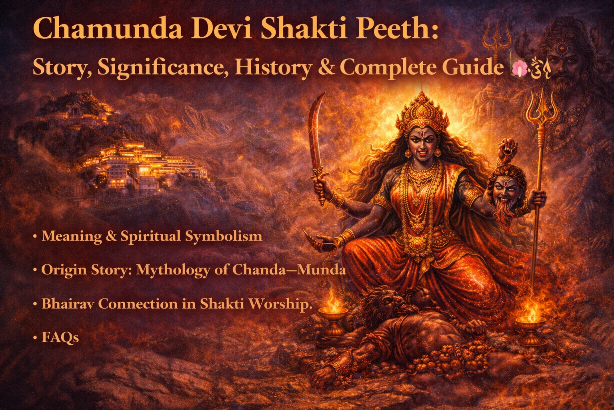
Chamunda Devi Shakti Peeth: Story, Significance, History & Complete Guide ⚔️🌺
Among the fierce and powerful forms of the Divine Mother, Maa Chamunda holds a unique place in Shakta tradition. She is remembered not as a Devi of softness, but as a Devi of protection through strength. For devotees, Chamunda Devi represents the energy that destroys negativity at its root—especially the kind of negativity that silently weakens the mind, the heart, and the spirit. ⚔️🌺
Chamunda Devi is often spoken about with deep respect because her worship carries intense symbolism. She is the Divine Feminine in her warrior form—fearless, disciplined, and unstoppable. But this strength is not meant to create fear. It is meant to create trust. Trust that the Divine Mother protects those who surrender sincerely, and removes what is harmful inside and outside the devotee’s life.
In this complete guide, we will explore Chamunda Devi Shakti Peeth meaning, mythological stories connected to Maa Chamunda, spiritual symbolism, cultural significance, the Bhairav connection in Shakti Peeth tradition, modern perspective, and a detailed FAQ section optimized for search. This blog is written responsibly in belief-based language and avoids exaggerated claims, making it beginner-friendly while still deep enough for advanced devotees.
What is Chamunda Devi Shakti Peeth? (Simple Meaning) ⚔️🌺
Chamunda Devi Shakti Peeth is a sacred Devi worship center associated with the fierce form of the Divine Mother known as Maa Chamunda. In Shakta tradition, Chamunda is worshipped as a powerful protector who destroys negativity and supports inner courage.
The name Chamunda is traditionally connected with Devi’s victory over powerful demonic forces in mythological narratives. While these stories are often described in dramatic terms, their spiritual meaning remains consistent: negative forces—whether external or internal—cannot survive where Shakti is awake.
For beginners, a simple understanding is this: Chamunda Devi is worshipped as a warrior Mother who protects devotees by destroying fear, weakness, and harmful energy through divine strength.
Why Chamunda Devi is Considered a Shakti Peeth 🌺🕉️
Shakti Peeths are sacred locations connected to the belief-based Shakti Peeth origin story linked to Sati and Shiva. According to devotional tradition, after Daksha Yagna and Sati’s sacrifice, Shiva carried Sati’s body and entered the Rudra Tandava, disturbing cosmic balance.
Vishnu intervened to restore order, and sacred locations formed where parts of Sati’s body or ornaments fell. These locations became known as Shakti Peeths—powerful centers of Devi worship.
Chamunda Devi is widely revered as a Shakti worship center in Shakta tradition and regional devotion. Whether listed directly in all classical enumerations or honored through regional belief, Chamunda Devi’s Shakti identity remains strong, respected, and spiritually intense.
The Mythological Story Behind Maa Chamunda Devi 📖⚔️
To understand Maa Chamunda, devotees often connect with her through the mythology of Devi as a warrior protector. Chamunda is commonly associated with the divine battles described in Shakta narratives where Devi destroys destructive forces that threaten balance and dharma.
One of the most well-known mythological associations is the story of Devi’s fierce manifestation against the powerful demonic forces known as Chanda and Munda. In belief-based tradition, Devi’s intense form defeats these forces, and the name “Chamunda” is connected to that victory.
The deeper meaning behind such stories is not simply about external enemies. It is about inner battles. Fear, ego, uncontrolled anger, weakness, and negativity behave like internal demons. Chamunda represents the Shakti that destroys these forces so the devotee can live with strength and clarity.
Spiritual Meaning of Maa Chamunda: Protection Through Fierce Compassion 🌺⚔️
Maa Chamunda’s spiritual meaning is often misunderstood because her form is fierce. But in Shakta understanding, fierceness can be a form of compassion. A mother who truly protects her child will fight without hesitation. Similarly, Chamunda protects devotees by removing what harms their spiritual growth.
Chamunda represents the power of discipline. She is not the Devi of excuses. She is the Devi of truth. Her worship inspires devotees to become fearless, consistent, and mentally strong.
This is why Maa Chamunda is deeply respected by devotees who are struggling with fear, emotional instability, or lack of inner courage. Her symbolism teaches a powerful lesson: spiritual strength is not given casually—it is awakened through sincere devotion and inner discipline.
Spiritual Significance of Chamunda Devi Shakti Peeth ⚔️🌺
Chamunda Devi Shakti Peeth is spiritually significant because it represents Devi’s warrior energy. In belief-based devotion, this is the Shakti that destroys negativity and strengthens the devotee from within.
Many devotees connect with Chamunda Devi when they feel mentally weak or emotionally unstable. The Devi’s symbolism inspires them to stand strong. This does not mean worship removes all problems overnight. But it does mean the devotee becomes stronger in how they face problems.
Chamunda Devi teaches spiritual seriousness. She represents the kind of devotion that does not depend on comfort. It depends on courage. And that courage becomes one of the most powerful blessings of her worship.
History & Cultural Importance of Maa Chamunda Devi 🛕⚔️
Maa Chamunda Devi holds deep cultural significance because fierce Devi worship has been a central part of Shakta traditions for centuries. Chamunda worship reflects the idea that the Divine Feminine is not only nurturing—it is also protective and warrior-like when dharma is threatened.
Over time, Chamunda Devi became widely revered in various regions of India. Her worship has been preserved through festivals, devotional songs, and regional storytelling traditions. This cultural continuity keeps Chamunda Devi devotion alive and meaningful even today.
For devotees, Chamunda is not only mythology. She is living faith. She is the belief that Divine Shakti stands between the devotee and fear.
Bhairav Connection in Chamunda Devi Tradition 🔱🖤
In many Shakti Peeth traditions, Bhairav is worshipped alongside Devi as the guardian energy. Bhairav represents discipline, spiritual boundaries, and protective seriousness. Devi represents Shakti, power, and transformation.
In the context of Chamunda worship, Bhairav symbolism becomes even more meaningful. Fierce Shakti must be approached with respect. Devotion must remain sincere, not ego-driven. Bhairav represents that discipline.
Deeper Symbolism of Maa Chamunda: The Shakti That Ends Fear ⚔️🌺
Maa Chamunda is often described as fierce, but her deeper spiritual symbolism is fearlessness. In Shakta tradition, fear is not only an emotion—it is a force that can control the mind, weaken decision-making, and destroy inner stability. Chamunda represents the Shakti that breaks this chain.
Her warrior energy is not meant to create violence. It is meant to create inner courage. It is meant to awaken the devotee’s ability to stand strong when life becomes difficult. In belief-based devotional understanding, Chamunda destroys negativity not as punishment, but as protection. She removes what harms the devotee’s spiritual growth, even if that removal feels intense.
This is why Chamunda worship is often experienced as deeply powerful. It is not only worship—it is a declaration of strength. A reminder that weakness is not destiny, and fear is not final.
What Maa Chamunda Represents Spiritually (Belief-Based Meaning) 🌺⚔️
Spiritually, Maa Chamunda represents protection, discipline, and the power to overcome negativity. Devotees often worship her when they want to build courage and mental stability.
In belief-based tradition, Chamunda is seen as the Devi who helps devotees overcome inner enemies—such as anger, ego, emotional weakness, laziness, fear, and self-doubt. These forces may look small, but over time they can silently destroy a person’s confidence and peace.
Chamunda worship symbolizes one important truth: a devotee does not need to be helpless. With devotion and discipline, a devotee can rise above negativity. The Devi becomes the spiritual representation of that rising.
Chamunda and the Inner Battle: Why Her Mythology Feels Real Today 🧠⚔️
The stories of Chanda and Munda may seem like ancient mythological events, but they carry timeless psychological meaning. In modern life, most battles are not fought on physical battlefields—they are fought inside the mind.
A person may appear successful, but internally they may fight anxiety. They may fight insecurity. They may fight emotional instability. They may fight fear of failure. These are modern forms of inner demons.
Chamunda represents the Shakti that defeats these forces. Not instantly, not magically, but through awakening inner power. When the devotee prays with sincerity, the mind becomes stronger. The emotions become more disciplined. The individual becomes more fearless. This is the realistic spiritual value of Chamunda worship.
Chamunda Devi and the Power of Boundaries: Strength With Discipline ✅🌺
One of the most underrated spiritual messages of Chamunda worship is boundaries. Chamunda represents Shakti that does not compromise with negativity. She does not negotiate with harmful energy. She ends it.
In real life, a devotee also needs boundaries. Boundaries against self-doubt. Boundaries against emotional weakness. Boundaries against negative influences. Boundaries against habits that drain life energy.
Chamunda devotion encourages these boundaries through symbolism. It reminds the devotee: protection is not always about external safety. It is also about inner discipline. When you build spiritual boundaries, fear reduces and clarity increases.
Chamunda Devi in Modern Life: Why Devotees Still Worship Her Today 🌺⚔️
Modern life has created many invisible pressures—financial stress, competitive environments, relationship instability, emotional exhaustion, and constant mental distractions. These pressures silently weaken people. Many individuals lose confidence, feel mentally heavy, or feel spiritually disconnected.
Chamunda devotion becomes meaningful because it represents power. Not external power, but inner power. It reminds devotees that their soul is not weak. It reminds them that the Divine Mother stands as protection and strength.
In belief-based devotion, people often connect with Chamunda during phases when they want mental stability and courage. Her worship becomes a reminder that strength is available—through discipline, prayer, and spiritual clarity.
Scientific & Modern Perspective: Why Fierce Devi Symbols Create Confidence ✅🧠
From a modern perspective, fierce divine symbolism can have a strong psychological impact. When a devotee visualizes a powerful divine protector, the mind experiences safety. It reduces helplessness. It increases courage.
Spiritual worship also creates a structured mental space. Prayer improves focus. It reduces mental noise. It creates emotional stability through meaning. In the modern world, meaning is one of the strongest tools for mental resilience.
Chamunda worship becomes a symbolic practice of courage. Even if someone approaches it purely culturally, the impact is clear: the mind becomes stronger when it connects with protective symbolism and disciplined devotion.
Frequently Asked Questions (FAQs) ❓
1) Why is Chamunda Devi famous?
Chamunda Devi is famous as a fierce form of the Divine Mother, worshipped for protection, courage, and destruction of negativity in Shakta tradition.
2) Is Chamunda Devi a Shakti Peeth?
Chamunda Devi is widely revered as a powerful Shakti worship center in regional devotion and Shakta tradition. Shakti Peeth lists can vary across sources.
3) What is the meaning of Maa Chamunda?
Maa Chamunda is associated with Devi’s victory over destructive forces like Chanda and Munda, symbolizing the defeat of negativity and fear.
4) What does Maa Chamunda represent spiritually?
Spiritually, Maa Chamunda represents protection, courage, discipline, and the power to overcome inner negativity (belief-based meaning).
5) Why is Chamunda Devi worship considered powerful?
Because her symbolism represents fearless Shakti, helping devotees build inner strength and emotional stability through devotion.
6) Is Chamunda Devi worship suitable for beginners?
Yes. Beginners can worship Maa Chamunda through simple prayer and sincere devotion without complex rituals.
7) What do devotees pray for at Chamunda Devi temple?
Devotees commonly pray for protection, courage, clarity, and strength to overcome fear and negativity (belief-based).
8) Is Chamunda Devi connected with Durga or Kali?
Chamunda Devi is often understood as a fierce aspect within Devi traditions connected with Durga’s warrior symbolism in Shakta worship.
9) What is the deeper meaning of Chanda and Munda story?
The deeper meaning is the defeat of destructive inner forces like ego, fear, anger, and negativity through Shakti and discipline.
10) Does Chamunda worship remove fear instantly?
No. Worship is a belief-based spiritual practice that supports courage over time rather than instant guarantees.
11) What is the role of Bhairav in fierce Devi worship?
Bhairav represents discipline, boundaries, and spiritual seriousness, balancing Devi’s intense protective Shakti.
12) What makes Chamunda worship different from gentle Devi forms?
Chamunda worship focuses on fearless protection and destruction of negativity, symbolizing strength and inner discipline.
13) Can Chamunda Devi be worshipped at home?
Yes. Devotees can worship through prayer, naam-jap, and sincere devotion at home respectfully.
14) Why do fierce Devi forms feel emotionally intense?
Because they represent protection and fearlessness, creating a strong psychological sense of safety and courage in devotees.
15) What is the main message of Maa Chamunda worship?
The main message is fearless devotion—Shakti destroys negativity and awakens inner courage, discipline, and stability.
⚔️ Conclusion 💫
Maa Chamunda is the Shakti of Fearlessness, Protection & Inner Discipline
Chamunda Devi is revered as one of the most powerful and fearless forms of the Divine Mother. Rooted in Shakta mythology and preserved through centuries of devotion, Maa Chamunda represents protection through strength and transformation through discipline.
When approached with sincere devotion, Chamunda worship becomes a path of inner courage. It inspires the devotee to defeat fear, remove negativity, and stand stable in truth. In modern life, where the mind often feels overwhelmed, Maa Chamunda remains a timeless reminder: Shakti is not only comfort—Shakti is the power that makes you fearless from within.
🙏 हर हर महादेव 🙏





Leave a comment