




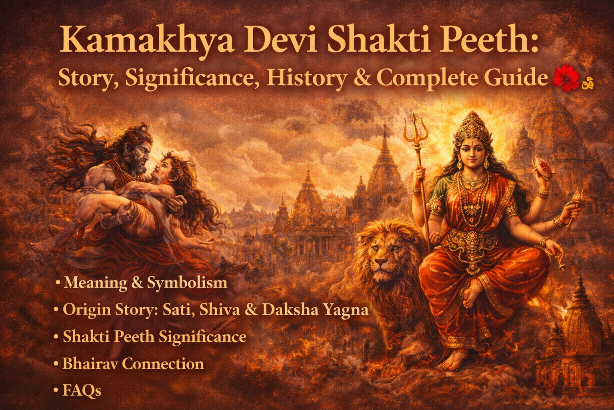
Kamakhya Devi Shakti Peeth: Story, Significance, History & Complete Guide 🌺🔥
Among all the sacred Shakti Peeths in Sanatan Dharma, Kamakhya Devi holds a place that feels both powerful and mysterious. Devotees often describe Kamakhya not only as a temple, but as a spiritual experience—one that carries intensity, depth, and a sense of connection with the most primal form of the Divine Feminine. 🌺
For some, Kamakhya Devi is a symbol of creation and Shakti. For others, it represents protection, inner transformation, and the awakening of spiritual strength. And for advanced seekers, Kamakhya is one of the rare centers where Shakti worship is understood in its deepest meaning—beyond rituals, into symbolism, consciousness, and life energy itself.
In this complete guide, we will explore Kamakhya Devi Shakti Peeth meaning, the mythological origin story connected to Shakti Peeth tradition, the spiritual significance of Devi Kamakhya, historical and cultural importance, and the deeper symbolism that makes Kamakhya one of the most revered Shakti centers in Bharat. This blog is written in a responsible and respectful tone—without exaggerated claims—and is designed to be beginner-friendly while still offering advanced depth.
What is Kamakhya Devi Shakti Peeth? (Simple Meaning) 🌺
Kamakhya Devi Shakti Peeth is one of the most famous and spiritually significant Shakti Peeths of India. In Shakta tradition, it is regarded as a major seat of Devi Shakti, where the Divine Feminine is worshipped in a form that represents creation, desire, and the raw power of life itself.
The name “Kamakhya” can be understood through the lens of desire and divine intention. In belief-based tradition, Kamakhya is linked with the power that generates life, sustains transformation, and maintains the energy of creation. This makes Kamakhya Devi different from many other Devi temples where Devi is primarily worshipped in protective or warrior forms.
It is important to note that “desire” in Shakta understanding is not automatically viewed as weakness. Kamakhya represents the purified and divine dimension of desire—the force that moves existence forward when aligned with dharma and spiritual awareness.
Why Kamakhya Devi is Considered a Shakti Peeth 🌺🕉️
Kamakhya is widely recognized as a Shakti Peeth due to its connection with the mythological Shakti Peeth origin story involving Sati and Shiva. In traditional belief, Shakti Peeths are sacred locations associated with Sati’s body parts or ornaments after the cosmic events following Daksha Yagna.
Kamakhya Devi, according to popular Shakti Peeth belief, is associated with a deeply symbolic aspect of Devi Shakti that represents the foundation of life energy and creation. Because of this, Kamakhya is often spoken of as a Shakti center that reflects the most intense and primal dimension of the Divine Feminine.
This association is always understood in a devotional and symbolic framework. The purpose is not sensationalism, but spiritual meaning—Kamakhya stands for the power that creates life, transforms consciousness, and awakens inner strength.
The Mythological Story Behind Kamakhya Shakti Peeth 📖🔥
To understand Kamakhya fully, we must connect it to the larger Shakti Peeth story. In belief-based Hindu mythology, the Shakti Peeths originate from the intense narrative of Daksha Yagna, Sati’s sacrifice, and Shiva’s cosmic grief.
The story begins when Daksha, a powerful king and Sati’s father, performs a grand yagna and intentionally disrespects Shiva by not inviting him. Sati, unable to tolerate the insult toward her husband, reaches the yagna and confronts the situation. When the disrespect continues, Sati sacrifices herself into the yagna fire.
Shiva, upon learning about this, becomes overwhelmed with grief and enters a cosmic state of destruction known as the Rudra Tandava while carrying Sati’s body. The universe begins to lose balance. To restore stability, Vishnu intervenes and, as per mythological tradition, separates Sati’s body—causing sacred locations to form where parts of her body or ornaments fell. These locations are honored as Shakti Peeths.
Kamakhya Devi is seen as one of the most significant of these sacred Shakti centers. What makes this story so powerful is not just the drama—it is the spiritual message: devotion cannot be insulted by ego, and Shakti continues to exist everywhere, even after loss and destruction.
The Spiritual Meaning of Kamakhya Devi: Shakti as Creation & Transformation 🌺✨
Kamakhya Devi is often understood as a form of Shakti connected with creation—the energy that makes life possible. In Shakta philosophy, Shakti is not separate from reality. Shakti is the living force behind everything that moves, grows, transforms, and evolves.
Kamakhya symbolizes this creative force in its raw truth. Where some Devi forms inspire protection and courage, Kamakhya inspires the understanding of life energy itself. This makes Kamakhya worship deeply meaningful for those who want to understand spirituality beyond surface-level comfort.
In belief-based devotion, Kamakhya also reflects the idea that spiritual life is not about escaping existence—it is about understanding existence with purity. When desire is uncontrolled, it becomes bondage. When desire is purified and guided, it becomes purposeful movement toward growth.
That is why Kamakhya Devi is respected not just as a temple tradition, but as a philosophical symbol of Shakti.
Kamakhya Devi and the Power of the Divine Feminine 🌺🕉️
Across Hindu tradition, Devi is worshipped in many forms: Durga as protection, Kali as transformation, Saraswati as wisdom, Lakshmi as prosperity, and Parvati as love and stability. Kamakhya holds a unique place because it represents the feminine divine in a deeply foundational way.
Kamakhya worship reminds devotees that the Divine Feminine is not secondary. It is not “supporting energy.” It is the core energy of life. Without Shakti, even Shiva is described as stillness. With Shakti, Shiva becomes dynamic consciousness.
This is why Shakta tradition often expresses a profound truth through symbolism: Shiva without Shakti is pure consciousness, but Shakti gives movement, creation, and expression. Kamakhya embodies that movement.
History & Cultural Significance of Kamakhya Devi 🛕
Kamakhya Devi has been a deeply respected worship center for centuries. It is not only known for its spiritual intensity, but also for how it preserves Shakta tradition in a strong and living form. Over time, Kamakhya became closely associated with deep Devi worship practices and cultural devotion across Eastern India and beyond.
The temple is often seen as a spiritual landmark because it represents the continuity of Shakti worship. Many generations of devotees have carried the Kamakhya tradition forward through rituals, storytelling, and sincere bhakti.
In modern times, Kamakhya continues to attract both devotees and spiritual seekers. Some come with pure devotion, while others come to understand the deeper symbolism of Shakti. This balance makes Kamakhya one of the most unique Shakti Peeths in the broader map of Devi worship.
Kamakhya Devi Worship: A Pure Devotional Perspective 🪔🌺
Kamakhya Devi worship is often described as intense, but intensity does not mean fear. It means sincerity. Kamakhya is a temple where devotion feels direct and powerful. For many devotees, it becomes a place to build inner strength, mental stability, and spiritual grounding.
In a pure bhakti approach, devotees connect with Kamakhya through simple prayer, surrender, and respect. They remember Devi as a mother, a protector, and the power behind creation. They seek blessings for courage, clarity, and spiritual growth.
For beginners, the most important guideline is to keep devotion simple. The Divine does not demand complexity. The Divine responds to sincerity.
Bhairav Connection in Kamakhya Shakti Tradition 🔱🖤
In Shakti Peeth tradition, Bhairav is often worshipped as the guardian energy connected with Devi. This spiritual pairing is deeply meaningful. Devi represents power, while Bhairav represents discipline and protection. Together, they form balance.
Kamakhya’s Shakta environment often reflects this idea: spiritual energy must be handled with respect, boundaries, and humility. Bhairav energy is the reminder that devotion should not become ego-driven, and spiritual practice should not become careless.
Kamakhya Devi’s Deeper Symbolism: Understanding Shakti Beyond the Surface 🌺✨
Kamakhya Devi is not only worshipped as a powerful goddess—she is understood as a profound symbol of how Shakti works in life. Many spiritual traditions focus only on “removing problems” or “getting blessings,” but Kamakhya worship often invites a deeper reflection: what is the energy behind creation, emotion, desire, and transformation?
In Shakta philosophy, Shakti is the force that makes everything possible. The same power that creates a universe also creates a human intention. The same power that transforms nature also transforms a seeker’s mind. Kamakhya reminds devotees that spiritual growth is not always gentle. Sometimes, it is intense. Sometimes, it requires inner strength. And sometimes, it requires truth.
This is why Kamakhya is often called one of the most spiritually “alive” Shakti centers. Not because it creates instant miracles, but because it represents Shakti in her most foundational role: the energy of existence itself.
What Kamakhya Devi Represents Spiritually (Belief-Based Meaning) 🌺🕉️
For many devotees, Kamakhya Devi represents three major spiritual themes: creation, transformation, and inner power. These themes are not only religious concepts—they are life realities.
Creation is not just about giving birth. It is about creating decisions, creating discipline, creating stability, and creating a life direction. Transformation is not just about changing externally. It is about changing the mind, habits, emotional patterns, and inner energy. Inner power is not about dominating others. It is about standing strong when life becomes uncertain.
In belief-based devotional understanding, Kamakhya Devi worship supports these qualities by strengthening the devotee’s inner courage, improving spiritual focus, and building deeper self-awareness. This is why Kamakhya attracts not only devotees but also serious spiritual seekers who want to understand Shakti as an inner experience—not just a temple visit.
Kamakhya Devi and the Concept of Sacred Feminine Energy 🌺🔥
In many modern conversations, “feminine energy” is treated like a trend. But in Shakta tradition, the sacred feminine is an ancient, serious, and deeply philosophical reality. Kamakhya Devi embodies that reality in its most direct form.
The Divine Feminine is not only loving and nurturing. It is also powerful, intense, and transformative. It protects, it creates, it destroys illusions, and it rebuilds truth. Kamakhya worship reminds devotees that Shakti is not weak energy. Shakti is the energy that gives life its direction and momentum.
This is why devotees approach Kamakhya with deep respect. It is not a casual place for devotion. It is a sacred space where the language of worship is sincerity.
Devotion at Kamakhya: The Role of Faith, Discipline, and Respect 🪔✅
One of the most important teachings Kamakhya offers is that Shakti must be approached with discipline. In Shakta tradition, the power of Devi worship does not depend on dramatic rituals—it depends on the devotee’s sincerity, respect, and inner stability.
Kamakhya reminds devotees that spiritual power is not entertainment. It is responsibility. This is why Shakti Peeths often include the Bhairav connection: Bhairav represents spiritual boundaries, seriousness, and protection.
For beginners, the best devotional approach is always simple: prayer, surrender, and consistency. Complicated rituals are not needed unless a devotee is guided properly through a tradition.
Kamakhya Devi in Modern Life: Why This Shakti Peeth Still Matters 🧠🌺
Even in the modern world, Kamakhya Devi remains relevant because the problems of the mind remain the same: fear, confusion, emotional imbalance, lack of direction, and inner weakness during difficult phases. People may live in a modern world, but the inner struggle is timeless.
Shakti worship, when approached responsibly, becomes a powerful mental anchor. It creates stability. It creates emotional courage. It reminds a devotee that they are not powerless.
Kamakhya stands as a spiritual symbol of that power. It tells a devotee: life is intense, but you can become stronger. Your mind may feel overwhelmed, but devotion can give clarity. Your emotions may feel heavy, but Shakti is transformation itself.
Scientific & Modern Perspective: Why Shakti Centers Feel Powerful ✅🧠
From a modern perspective, places like Kamakhya can be understood through the lens of sacred psychology and collective devotion. When a place is worshipped for centuries, it develops cultural and emotional weight. People arrive with deep belief, personal stories, prayers, and hope. That creates an atmosphere that feels intense even to those who are not deeply religious.
Rituals create structure and focus. Temple environments encourage silence and reflection. The mind becomes more present. This can naturally make devotees feel calmer, more grounded, or emotionally lighter.
None of this requires miracle claims. The power of sacred spaces can be understood as the powerful meeting point of belief, tradition, and inner attention—especially when supported by community devotion.
Frequently Asked Questions (FAQs) ❓
1) Why is Kamakhya Devi Shakti Peeth famous?
Kamakhya Devi is famous because it is one of the most revered Shakti Peeths and is strongly associated with intense Shakti worship and deep spiritual symbolism.
2) What is Kamakhya Devi known for spiritually?
Spiritually, Kamakhya Devi is associated with creation, transformation, and inner power in Shakta tradition (belief-based understanding).
3) Is Kamakhya Devi a Shakti Peeth?
Yes, Kamakhya Devi is widely recognized as a major Shakti Peeth in popular and devotional tradition.
4) What is the mythological story behind Kamakhya Shakti Peeth?
Kamakhya’s Shakti Peeth connection is linked to the Sati–Shiva origin story, where Shakti Peeths formed after the events of Daksha Yagna and Shiva’s tandava.
5) What does Kamakhya Devi represent?
Kamakhya Devi represents the Divine Feminine as the living power of creation and transformation, inspiring inner courage and spiritual focus.
6) Is Kamakhya worship connected with Tantra?
Some traditions connect Kamakhya with tantric worship systems, while many devotees follow purely bhakti-based worship respectfully.
7) Can beginners worship Kamakhya Devi?
Yes, beginners can worship Kamakhya Devi through simple prayer, devotion, and respect without needing complex rituals.
8) Is Kamakhya Devi associated with Shiva?
Yes, Kamakhya is connected to the broader Shakti Peeth tradition linked to Shiva and Sati in Hindu mythology.
9) Why is Bhairav important in Shakti Peeth worship?
Bhairav represents the guardian and disciplined aspect of spiritual energy in Shakti Peeth traditions, balancing Devi’s power with protection and boundaries.
10) What is the spiritual message of Kamakhya Devi?
The spiritual message is that Shakti is the power behind creation and transformation, and devotion builds inner strength and clarity.
11) Is Kamakhya Devi only about “desire” worship?
No. In Shakta understanding, Kamakhya represents divine life energy, where desire becomes purified and aligned with spiritual awareness.
12) What makes Kamakhya different from other Devi temples?
Kamakhya is considered uniquely intense because it represents Shakti in a deeply foundational way—creation, energy, and transformation.
13) Can Kamakhya worship be done at home?
Devotees can connect with Devi through prayer and devotion at home, though temple traditions have their own sacred practices.
14) What is the best way to approach Kamakhya Devi devotion?
The best approach is sincerity, respect, discipline, and steady devotion without fear or unnecessary complexity.
15) What is the main takeaway from Kamakhya Devi Shakti Peeth?
The main takeaway is that Shakti is transformation itself—devotion awakens courage, clarity, and spiritual strength within the seeker.
🍃 Conclusion 🌺
Kamakhya Devi is Shakti in Her Most Foundational Form
Kamakhya Devi Shakti Peeth holds a rare spiritual position in Shakta tradition because it represents the Divine Feminine not only as a protector, but as the very power behind creation and transformation. Rooted in the mythological Shakti Peeth origin story and preserved through centuries of devotion, Kamakhya remains a sacred reminder that Shakti is not separate from life—Shakti is life itself.
For devotees, Kamakhya worship becomes meaningful when approached with respect, discipline, and sincerity. The temple’s spiritual identity teaches a powerful lesson: inner strength is not something you “receive” instantly—it is something that awakens through devotion, truth, and spiritual seriousness.
🙏 हर हर महादेव 🙏





Leave a comment