

















Chaitra Navratri: Meaning, History, Rituals & Spiritual Significance 🌺🕉️
Chaitra Navratri marks one of the most profound yet understated spiritual periods in the Hindu calendar. Observed during the lunar month of Chaitra, it coincides with the arrival of spring—a season of renewal, regeneration, and awakening. Unlike the grand and socially vibrant celebrations of Sharad Navratri, Chaitra Navratri unfolds quietly, emphasizing discipline, inward focus, and conscious realignment with nature’s rhythm.
This Navratri is not about external celebration. It is about internal preparation. Ancient Hindu wisdom recognized that seasonal transitions deeply influence the human body, mind, and emotions. Chaitra Navratri was established as a sacred window to stabilize these shifts and consciously guide one’s energy toward clarity and balance.
What Is Chaitra Navratri? 🌺
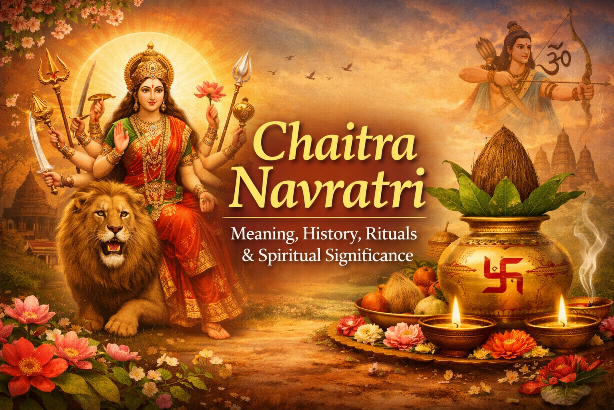
Chaitra Navratri is a nine-day spiritual observance dedicated to Goddess Durga and her nine manifestations, collectively known as Navadurga. It begins on the first day of the Shukla Paksha (waxing moon) of the Chaitra month and concludes on Ram Navami, the birth anniversary of Lord Rama.
Traditionally, this Navratri is observed with simplicity, restraint, and devotion. The focus remains on fasting, prayer, mantra chanting, and inner discipline rather than outward festivity. In many spiritual households, Chaitra Navratri is considered the true spiritual beginning of the year.
Why Chaitra Navratri Is Spiritually Significant 🌱
Spring represents transition. As the climate shifts, digestion changes, metabolism fluctuates, and emotional sensitivity often increases. Ancient sages referred to such transitional phases as sandhi kaal—periods when imbalance is more likely to arise.
Chaitra Navratri acts as a stabilizing anchor during this time. Through disciplined practices such as fasting, controlled routines, and spiritual reflection, individuals align themselves with the changing environment rather than resisting it. This alignment reduces inner turbulence and supports clarity.
Chaitra Navratri and Seasonal Transition (Sandhi Kaal) ⏳
In Hindu philosophy, sandhi kaal is not seen as dangerous but as sensitive. Sensitivity implies potential—both for imbalance and for growth.
Chaitra Navratri is strategically placed during this sandhi kaal to help practitioners recalibrate. Food habits are simplified, sensory indulgence is reduced, and awareness is heightened. These measures help the body and mind adapt smoothly to seasonal change.
Rather than reacting to environmental shifts unconsciously, Chaitra Navratri encourages conscious participation.
Mythological Roots of Chaitra Navratri 🔱
Mythologically, Navratri commemorates the victory of Goddess Durga over Mahishasura. While the story is often narrated as a battle between good and evil, its deeper meaning lies in the conquest of imbalance.
Mahishasura represents uncontrolled impulses—sometimes aggressive, sometimes lethargic. Durga represents integrated strength—alert, disciplined, and aware. Chaitra Navratri symbolizes the awakening of this inner Durga at the beginning of a new cycle.
The nine nights signify progressive refinement of consciousness rather than a one-time triumph.
Connection Between Chaitra Navratri and Ram Navami 🕉️
Chaitra Navratri concludes with Ram Navami, celebrating the birth of Lord Rama. This sequence is deeply symbolic.
Durga represents the raw spiritual energy required for transformation, while Rama represents dharma—balanced living guided by ethics, responsibility, and restraint. The progression from Durga worship to Rama’s birth emphasizes that spiritual power must be guided by righteousness.
Chaitra Navratri thus prepares the seeker not only to awaken energy, but to live wisely with it.
Navadurga Worship During Chaitra Navratri 🌸
Each day of Chaitra Navratri is dedicated to one form of the Goddess, beginning with Shailaputri and culminating with Siddhidatri.
These forms are not merely mythological identities. They represent stages of inner development—grounding, strength, discipline, compassion, focus, and ultimately wisdom. Worshipping Navadurga sequentially reflects a structured inner journey.
This progression makes Chaitra Navratri especially suitable for personal transformation.
Kalash Sthapana: Inner Meaning & Symbolism 🪔
Chaitra Navratri begins with Kalash Sthapana, the installation of a sacred pot symbolizing the womb of creation.
The Kalash represents containment, stability, and potential. Placed at the center of the worship space, it reflects the need for grounding before growth. Without stability, energy becomes chaotic.
This ritual silently teaches patience and discipline—qualities essential for sustained spiritual progress.
Fasting During Chaitra Navratri: Balance, Not Denial 🍃
Fasting during Chaitra Navratri is often misunderstood as deprivation. In reality, it is a method of recalibration.
Simplifying food intake reduces digestive stress during seasonal change and supports mental clarity. It also strengthens self-awareness by breaking habitual consumption patterns.
Fasting, when practiced mindfully, becomes a tool for balance rather than hardship.
Chaitra Navratri as a Time for Sankalp (Inner Intention) 🧠
Chaitra Navratri is traditionally regarded as the spiritual beginning of the year. During this time, many devotees take sankalp—a conscious inner commitment.
Sankalp is not a wish but a direction. It aligns intention with discipline, ensuring that growth is purposeful rather than accidental.
This practice reinforces accountability and sets the tone for the months ahead.
Chaitra Navratri as an Inner Recalibration of the Mind 🧘♀️
Chaitra Navratri functions as a powerful psychological reset embedded within spiritual practice. Over the course of daily life, the mind gradually accumulates restlessness, emotional residue, unexamined desires, and habitual reactions. These layers do not disappear on their own; they solidify into patterns. Chaitra Navratri creates a deliberate pause in this momentum.
The disciplines followed during these nine days—early rising, simplified food, reduced stimulation, repetition of mantra—gently interrupt unconscious behavior. This interruption is not abrupt or forceful. Instead, it creates space for observation. The mind begins to notice its own tendencies, reactions, and distractions.
In this way, Chaitra Navratri is less about devotion as belief and more about devotion as awareness.
Why Discipline Is Central to Chaitra Navratri 🔥
Discipline during Chaitra Navratri is often misunderstood as restriction. In reality, it is the restoration of order. When energy lacks structure, it becomes scattered. When discipline is introduced, energy gains direction.
The practices of Navratri are intentionally repetitive. Repetition builds stability. Stability builds clarity. This is why Chaitra Navratri emphasizes consistency rather than intensity. Small acts performed daily reshape the nervous system far more effectively than occasional extremes.
This discipline is not imposed by authority; it is chosen as a conscious alignment with inner balance.
Chaitra Navratri and the Awakening of Shakti 🌺
Shakti, in Hindu philosophy, is not an external force waiting to be summoned. It is the latent energy present within every individual. Chaitra Navratri symbolizes the awakening of this dormant potential.
Spring represents outward movement in nature, and Shakti mirrors this expansion inwardly. Through worship of the Goddess, the practitioner aligns with growth that is guided rather than impulsive.
The nine forms of Durga worshipped during Chaitra Navratri represent stages of energy refinement—from raw potential to conscious strength.
Why Chaitra Navratri Is Observed Every Year ⏳
If spiritual clarity were permanent, repetition would be unnecessary. However, human awareness naturally fluctuates. Just as physical fitness requires regular maintenance, mental and emotional balance must be renewed.
Chaitra Navratri returns annually as a reminder rather than a milestone. It does not promise permanent transformation; it offers recalibration.
This annual rhythm prevents spiritual practice from becoming rigid, mechanical, or forgotten.
Chaitra Navratri and Simplicity of Living 🍃
One of the most overlooked aspects of Chaitra Navratri is its emphasis on simplicity. Simplicity reduces friction. When fewer inputs demand attention, awareness naturally deepens.
By minimizing indulgence, the practitioner experiences how little is actually required for stability. This insight often extends beyond the festival, influencing daily choices long after Navratri ends.
Simplicity, in this context, becomes a gateway to clarity rather than austerity.
Chaitra Navratri and the Integration of Devotion & Awareness 🕉️
Chaitra Navratri does not separate devotion from understanding. Ritual without awareness becomes habit; awareness without devotion lacks depth.
By combining structured worship with disciplined living, Chaitra Navratri integrates both dimensions. The deity becomes a symbol of alignment rather than an external authority.
This integration is what makes Chaitra Navratri spiritually sustainable rather than emotionally overwhelming.
Frequently Asked Questions (FAQs) ❓
1. Is Chaitra Navratri more important than Sharad Navratri?
No. Chaitra Navratri focuses on initiation and renewal, while Sharad Navratri focuses on consolidation and strength.
2. Is fasting compulsory during Chaitra Navratri?
No. Fasting is a supportive practice, not an obligation. Awareness matters more than form.
3. Can Chaitra Navratri be observed mentally?
Yes. Conscious discipline and inner restraint are as effective as external ritual.
4. Why does Chaitra Navratri end with Ram Navami?
It symbolizes the transition from awakened energy (Shakti) to righteous living (Dharma).
📌 Conclusion 🌼
Chaitra Navratri as a Foundation of Conscious Living
Chaitra Navratri is not a festival meant to impress the senses. It is a discipline meant to realign awareness.
By synchronizing inner practice with seasonal transition, it offers a sustainable method for restoring balance, clarity, and direction. The worship of the Goddess during this time is symbolic of awakening strength that is guided by restraint, insight, and responsibility.
When observed with understanding, Chaitra Navratri becomes more than nine sacred days—it becomes a foundation for conscious living throughout the year.
🙏 हर हर महादेव 🙏





Leave a comment