


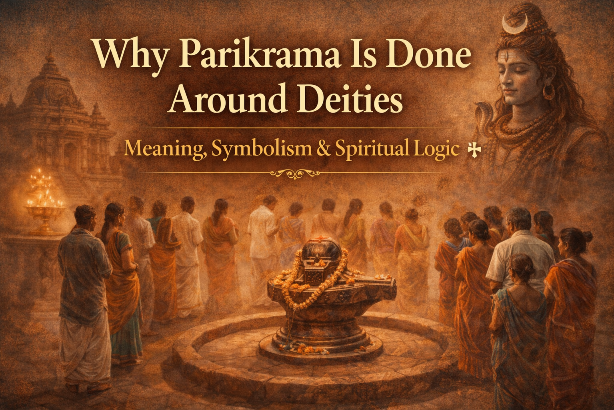
Why Parikrama Is Done Around Deities: Meaning, Symbolism & Spiritual Logic 🛕
In almost every Hindu temple, one simple action is performed instinctively by devotees—walking slowly around the deity in a circular path. This act, known as Parikrama or Pradakshina, is so deeply embedded in worship that most people perform it without ever questioning why.
Yet Parikrama is not a casual tradition or a ritual habit. It is a carefully preserved spiritual practice that communicates profound truths about orientation, humility, awareness, and the relationship between the individual and the sacred.
To understand why Parikrama is done around deities, one must look beyond physical movement and explore the inner movement it is designed to create.
Parikrama: More Than Walking in a Circle ⭕
At a surface level, Parikrama appears to be a simple act of walking around a sacred object. But in spiritual symbolism, movement always carries meaning.
The circular path of Parikrama represents completeness. Unlike straight lines, circles have no beginning and no end. By walking in a circle around the deity, the devotee symbolically steps into a space where linear thinking—past and future, desire and fear—begins to dissolve.
Parikrama gently withdraws the mind from goal-oriented movement and brings it into a rhythm of presence.
Why the Deity Remains at the Center 🍃
In Parikrama, the devotee moves, while the deity remains still.
This arrangement is deeply intentional. It reflects a fundamental spiritual truth: life moves, circumstances change, and the world remains in constant motion—but awareness remains steady.
By keeping the deity at the center and moving around it, the devotee learns to place awareness, values, or the divine principle at the core of life, allowing all actions to revolve around it.
Symbolism of the Circular Path 🔄
The circular movement of Parikrama mirrors the cyclical nature of existence. Birth, growth, decay, and renewal repeat endlessly.
When a devotee performs Parikrama, they symbolically acknowledge this cycle without attempting to escape it. Instead of resisting change, the devotee learns to move harmoniously within it.
This is why Parikrama is not hurried. It is slow, deliberate, and mindful—an embodied meditation.
Why the Movement Is Clockwise 🔃
Parikrama is traditionally performed in a clockwise direction. This direction aligns with the apparent movement of the sun across the sky, symbolizing harmony with cosmic order.
Clockwise movement represents alignment with natural rhythms rather than resistance to them. It subtly trains the mind to flow with life instead of pushing against it.
This alignment reinforces the idea that spiritual growth does not require force, but attunement.
Parikrama as an Act of Humility 🌱
Walking around sacred place automatically places the devotee in a position of humility. The act silently acknowledges that one’s life does not revolve around the ego, but around something greater.
This humility is not submission; it is alignment. By physically circling the deity, the devotee symbolically steps out of self-centeredness.
Parikrama becomes a physical reminder that awareness, truth, or the divine must remain central—while the individual learns to orbit with grace.
The Psychological Impact of Repetitive Sacred Movement 🧠
From a psychological perspective, repetitive circular movement has a calming effect on the mind. It reduces mental noise, stabilizes attention, and brings rhythm to thought.
Unlike random movement, Parikrama is structured and intentional. This structure gently guides the mind toward stillness without effort.
Over time, this practice conditions the mind to associate calmness with presence rather than stimulation.
Parikrama as Moving Meditation 🧘♀️
For many devotees, Parikrama becomes a form of moving meditation.
There is no external goal—no destination to reach. The act itself is complete. This trains the mind to find fulfillment in process rather than outcome.
In a world obsessed with achievement, Parikrama offers a rare spiritual counterbalance: movement without ambition.
Parikrama and the Gradual Dissolution of Ego 💫
At its deepest level, Parikrama is not about the deity alone—it is about the devotee’s relationship with the self. Ego thrives on centrality. It wants to stand at the center of experience, interpreting everything in relation to “me.” Parikrama quietly reverses this tendency.
When a devotee walks around the deity, the physical body accepts a secondary position. The center is no longer the self, but the sacred principle represented by the deity. This repeated bodily action slowly reshapes inner orientation. Without intellectual struggle or forced discipline, Parikrama trains the mind to let go of self-importance.
Over time, this simple ritual teaches one of spirituality’s most difficult lessons: peace arises not from being at the center, but from aligning with something greater than oneself.
Why Parikrama Is Often Done an Odd Number of Times 🧭
Many devotees perform Parikrama an odd number of times—three, five, or seven—without fully knowing why. Symbolically, odd numbers represent continuity rather than closure.
Even numbers suggest completion and symmetry, while odd numbers keep movement open-ended. Spiritually, this reflects the idea that awareness is never finished or perfected. Growth remains ongoing.
By completing Parikrama in odd counts, the devotee affirms humility—the understanding that the spiritual journey is not something one “finishes,” but something one lives.
Outer Parikrama and Inner Orientation ✨
While physical Parikrama is visible, its real purpose is inward.
The external act is a training tool. With repetition, it gradually becomes an inner habit—placing awareness at the center of thought, decision, and emotion.
In this sense, Parikrama continues even after leaving the temple. Life itself becomes a form of circumambulation, where actions, responsibilities, and relationships are guided by conscious values rather than impulse.
Parikrama as Acceptance of Life’s Cycles 🕉️
The circular motion of Parikrama mirrors the structure of existence itself. Life does not move in straight lines. It moves through cycles—success and failure, joy and sorrow, gain and loss.
Parikrama teaches acceptance of this rhythm. Instead of resisting change, the devotee learns to move with it while remaining inwardly steady.
This acceptance does not create passivity; it creates resilience. When one understands that cycles are natural, emotional turbulence loses its power.
Why Parikrama Is Done Slowly and Mindfully ✅
Speed creates distraction. Slowness creates awareness.
Parikrama is traditionally performed at a measured pace because haste carries the mind outward. Slowness brings it inward. Each step becomes intentional, each movement deliberate.
This mindful pacing transforms Parikrama into a form of embodied meditation, where the body participates in calming the mind.
Parikrama and the Training of Attention 🧠
Modern life fragments attention. The mind jumps rapidly between stimuli, rarely settling.
Parikrama counteracts this fragmentation by offering a simple, repetitive, sacred pattern. Attention gently anchors itself to movement, breath, and presence.
Over time, this practice strengthens concentration without strain, making it easier to remain attentive even outside ritual settings.
Frequently Asked Questions (FAQs) ❓
1. Is Parikrama mandatory in worship?
No. Parikrama is not compulsory. It is a supportive practice designed to cultivate awareness, humility, and inner alignment.
2. Can Parikrama be done mentally?
Yes. When physical movement is not possible, inner Parikrama—mentally placing awareness at the center—serves the same purpose.
3. Is Parikrama only for temples?
No. The principle of Parikrama applies to life itself, where actions revolve around values rather than ego.
4. Why is Parikrama repeated daily by some devotees?
Repetition reinforces orientation. Like any discipline, consistency deepens its effect.
📌 Conclusion 🌀
Parikrama as a Way of Living
Parikrama is not merely a ritual performed in temples; it is a philosophy expressed through movement.
By walking around the deity, the devotee learns to place awareness at the center of life. Ego steps aside. Attention becomes steady. Action aligns with meaning.
In a world that constantly urges individuals to place themselves at the center, Parikrama offers a quiet but radical alternative: let life revolve around awareness, truth, and humility.
When understood deeply, Parikrama transforms from a ritual gesture into a way of living—calm, balanced, and consciously aligned.
🙏 Har Har Mahadev 🙏





Leave a comment