

















Why Every Shakti Peeth Has a Bhairav: The Hidden Shiva–Shakti Balance Explained 🔱🖤
If Shakti represents power, movement, and intensity, then an important question naturally arises: Who regulates this power?
The answer, deeply rooted in Hindu spiritual logic, is Bhairav. This is why every Shakti Peeth—without exception—is associated with a Bhairav. His presence is not symbolic of fear or punishment, but of balance, discipline, and responsibility.
This blog explains the hidden logic behind Bhairav’s presence at Shakti Peeths. We will explore mythology, philosophy, and symbolism to understand why Shakti is never left unguarded, and why Shiva manifests as Bhairav wherever divine energy becomes intense. All explanations are belief-based, responsible, and written to be easily understood by beginners while remaining meaningful for advanced readers.
Who Is Bhairav? (Beyond Fear-Based Misunderstandings) 🔱
Bhairav is a fierce manifestation of Shiva, but fierceness here does not mean cruelty. Bhairav represents time (Kaal), discipline, boundaries, and moral order.
Where Shiva is awareness and Shakti is energy, Bhairav is the principle that regulates energy through awareness. He ensures that power does not become reckless and that devotion does not become blind.
In simple terms, Bhairav is Shiva in his role as the protector of balance.
Why Shakti Needs a Guardian 🌺
Shakti is raw, transformative energy. She creates, destroys, protects, and transforms. But energy without regulation can easily turn destructive.
This is why Shakti is always accompanied by Bhairav at Shakti Peeths. His presence ensures that Shakti remains purposeful rather than chaotic.
Philosophically, this reflects a universal principle: power must be handled with responsibility. Wherever divine energy concentrates, discipline must follow.
The Mythological Origin: Daksha Yagna and Sati’s Sacrifice 📖
The association of Bhairav with Shakti Peeths originates from the story of Daksha Yagna. When Sati sacrificed herself, Shiva’s grief transformed into intense cosmic fury.
From this fury emerged Bhairav—a form of Shiva embodying righteous wrath and boundary enforcement. As Sati’s body parts fell across the land, forming Shakti Peeths, Bhairav was appointed as the guardian of each sacred site.
This mythological narrative encodes a philosophical truth: intense power requires disciplined guardianship.
Bhairav as the Regulator of Shakti ⚖️
Bhairav’s role is not to dominate Shakti, but to regulate her expression. He ensures that divine energy does not exceed its purpose.
This balance is visible across traditions. Where Shakti manifests fiercely, Bhairav stands firm. Where Shakti nurtures, Bhairav protects boundaries. This dynamic mirrors the Shiva–Shakti relationship itself: awareness guiding energy.
Why Every Shakti Peeth Has a Different Bhairav 🛕
Each Shakti Peeth is associated with a specific Bhairav form because each Peeth represents a unique expression of Shakti.
Transformation, nourishment, protection, restraint—each aspect of energy requires a different mode of regulation. Bhairav adapts accordingly.
This explains why Bhairav’s names, forms, and symbolism vary across Peeths while his core role remains the same.
Shiva–Shakti–Bhairav: The Complete Trinity of Balance 🔱
Seen together, Shiva, Shakti, and Bhairav form a complete system:
Shiva provides awareness. Shakti provides energy. Bhairav provides discipline.
Remove any one element, and imbalance occurs. This triadic structure explains not only divine cosmology but also human psychological balance.
Bhairav as Kaal (Time): Why Time Regulates Power ⏳
Bhairav is often identified with Kaal—time itself. This association is not accidental. Time is the ultimate regulator. No force, emotion, or energy can escape it.
When Shakti manifests intensely at a Peeth, Bhairav as Kaal ensures limits. He reminds devotees that power must mature within time, patience, and responsibility.
Philosophically, this teaches that unchecked intensity—spiritual or emotional—burns out. Time tempers power into wisdom.
Why Bhairav Is Fierce (And Why That Matters) ⚔️
Bhairav’s fierceness symbolizes clarity, not cruelty. Fierce forms exist to cut illusion, enforce boundaries, and protect sacred order.
Where Shakti is deeply transformative, softness alone is insufficient. Bhairav’s intensity ensures that transformation does not slip into excess.
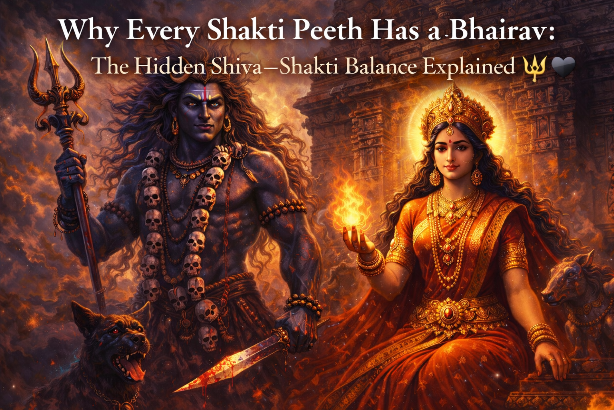
This is why Bhairav is depicted with strong symbols—dogs, skulls, weapons—not to instill fear, but to convey accountability and discipline.
Psychological Meaning: Power, Boundaries, and Self-Control 🧠
On a psychological level, Shakti represents drive, emotion, and motivation. Bhairav represents self-control, limits, and ethical restraint.
Without restraint, motivation turns impulsive. Without motivation, restraint turns rigid. Healthy functioning requires both.
This framework mirrors modern ideas of emotional regulation—where intensity is guided rather than suppressed.
Why Devotion to Shakti Is Incomplete Without Bhairav 🌺
Shakti devotion focuses on empowerment, courage, and transformation. Bhairav devotion grounds these qualities in humility and discipline.
This is why Shakti Peeth traditions honor Bhairav alongside the Goddess. The pairing ensures that spiritual energy remains constructive.
It also reminds devotees that reverence must be matched with responsibility.
Frequently Asked Questions (FAQs) ❓
1) Who is Bhairav in relation to Shiva?
Bhairav is a fierce manifestation of Shiva that represents discipline, time, and protection.
2) Why does every Shakti Peeth have a Bhairav?
Because intense divine energy requires regulation and boundaries to remain balanced.
3) Is Bhairav meant to instill fear?
No. Bhairav symbolizes clarity, accountability, and protection—not fear.
4) Are Bhairav and Shiva the same?
Bhairav is Shiva in a specific role—guardian and regulator of power.
5) Why are Bhairav forms different at each Peeth?
Each Shakti Peeth expresses a unique energy, requiring a specific mode of regulation.
6) What does Bhairav represent psychologically?
Self-control, ethical limits, and responsible use of power.
7) Is Bhairav worship only for advanced seekers?
No. The principle of discipline applies to all levels of spiritual practice.
8) Why is Bhairav linked with time (Kaal)?
Time is the ultimate regulator of all power and transformation.
9) Does Bhairav oppose Shakti?
No. He supports and stabilizes her expression.
10) What happens when Shakti is worshipped without discipline?
Power risks becoming excessive or misdirected.
11) Is Bhairav always fierce?
Fierceness symbolizes clarity and firmness, not aggression.
12) How does this concept apply to daily life?
It teaches balancing ambition with self-control.
13) Are Bhairav temples separate from Shakti Peeths?
Often nearby or symbolically connected, reflecting guardianship.
14) Is Bhairav part of the Shiva–Shakti philosophy?
Yes. He completes the system by regulating energy.
15) What is the ultimate lesson of Bhairav’s presence?
Power must be guided by awareness and discipline.
🔱 Conclusion 🌀
Bhairav Makes Shakti Sustainable
Bhairav’s presence at every Shakti Peeth reveals a timeless truth: power without boundaries is unstable. Shiva provides awareness, Shakti provides energy, and Bhairav ensures balance.
Together, they form a complete spiritual system—one that values empowerment without excess and devotion without blindness.
Understanding Bhairav’s role transforms how we view Shakti Peeths—not as places of raw power, but as centers of disciplined, conscious energy.
🙏 हर हर महादेव 🙏





Leave a comment