




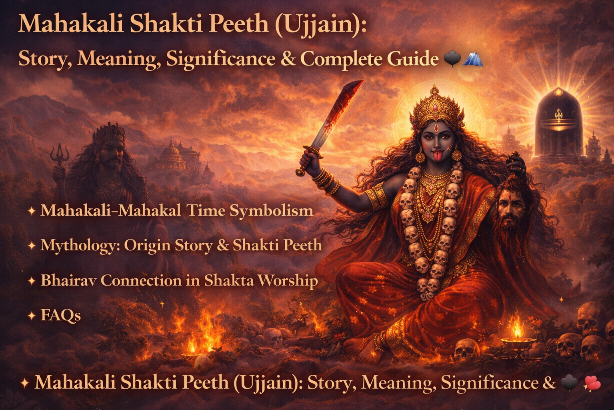
Mahakali Shakti Peeth (Ujjain): Story, Meaning, Significance & Complete Guide 🖤🌺
Among all forms of the Divine Mother, Mahakali stands apart. She is not worshipped for comfort alone, nor for gentle reassurance. Mahakali represents truth in its rawest form—time, transformation, dissolution of ego, and fearless spiritual awakening. At Ujjain, this energy takes on an even deeper meaning, as Mahakali Shakti Peeth exists in sacred proximity to Mahakal, the timeless form of Shiva. 🖤🌺
Mahakali Shakti Peeth is not about fear—it is about liberation from fear. It is about understanding that destruction, when guided by divine intelligence, is not negative. It is necessary. In this sense, Mahakali does not destroy life; she destroys illusion.
In this complete guide, we explore the meaning of Mahakali, her Shakti Peeth identity, mythological roots, spiritual symbolism of time and darkness, her relationship with Mahakal (Shiva), Bhairav connection, cultural importance, and modern relevance. This blog is written responsibly using belief-based language, suitable for beginners and advanced seekers alike, without exaggerated or miracle-style claims.
What is Mahakali Shakti Peeth? (Simple Meaning) 🖤
Mahakali Shakti Peeth is a sacred Devi worship center where the Divine Mother is revered in her most powerful and uncompromising form. “Mahakali” literally means the Great Kali—the force of time that dissolves ego, ignorance, and attachment.
For beginners, Mahakali can be understood as the Divine Mother who removes what no longer serves growth. She does not comfort falsehood. She clears the path for truth. This makes her worship deeply transformative rather than emotionally soothing.
At Ujjain, Mahakali’s presence is especially meaningful because the city itself is associated with Kaal (time). Here, Shakti and Shiva coexist in their most primal forms.
Why Mahakali is Revered as a Shakti Peeth 🕉️
The Shakti Peeth tradition originates from the sacred mythology of Sati and Shiva. After Daksha Yagna and Sati’s sacrifice, Shiva carried Sati’s body across the cosmos in grief. To restore cosmic balance, Vishnu intervened, and sacred locations formed where parts of Sati’s body or ornaments were believed to have fallen.
These locations became known as Shakti Peeths—centers of Devi Shakti worship. Mahakali Shakti Peeth at Ujjain is widely revered within this sacred framework, especially in Shakta traditions that emphasize transformation, time, and dissolution of ego.
Responsibly speaking, Shakti Peeth lists may vary across texts, but Mahakali’s spiritual authority and living devotional importance are unquestioned.
The Mythological Story Behind Mahakali 📖
Mahakali’s mythology is deeply connected with the concept of cosmic time. In belief-based tradition, Mahakali emerges when the balance of the universe is threatened by arrogance, ignorance, or uncontrolled power.
Unlike other Devi forms that restore order gently, Mahakali represents the final solution—when illusion must be destroyed completely. Her appearance symbolizes the moment when truth can no longer be postponed.
This mythological role makes Mahakali deeply respected and sometimes misunderstood. She is not cruel. She is precise. She removes what blocks liberation.
Mahakali and Mahakal: The Sacred Union of Shakti and Time 🔱
Ujjain is one of the most spiritually unique locations in Sanatan Dharma because it represents the union of Mahakali (Shakti) and Mahakal (Shiva). Mahakal is Shiva as time itself—beyond birth and death. Mahakali is the Shakti that activates time’s power.
Together, they represent the ultimate spiritual truth: nothing exists outside time, and nothing survives illusion. Life, ego, fear, and attachment—all dissolve before Mahakal and Mahakali.
This is why Mahakali worship near Mahakal is not accidental. It reflects cosmic balance—Shiva as consciousness, Shakti as energy.
Spiritual Meaning of Mahakali: Darkness as Truth ✨
Darkness in Mahakali symbolism does not represent evil. It represents the unknown, the infinite, and the truth beyond human comfort zones. Darkness absorbs everything. It does not discriminate. This is why Mahakali is dark—she absorbs illusion.
Spiritually, Mahakali represents fearlessness. She teaches that liberation begins when fear ends. When the devotee stops clinging to false identities, Mahakali’s grace becomes transformative.
In belief-based devotion, worshipping Mahakali is often associated with courage, surrender, and acceptance of truth.
Spiritual Significance of Mahakali Shakti Peeth 🌺
Mahakali Shakti Peeth is spiritually significant because it represents the highest form of transformation. Unlike gentler Devi forms such as Maa Chintpurni Shakti Peeth Mahakali does not gradually guide—she decisively clears the path.
Devotees who feel drawn to Mahakali are often undergoing deep inner change. They seek truth, not comfort. Strength, not illusion. Liberation, not attachment.
This makes Mahakali worship intense but profoundly meaningful.
Mahakali as the Divine Mother: Fierce Yet Compassionate 💫
Though Mahakali appears fierce, her compassion is unmatched. She destroys only what harms growth. She protects by removing danger at its root.
In this sense, Mahakali is the ultimate mother—one who does not hesitate to discipline when needed, but always for the devotee’s highest good.
This dual nature makes her worship deeply transformative rather than emotionally comforting.
History & Cultural Importance of Mahakali in Ujjain 🛕
Ujjain has been a center of spiritual knowledge, astrology, and timekeeping for centuries. The presence of Mahakali here reinforces the city’s identity as a place where time, transformation, and spiritual truth converge.
Mahakali worship in Ujjain is deeply woven into Shakta and Shaiva traditions, creating a rare spiritual balance rarely found elsewhere.
Bhairav Connection in Mahakali Shakti Tradition 🔱
Bhairav represents discipline, boundaries, and spiritual seriousness. In Mahakali worship, Bhairav’s presence reinforces the idea that transformation requires responsibility.
Without discipline, power becomes destructive. Bhairav ensures that Mahakali’s energy remains purposeful.
Deeper Symbolism of Mahakali: Time, Ego & Liberation ⏳
Mahakali is not merely a deity of destruction; she is the embodiment of Kaal—time itself. Time does not attack or punish. It simply moves forward, dissolving everything that cannot sustain itself. In this way, Mahakali represents the ultimate spiritual truth: nothing false survives forever.
The ego fears Mahakali because ego survives on illusion—identity, attachment, pride, and fear. Mahakali dissolves these layers without compromise. This is why her symbolism appears intense. But intensity does not mean cruelty. It means precision.
In belief-based spirituality, Mahakali devotion is often described as surrender to truth. When the devotee stops resisting reality, transformation begins naturally.
To understand this deeper relationship between time, dissolution, and truth, you may also read our blog on Why Shiva Is Called Mahakaal, which explains Shiva’s role as the eternal witness beyond creation and destruction. 🔱
What Mahakali Represents Spiritually (Belief-Based Meaning) 🌺
Spiritually, Mahakali represents fearlessness, truth, surrender, and inner awakening. She is the Devi who cuts through ignorance and attachment, not to harm, but to free.
Devotees who feel drawn to Mahakali are often in phases of deep questioning. They may feel stuck, fearful, or trapped in old patterns. Mahakali’s symbolism supports courage—the courage to let go.
In belief-based devotion, her blessings are often experienced as clarity, strength, and the ability to face difficult truths without collapse.
Mahakali and the Spiritual Lesson of Impermanence ✨
One of Mahakali’s most important teachings is impermanence. Everything that begins must end. This truth can feel frightening, but it is also liberating. When one accepts impermanence, fear loses its grip.
Mahakali does not ask devotees to abandon life. She asks them to stop clinging to what cannot last. This understanding brings emotional freedom and spiritual maturity. Her worship encourages acceptance—not resignation, but awareness.
Mahakali in Modern Life: Why Her Symbolism Still Matters 🧠
Modern life is full of anxiety, identity pressure, and fear of loss. People cling to roles, achievements, relationships, and labels. When these are threatened, fear arises.
Mahakali’s symbolism becomes relevant here because she represents the courage to face uncertainty. In belief-based devotion, people connect with Mahakali when they are ready to change, even if change feels uncomfortable.
She reminds devotees that growth often requires letting go—and letting go is not weakness. It is strength.
Scientific & Psychological Perspective: Why Mahakali Feels Transformative ❇️
From a psychological perspective, confronting fear and accepting impermanence are key steps toward mental resilience. Symbolic practices that encourage acceptance of change help individuals process loss, transition, and uncertainty.
Mahakali’s imagery may appear intense, but intensity itself can be therapeutic when understood correctly. It forces the mind to confront suppressed fears rather than avoid them.
Without making exaggerated claims, it is reasonable to say that Mahakali symbolism supports emotional strength and psychological courage over time.
Frequently Asked Questions (FAQs) ❓
1) Why is Mahakali Shakti Peeth famous?
Mahakali Shakti Peeth is famous for its deep symbolism of time, transformation, and liberation from fear.
2) Is Mahakali Shakti Peeth in Ujjain?
Yes, Mahakali Shakti Peeth is associated with Ujjain, a city deeply connected with Kaal (time) and Mahakal.
3) What does Mahakali mean spiritually?
Spiritually, Mahakali represents time, truth, fearlessness, and the dissolution of ego (belief-based meaning).
4) Why is Mahakali depicted as dark?
Darkness symbolizes the infinite, the unknown, and the truth beyond illusion—not negativity or evil.
5) Is Mahakali a fierce or compassionate Devi?
Mahakali is both fierce and compassionate. Her fierceness exists to protect and liberate, not to harm.
6) What is the connection between Mahakali and Mahakal?
Mahakali represents Shakti (energy), while Mahakal represents Shiva as time. Together, they symbolize cosmic balance.
7) What do devotees seek from Mahakali worship?
Devotees often seek courage, clarity, protection, and liberation from fear and illusion (belief-based).
8) Is Mahakali worship suitable for beginners?
Yes, but it requires respect and understanding. Beginners can approach Mahakali through simple prayer and sincerity.
9) Does Mahakali worship bring instant change?
No. Worship supports gradual inner transformation rather than instant external results.
10) What is the Bhairav role in Mahakali worship?
Bhairav represents discipline and ensures Shakti remains purposeful rather than chaotic.
11) Why do people fear Mahakali?
Fear often arises from misunderstanding. Mahakali represents truth, which can feel uncomfortable before it feels liberating.
12) Can Mahakali be worshipped at home?
Yes. Mahakali can be worshipped respectfully at home through sincere devotion.
13) What is Mahakali’s spiritual lesson?
The lesson is that liberation comes through acceptance of truth and impermanence.
14) Why is Mahakali worship relevant today?
Because modern life is filled with fear of loss, and Mahakali teaches courage and inner freedom.
15) What makes Mahakali Shakti Peeth unique?
Its deep connection with time, transformation, and the sacred presence of Mahakal in Ujjain.
🖤 Conclusion 🔱
Mahakali is the Shakti of Truth, Time & Liberation
Mahakali Shakti Peeth represents the most uncompromising form of divine truth. Rooted in Shakti Peeth tradition and amplified by Ujjain’s connection with Mahakal, Mahakali stands as the Shakti who liberates through transformation.
Her worship does not promise comfort—it offers clarity. It does not remove fear—it dissolves it. In a world obsessed with permanence, Mahakali reminds devotees of a higher truth: freedom lies in accepting impermanence and living fearlessly in the present moment.
🙏 हर हर महादेव 🙏





Leave a comment