




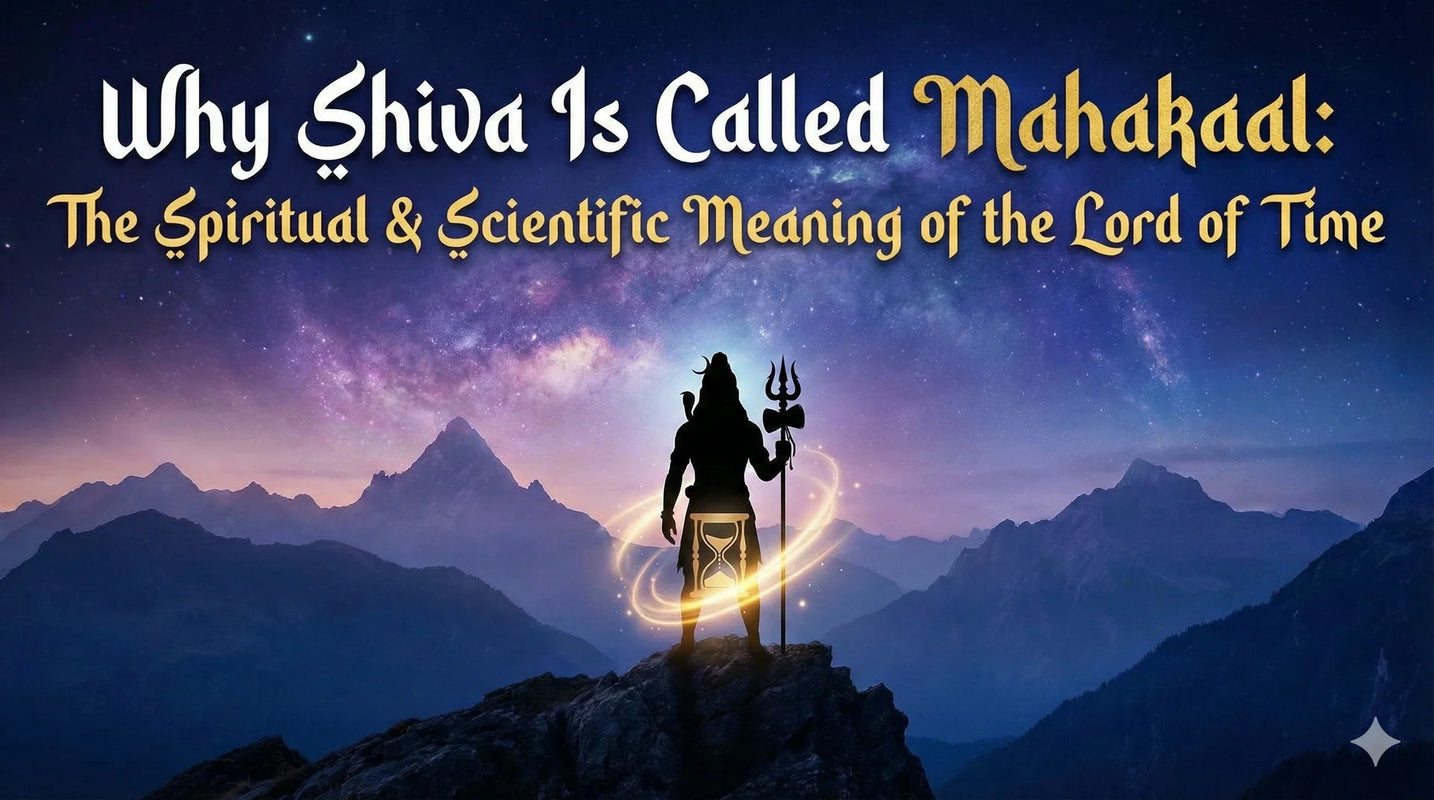
🕉️✨ Why Shiva Is Called Mahakaal – The Lord of Time & The Cosmic Science Behind It
In the vast ocean of Sanatan Dharma, few names are as mysterious and powerful as Mahakaal – Lord Shiva as the Lord of Time. Every star that shines, every body that breathes, every thought that appears in the mind… all are born, live and disappear inside the boundary of Time (Kaal). But Shiva as Mahakaal is something else entirely – He is the witness of the beginning, the middle and the end, yet remains untouched by all three. To understand Mahakaal is to understand why everything changes, why nothing lasts forever, and why there is a state beyond all change where pure consciousness rests in timeless peace.
Time is the most silent yet most dominating force in our lives. It heals wounds but also destroys egos, it grows a child into an adult and slowly takes away that very body, it allows relationships to blossom and also to fade. No king can conquer it, no scientist can stop it, no billionaire can buy it. And still, in the heart of Hindu spirituality, there is a bold declaration – the one who realizes Mahakaal rises above the fear of time, aging and death. This is not a poetic exaggeration but a deep spiritual truth: there is a dimension of awareness where time slows down, stretches, collapses and finally dissolves, and that dimension is symbolized by Mahakaal.
🔱 The Deeper Meaning of “Mahakaal” – Beyond Death, Beyond Endings
The word “Mahakaal” is made of two parts – “Maha” meaning great, unlimited, infinite and “Kaal” meaning time. Taken together it doesn’t just mean “very powerful time” or “the darkest death”, it points to that Infinite Being who stands beyond time. Time can touch everything that has a form: bodies, planets, memories, thoughts, emotions, identities and even universes. But time cannot touch that which is formless. Mahakaal is the name given to that formless, eternal consciousness which remains the same, even while the entire cosmos is continuously changing.
This is why Shiva in his Mahakaal form is not always shown as violent or frightening; very often he is still, meditative and deeply silent. Stillness is not just a physical posture; it is a state where the mind is not chasing past memories or future worries. In this state, there is no rush of time, only a steady, present awareness. When the mind becomes completely still, time seems to lose its grip. For a yogi in deep samadhi, one hour can feel like one minute, and for a restless mind, one minute can feel like an hour. Mahakaal is that ultimate stillness where even this difference disappears and only pure being remains.
🕰️ Time in Sanatan Dharma – Cycles, Not Straight Lines
In modern thinking, time is usually viewed as a straight line: past behind us, present at our feet and future ahead. But in Hindu philosophy, time is seen as cyclical. Just as day follows night and night again follows day, existence moves in repeating patterns. The scriptures speak of different scales of time – from a tiny unit like nimesha, the blink of an eye, to yugas and kalpas spanning millions and billions of years. Creation arises, expands, matures and dissolves only to rise again in another cycle. This continuous rhythm is not random; it is the cosmic breathing of existence.
In this vision, Brahma represents creation, Vishnu represents preservation and Shiva represents dissolution. But as Mahakaal, Shiva is beyond even these roles. He is like the vast sky in which clouds appear and vanish. The clouds may be born and destroyed, but the sky remains unaffected. In the same way, time rules the body, the mind and the world, but Mahakaal is the background in which even time comes and goes. For a spiritual seeker, simply remembering this can bring a deep relaxation – your problems belong to the realm of time, but the soul belongs to the realm of Mahakaal.
💫 Kaal-Vistaar – When Time Expands and Contracts
Ancient stories often describe situations where a short time in one realm equals many years in another. A devotee may enter a divine vision for a few minutes but return to find that decades have passed on Earth. At first, these appear to be just miracle stories, but if we look deeper, they reflect a subtle understanding: time does not move at the same speed everywhere. The flow of time depends on the level of consciousness and the field in which one is present. In yogic language, this is called Kaal-Vistaar – the expansion and contraction of time.
Interestingly, modern physics says something similar. According to the theory of relativity, time slows down near massive objects and for those moving at very high speeds. Two twins could age differently if one travels in space at near-light speed while the other stays on Earth. This phenomenon is known as time dilation. What science explains through gravity and velocity, the sages explained through consciousness and subtle dimensions. In both cases the message is the same – time is not absolute. Mahakaal is that state where this relative game of time is clearly seen and transcended.
🧠 How the Mind Experiences Time – The Psychological Edge of Mahakaal
If you observe closely, you will notice that time does not always feel the same. When you are deeply absorbed in something you love – chanting, meditating, creating, serving – hours pass like minutes. But when you are stressed, bored or in pain, even a few minutes can feel like torture. This shows that time is not just what the clock says; it is also what the mind feels. Our inner state decides how we experience each moment.
When we chant the name of Shiva, meditate on Mahakaal, or sit in silence with awareness of the breath, the mind slowly starts dropping its constant commentary. As thoughts become fewer, the rush of time also appears to slow down. That is why many meditators say, “I don’t know how one hour passed.” They have touched, in a small way, the energy of Mahakaal. The outer clock did not stop, but the inner pressure of time reduced. The deeper the meditation, the closer the mind comes to that state where past and future lose their grip and only the present shines. That present is the doorway to Mahakaal.
🏔️ Mahakaal and the Dance of Creation & Destruction
Shiva is often shown as Nataraja, the cosmic dancer, whose tandava represents both creation and destruction. Every beat of his damru symbolizes the rise and fall of worlds, the birth and death of forms, the appearance and disappearance of thoughts. As long as the dance continues, time continues. When the dance stops, the universe returns to a state of pure potential. Mahakaal is both the silent witness and the dancer himself. In this paradox, the deepest spiritual secret is hidden – the same consciousness that plays the game of change is also the one that remains unchanged.
From a spiritual perspective, the “destruction” of Shiva is not a negative event. It is the gentle dismantling of what has become stale, limiting or unnecessary. Old beliefs, rigid identities, painful karmic patterns – all of these are under the jurisdiction of time. As we grow, life takes away many things from us. Instead of seeing this as loss, when we see it as the grace of Mahakaal clearing our path, a profound acceptance arises. This acceptance is not weakness; it is strength born from understanding the divine rhythm behind change.
⏳ Why Mahakaal Temple at Ujjain Is Seen as the “Center of Time”
The Mahakaleshwar Jyotirlinga at Ujjain is not just a famous temple; it is an energetic symbol of Shiva as Mahakaal. Ujjain has been associated with time and cosmic measurement since ancient days. Traditions connect it with important meridian calculations and sacred geography. Even if a devotee does not understand astronomy or complex philosophy, simply stepping into that space with faith can create a shift in the inner experience of time. Worries about the future become lighter, regrets of the past become softer and for a few moments the mind tastes a sense of timelessness.
When people say they feel “lighter” after visiting Mahakaal, it is not just emotion. On a subtle level, the heavy identification with the story of “my life, my age, my deadlines, my fears” becomes weaker. The soul instinctively recognizes – “I am older than this body, older than this birth, older than the ticking of any clock.” This recognition is the real prasadam of Mahakaal. Flowers, sweets and offerings are beautiful, but the true blessing is this inner shift in identity from being a prisoner of time to being a child of the timeless.
🧘♂️ Bringing Mahakaal Into Daily Life – A Practical Spiritual Approach
The concept of Mahakaal is not just for scriptures or temple walls; it is meant to be lived. Every time you face a difficult situation, remember: this too is happening inside time, and time is under the gaze of Mahakaal. The fear that “this will last forever” begins to loosen its grip. Just as joyful moments pass, painful moments also pass. Understanding this impermanence brings both humility and courage. Humility, because nothing is permanent; courage, because no suffering is final.
You can slowly bring the energy of Mahakaal into your life in simple ways:
- By chanting “Om Namah Shivaya” or “Om Mahakaalaya Namah” with full awareness of each breath. 🕉️
- By taking a few minutes daily to sit in silence, watching thoughts arrive and depart without attachment.
- By remembering, in moments of stress, that you are more than the story your mind is repeatedly telling you.
- By seeing change not as an enemy but as the dance of Mahakaal clearing space for new possibilities.
When you do this, time slowly stops feeling like a cruel master and starts feeling like a divine teacher. Deadlines remain, responsibilities remain, but the suffocation around them reduces. Life feels more spacious, even if nothing externally changes. This inner spaciousness is a small taste of the vast, infinite presence we call Mahakaal.
🌌 Mahakaal and the Journey of the Soul
Sanatan Dharma teaches that the soul is birthless and deathless. Bodies are born and die, minds grow and decay, identities rise and fall, but the soul travels through different lifetimes like a pilgrim moving from one city to another. Time marks these journeys, keeping track of experiences, lessons and karmas. But even these long cycles of birth and rebirth are limited compared to the eternity of Mahakaal. When a seeker deeply realizes Shiva as Mahakaal, the grip of karma begins to loosen, not because karma disappears magically, but because awareness rises beyond compulsive reactions and unconscious patterns.
In this way, Mahakaal is not only the lord of cosmic time; he is also the guide of the inner time-line of the soul. Each sincere prayer, each honest tear, each moment of true surrender slowly aligns the soul with that vast, timeless presence. One day, the seeker no longer fears endings, because he or she knows – nothing real can ever be destroyed. Forms perish, essence remains. When this is known not just in the mind but in the heart, the journey of fear slowly transforms into a journey of love.
✨ Conclusion – Living With the Awareness of Mahakaal
To call Shiva Mahakaal is to acknowledge that there is a sacred intelligence behind the flow of time. Yes, bodies age, relationships change, circumstances shift and the world keeps moving, but behind all this activity is a still, silent presence. That presence is Shiva. When we remember Mahakaal, we remember that we are not just victims of time; we are expressions of the timeless. This remembrance doesn’t remove challenges from life, but it gives an unshakeable strength to walk through them with dignity, devotion and inner freedom.
May the grace of Mahakaal help you accept what you cannot change, change what you can, and rise above the fear of endings. In every breath, in every heartbeat, may you feel that you are gently held by the same timeless consciousness that watches over galaxies and grains of sand alike. When this awareness blossoms, every moment – whether joyful or painful – becomes a sacred step in your journey towards the Eternal. 🕉️🔱
🙏 हर हर महादेव 🙏
Frequently Asked Questions About Mahakaal
1. Why is Lord Shiva called Mahakaal?
Shiva is called Mahakaal because He exists beyond time, space, birth and death. While everything in the universe is controlled by time, Mahakaal is the one who witnesses the rise and fall of creation without being affected by it.
2. What is the difference between Kaal and Mahakaal?
“Kaal” means time, the force that governs creation and destruction. “Mahakaal” is the infinite consciousness that stands beyond time and controls its flow.
3. Does meditation help us connect with Mahakaal?
Yes. Deep meditation slows the perception of time, calms the mind and leads to a state where past and future lose their grip. This inner stillness reflects the presence of Mahakaal.
4. Why is Ujjain known as the seat of Mahakaal?
The Mahakaleshwar Jyotirlinga in Ujjain is believed to be situated on powerful energetic lines connected to cosmic time cycles. Therefore, it is considered the “center of time.”
5. Is Mahakaal different from Shiva?
Mahakaal is not separate from Shiva. It is one of His most profound forms, representing the timeless, immortal and supreme dimension of consciousness.
6. Can understanding Mahakaal help reduce fear of death?
Yes. When one understands that the soul is eternal and beyond time, the fear of death weakens. This understanding brings tremendous peace and acceptance.
7. What is Kaal-Vistaar (time expansion)?
Kaal-Vistaar is the ancient concept of time expanding or contracting based on consciousness and dimensions. It aligns closely with modern physics’ time dilation.





Leave a comment