


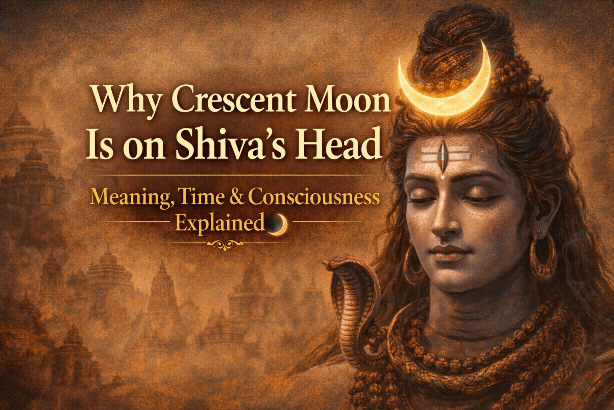
Why Crescent Moon Is on Shiva’s Head: Meaning, Time & Consciousness Explained 🌙
Among the many powerful symbols associated with Lord Shiva, the crescent moon resting gently on his head stands out as both subtle and deeply philosophical. Unlike crowns worn by kings or weapons held by warriors, the moon on Shiva’s head does not represent authority through dominance. Instead, it reflects mastery through awareness.
For centuries, devotees have seen Shiva depicted with a half-moon tucked into his matted hair, yet few pause to ask why this symbol exists and what it truly signifies. The crescent moon is not an ornamental detail. It is a carefully chosen symbol that communicates Shiva’s relationship with time, emotion, rhythm, and consciousness itself.
To understand why Shiva bears the crescent moon on his head, one must move beyond mythology alone and explore the deeper philosophical logic embedded within this imagery.
The Moon as a Symbol of Time and Cycles 🌀
In Indian philosophical thought, the moon is deeply connected with time. Unlike the sun, which appears constant and unchanging, the moon waxes and wanes, visibly reminding humanity of cycles—growth, fullness, decline, and renewal.
Human life itself follows similar rhythms. Emotions rise and fall, mental clarity comes and goes, and circumstances shift constantly. The moon reflects this dynamic nature of existence.
By placing the crescent moon on Shiva’s head, the symbolism suggests that Shiva is not subject to time—he observes it. Time moves, cycles repeat, but consciousness remains steady.
Why the Moon Is a Crescent, Not Full 🌙
The choice of a crescent moon rather than a full moon is deliberate and meaningful.
A full moon represents culmination and outward expression, while a crescent represents restraint, balance, and controlled potential. Shiva does not wear the moon in its most dramatic form; he wears it in a state of quiet equilibrium.
This reflects the spiritual ideal of living with awareness rather than excess. Emotional intensity, when uncontrolled, leads to instability. The crescent moon symbolizes emotions held gently under awareness.
Moon, Mind, and Emotional Cycles 🧠
In yogic and tantric traditions, the moon is closely associated with the mind. The mind, like the moon, is reflective rather than luminous. It does not generate light of its own but reflects consciousness.
Mental states fluctuate just as lunar phases do. Calmness, agitation, clarity, confusion—all arise and dissolve.
Shiva wearing the moon signifies mastery over the mind. The mind exists, but it does not dominate. Emotions arise, but they do not overwhelm. Awareness remains seated above them.
Why the Moon Rests on Shiva’s Head 💫
The placement of the moon is as important as the moon itself.
The head represents awareness and consciousness. By placing the moon there, the symbolism conveys that emotional and mental fluctuations are governed by higher awareness.
The moon is not crushed or destroyed—it is gently supported. This teaches that spiritual growth is not about suppressing emotions but understanding and regulating them.
Shiva as the Lord of Time (Beyond Mahakaal) ⏳
Even beyond his form as Mahakaal, Shiva’s relationship with time is deeply nuanced.
The moon measures time through lunar calendars, months, and rituals. By wearing the moon, Shiva becomes the observer of time rather than its prisoner.
This symbolism teaches devotees that while time governs the physical world, awareness transcends it.
The Moon, Soma, and Inner Nourishment 🌕
In Vedic symbolism, the moon is associated with Soma—the nectar of nourishment, calmness, and rejuvenation.
Soma is not merely a substance but a state of inner nourishment that arises from balance and serenity.
By holding the moon, Shiva embodies a source of inner cooling and stability amidst the heat of worldly existence.
Stillness Above Movement 🧭
The moon moves through phases, but Shiva remains unmoving.
This contrast illustrates a profound spiritual truth: life is dynamic, but awareness need not be disturbed by change.
The crescent moon thus becomes a visual metaphor for living fully within cycles without being consumed by them.
Moon and Sun: Emotion and Awareness in Balance ⚖️
In spiritual symbolism, the moon and the sun are often understood as complementary forces. The sun represents clarity, action, and outward awareness, while the moon represents emotion, reflection, and the inner world. Human life constantly moves between these two forces—doing and feeling, thinking and reacting, expressing and absorbing.
Shiva’s symbolism is unique because he does not reject either force. Instead of suppressing the moon, he places it consciously upon his head. This placement communicates balance rather than denial. Emotions are not enemies to spiritual growth; they become obstacles only when they remain unconscious.
The crescent moon on Shiva’s head therefore teaches a subtle but powerful lesson: awareness must sit above emotion, not against it. When emotions are guided by awareness, they become sources of sensitivity and depth rather than instability.
Why Shiva Wears the Moon Calmly, Not Dramatically 🔱
Unlike other deities who are adorned with elaborate crowns or radiant ornaments, Shiva’s crescent moon rests quietly in his matted hair. This quiet placement is intentional.
True mastery does not announce itself. Emotional maturity is not loud, reactive, or dramatic. It is silent, steady, and contained. The crescent moon symbolizes this restraint. Shiva does not display the moon to impress; he carries it as a natural extension of inner balance.
This teaches devotees that spiritual growth is reflected not in outward display, but in inner composure.
The Crescent Moon and Spiritual Maturity 🌱
A crescent moon is neither absent nor overwhelming. It exists in a state of becoming. This perfectly reflects the spiritual journey itself.
Spiritual maturity does not mean the complete absence of emotions or desires. It means engaging with life while remaining inwardly stable. The crescent moon represents this stage of conscious growth—where awareness has emerged but remains humble.
By wearing the crescent moon, Shiva becomes the embodiment of mature awareness—present within the world, yet not overwhelmed by it.
Moon Phases and the Human Mind ❇️
Just as the moon moves through phases, the human mind experiences cycles of clarity and confusion, enthusiasm and exhaustion, joy and sorrow. These fluctuations are natural.
The problem arises when identity becomes entangled with these changing states. Shiva’s symbolism offers an alternative perspective. He allows the moon to exist, to change, and to move through phases—but he remains unchanged.
This teaches that awareness should observe mental states without becoming trapped within them.
Cooling the Inner Fire 🔥
Shiva is often associated with intense energy—ascetic heat, cosmic power, and transformative force. The crescent moon introduces balance into this intensity.
In yogic symbolism, excessive heat—whether physical, emotional, or mental—leads to restlessness. The moon represents cooling, calmness, and restoration.
By wearing the moon, Shiva embodies equilibrium. Power without balance becomes destructive; balance without power becomes passive. Shiva integrates both.
Why the Moon Does Not Control Shiva 🕉️
One of the most important philosophical aspects of this symbolism is that the moon does not influence Shiva—it rests under his awareness.
In astrology and daily life, the moon is often associated with emotional influence. Shiva’s depiction reverses this dynamic. He is not affected by lunar cycles; he observes them.
This represents liberation from unconscious influence. Awareness becomes the master, not the victim, of emotional cycles.
Frequently Asked Questions (FAQs) ❓
1. Is the crescent moon connected to astrology?
Symbolically, yes. The moon reflects emotional cycles, but Shiva’s symbolism shows mastery over them rather than dependence.
2. Why is the moon placed on the head and not elsewhere?
The head represents awareness. Placing the moon there signifies conscious regulation of emotions and time.
3. Does the crescent moon relate to Shiva’s role as Mahakaal?
Yes. The moon measures time, and Shiva’s calm relationship with it reflects his transcendence over time.
4. Is the moon symbolic only, or is there mythological significance too?
Both. Mythological stories and philosophical symbolism work together to convey the same truth.
✅ Conclusion 📌
Awareness Above All Cycles
The crescent moon on Shiva’s head is not an ornament—it is a teaching.
It teaches that life will continue to move through cycles, emotions will continue to rise and fall, and time will continue to flow. Liberation does not come from escaping these realities, but from rising above unconscious attachment to them.
By placing the moon upon his head, Shiva shows that awareness must always remain higher than emotion, steadier than time, and calmer than change.
For devotees and seekers alike, this symbolism offers a quiet but powerful reminder: master the mind gently, observe emotions patiently, and remain rooted in awareness even as life continues to move.
🙏 Har Har Mahadev 🙏





Leave a comment