





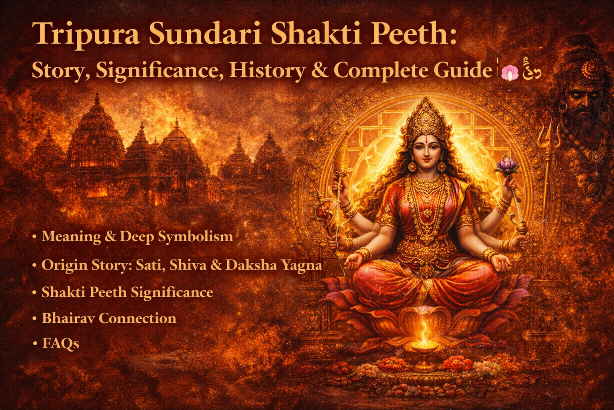
Tripura Sundari Shakti Peeth: Story, Significance, History & Complete Guide 🌸🕉️
Among the most spiritually refined and deeply symbolic Shakti Peeths, Tripura Sundari holds a special place in Devi worship. While many forms of the Divine Mother are worshipped as fierce protectors, Tripura Sundari is worshipped as the supreme beauty of consciousness—where beauty is not just appearance, but the harmony of truth, wisdom, and spiritual completeness.
For devotees, Tripura Sundari represents something rare: the Divine Feminine as both compassion and power, both grace and authority, both love and supreme intelligence. In deeper Shakta traditions, Tripura Sundari is often associated with the highest vision of Devi worship—where the Divine Mother is not only worshipped for blessings, but also honored as the highest reality of the universe.
In this complete guide, we will explore Tripura Sundari Shakti Peeth meaning, its mythological connection to the Shakti Peeth tradition, spiritual symbolism, cultural significance, the deeper devotional understanding of Tripura Sundari, and FAQs written in a beginner-to-advanced format. This article is written responsibly and respectfully, without exaggerated claims—focused on spiritual clarity and authentic tradition.
What is Tripura Sundari Shakti Peeth? (Simple Meaning) 🌸
Tripura Sundari Shakti Peeth is a revered Devi worship center where the Divine Mother is worshipped as Tripura Sundari—one of the most spiritually refined and symbolic forms of Shakti. The word “Tripura” can be understood as “three worlds” or “three realms,” and “Sundari” means “the most beautiful.”
In spiritual language, Tripura Sundari is not simply “beautiful” in a worldly way. She represents divine beauty as a complete spiritual state—where consciousness is balanced, wisdom is clear, and Shakti is perfectly aligned with truth.
For beginners, a simple understanding is this: Tripura Sundari is the Divine Mother worshipped as the highest harmony of Shakti—graceful, powerful, and spiritually complete.
Why Tripura Sundari is Considered a Shakti Peeth 🌺🕉️
Tripura Sundari is honored as a Shakti Peeth because it is connected to the larger Shakti Peeth tradition rooted in the mythological story of Sati and Shiva. In belief-based narratives, Shakti Peeths are sacred locations that formed after the events of Daksha Yagna, Sati’s sacrifice, and Shiva’s cosmic grief, where parts of Sati’s body or ornaments are believed to have fallen.
These Shakti Peeths became sacred centers of Devi worship, where devotees feel a concentrated spiritual presence of the Divine Mother. Tripura Sundari is widely respected as one such powerful Shakti center, known for a deeply symbolic form of Devi worship.
Even though different traditions may present Shakti Peeth lists with slight variations, Tripura Sundari remains highly revered in Shakta devotion as a sacred seat of the Divine Feminine.
The Mythological Story Behind Tripura Sundari Shakti Peeth 📖
To understand Tripura Sundari as a Shakti Peeth, we must connect it to the larger origin story of Shakti Peeths. This story begins with Daksha Yagna, where Shiva was disrespected, and Sati faced humiliation due to her father’s pride and ego.
In belief-based tradition, Sati sacrificed herself into the yagna fire, unable to tolerate Shiva’s insult. Shiva, overwhelmed with grief, carried Sati’s body and entered the powerful cosmic expression known as the Rudra Tandava. This disturbance threatened cosmic balance.
To restore stability, Vishnu intervened and, in traditional devotion, separated Sati’s body, creating sacred locations where parts or ornaments fell. These locations became Shakti Peeths—powerful spiritual centers of Devi worship.
Tripura Sundari is remembered as one such sacred Shakti Peeth. Beyond the dramatic narrative, the story carries a deeper spiritual message: Shakti never disappears. It spreads across existence as divine presence, guiding devotees through devotion, symbolism, and inner transformation.
Spiritual Meaning of Tripura Sundari: Beauty as Divine Consciousness ✨
Tripura Sundari is often misunderstood if we view her only through a surface lens. Many people hear the word “Sundari” and think it means physical beauty alone. But in Shakta philosophy, Tripura Sundari represents divine beauty as harmony—where truth, wisdom, and spiritual power exist together.
This is a powerful spiritual concept. In real life, beauty without wisdom becomes illusion. Power without compassion becomes dangerous. Love without discipline becomes unstable. Tripura Sundari represents the perfect balance—beauty that is rooted in truth, and power that is guided by wisdom.
In belief-based devotion, worshipping Tripura Sundari is not only about desire or worldly comfort. It is about aligning oneself with higher clarity. It is about becoming balanced inside. It is about awakening the subtle intelligence of the Divine Feminine.
Tripura Sundari and the Divine Feminine in Shakta Tradition 🕉️
Shakta tradition honors Devi in many forms. Some forms protect through fierceness. Some heal through compassion. Some guide through wisdom. Tripura Sundari reflects the Divine Feminine in her most refined expression—where Shakti appears as grace, intelligence, and spiritual completeness.
This is why Tripura Sundari worship is often respected by devotees who seek inner clarity rather than only external results. The symbolism teaches that the highest form of Shakti is not noise—it is mastery. It is calm power. It is stable wisdom.
Tripura Sundari is therefore not only a temple identity. She is a philosophy. She is a living symbol of how a devotee should evolve: balanced, clear, disciplined, and spiritually radiant.
Spiritual Significance of Tripura Sundari Shakti Peeth 🌼
Tripura Sundari Shakti Peeth is spiritually significant because it represents Devi as the supreme harmony of power and wisdom. In belief-based devotion, devotees connect with Tripura Sundari when they seek mental clarity, emotional stability, and spiritual growth.
Unlike some Shakti forms that represent strong destruction of negativity, Tripura Sundari represents the subtle transformation of consciousness. The devotee grows not only by fighting problems, but by becoming wiser. By becoming calmer. By becoming stable.
This is why Tripura Sundari is often described as a Devi form that awakens spiritual intelligence. It inspires the devotee to live with higher awareness, more discipline, and deeper devotion.
History & Cultural Importance of Tripura Sundari 🛕
Tripura Sundari’s worship carries deep cultural respect because it preserves a refined aspect of Devi worship traditions. Over time, this Shakti center became associated with devotional practices that honor Devi not only as a protector, but as the supreme reality of Shakti and consciousness.
Even for devotees who are not deeply familiar with Shakta philosophy, Tripura Sundari devotion remains emotionally meaningful. It creates a sense of divine beauty that is spiritual, not superficial. This cultural devotion has allowed Tripura Sundari to remain spiritually relevant for generations.
Tripura Sundari is a reminder that Sanatan Dharma is not only about powerful stories—it is also about refined spiritual understanding. Devi worship can be fierce, nurturing, or deeply philosophical. Tripura Sundari represents that philosophical depth.
Bhairav Connection in Tripura Sundari Shakti Peeth Tradition 🔱🖤
In Shakti Peeth tradition, many Devi centers also include the worship of Bhairav as a guardian energy. Bhairav represents discipline, spiritual seriousness, and protective boundaries. Devi represents power, creation, and transformation.
In the context of Tripura Sundari, Bhairav symbolism becomes very meaningful. Divine beauty without discipline can become illusion. Divine grace without boundaries can become weakness. Bhairav represents the stability and seriousness that protects Shakti’s purity.
So even when devotees focus mainly on Devi, the guardian concept remains important: spiritual power must be approached with respect, sincerity, and humility.
Deeper Symbolism of Tripura Sundari: The Supreme Harmony of Shakti ❇️
Tripura Sundari is one of the most spiritually layered forms of the Divine Mother. Her worship is not only about devotion—it is also about understanding. Many Devi forms are emotionally powerful and direct, but Tripura Sundari is refined and deeply symbolic, like a spiritual mirror that reflects what a seeker is meant to become.
In Shakta tradition, Tripura Sundari is often understood as the embodiment of balance. She represents the kind of beauty that is not limited to external appearance but is rooted in inner harmony. This harmony is the real foundation of spiritual progress: the mind becomes calm, emotions become stable, thoughts become clearer, and life begins to feel more aligned with purpose.
This is why Tripura Sundari devotion has a different emotional texture. It does not only awaken devotion—it awakens awareness. It invites the devotee to rise beyond confusion and live with deeper clarity.
What Tripura Sundari Represents Spiritually (Belief-Based Meaning) ✅
In belief-based spiritual understanding, Tripura Sundari represents divine wisdom, inner beauty, and spiritual completeness. She is worshipped as the Shakti that brings refinement into a devotee’s life—not through loud transformation, but through subtle elevation.
Many devotees connect with Tripura Sundari when they feel mentally scattered or emotionally unstable. Instead of asking only for external solutions, they seek inner clarity. They seek the ability to think cleanly, decide wisely, and remain stable even when life is uncertain.
Tripura Sundari worship encourages the devotee to shift from reactive living to conscious living. From confusion to clarity. From instability to balance. This is why her symbolism is so relevant in the modern world.
Tripura Sundari and the Idea of “Three Worlds” (Tripura) 🌍
The word “Tripura” is often interpreted as “three worlds” or “three realms.” Spiritually, this idea can be understood in multiple layers. It may be interpreted as the three cosmic realms, or as the three dimensions of human life—mind, body, and spirit. It may also be understood as the three states of consciousness: waking, dreaming, and deep sleep.
Tripura Sundari symbolically represents mastery over these realms. She is the Shakti that brings stability in all dimensions of existence. This is why her worship is considered spiritually elevated. It is not only about receiving blessings—it is about becoming balanced inside.
In belief-based devotion, Tripura Sundari is the reminder that the highest Shakti is the one that organizes your inner world. When your inner world is stable, your outer life becomes more purposeful.
Divine Beauty: Why Tripura Sundari is Called “Sundari” 🌸
Tripura Sundari is called “Sundari” not merely because she represents beauty, but because she represents the highest version of beauty—beauty that is inseparable from truth. In spiritual language, beauty means harmony. It means clarity. It means balance. It means a life that is aligned with dharma.
Many people chase beauty in the external world and remain emotionally empty. Tripura Sundari devotion reminds devotees that real beauty is inner refinement. It is emotional maturity. It is spiritual stability. It is the kind of mind that remains calm even when life becomes intense.
This is why Tripura Sundari worship feels deeply peaceful to many devotees. It does not create mental chaos. It creates quiet strength.
Tripura Sundari in Modern Life: Why This Shakti Peeth Still Matters Today 🧠
Modern life often creates a constant mental storm. People are surrounded by distractions, information overload, and emotional pressure. Even when life looks successful on the outside, many people feel scattered inside. The mind becomes restless. The heart becomes unstable. The inner world feels unclear.
Tripura Sundari devotion becomes meaningful because it invites the devotee toward inner balance. It inspires stillness. It inspires refined awareness. It encourages a deeper kind of strength—the strength of stability.
For many devotees, Tripura Sundari becomes a spiritual anchor. Not because problems disappear instantly, but because the mind becomes clearer. Decisions become wiser. Emotional reactions become more controlled. This is one of the most realistic and responsible ways to understand the benefit of Devi worship.
Scientific & Modern Perspective: Why Symbolic Devi Worship Creates Inner Stability ✅
From a modern perspective, spiritual symbols work because the mind responds to meaning. When a person prays with devotion, the mind becomes structured. The nervous system begins to relax. Inner attention becomes focused. Emotional heaviness reduces.
Tripura Sundari represents refinement and harmony, and such symbolism naturally creates a calming mental effect. A devotee does not need to force peace. The act of devotion itself becomes a practice of inner organization.
This is how spiritual worship remains relevant even today. It does not need exaggerated claims. It only needs sincerity, meaning, and consistency. The result is emotional clarity and inner balance—qualities that modern life often steals from people.
Frequently Asked Questions (FAQs) ❓
1) Why is Tripura Sundari Shakti Peeth famous?
Tripura Sundari is famous because she is worshipped as a highly refined form of Devi Shakti, symbolizing divine beauty, wisdom, and spiritual harmony.
2) Is Tripura Sundari a Shakti Peeth?
Yes, Tripura Sundari is widely respected as a Shakti Peeth in Shakta tradition and devotional belief systems.
3) What does Tripura Sundari mean spiritually?
Spiritually, Tripura Sundari represents divine beauty as harmony, where Shakti and wisdom exist in perfect balance (belief-based meaning).
4) What is the mythological origin story of Tripura Sundari Shakti Peeth?
Tripura Sundari is linked to the broader Shakti Peeth origin story connected to Sati, Shiva, Daksha Yagna, and sacred Devi centers.
5) What does “Tripura” mean in Tripura Sundari?
Tripura is often interpreted as “three worlds” or “three realms,” symbolizing Devi’s mastery over all dimensions of existence.
6) Why is Tripura Sundari called Sundari?
She is called Sundari because she represents divine beauty as truth, balance, and spiritual completeness—not just external appearance.
7) Is Tripura Sundari worship suitable for beginners?
Yes. Beginners can worship Tripura Sundari with simple devotion and prayer without needing complicated rituals.
8) What do devotees seek through Tripura Sundari worship?
Devotees often seek clarity, emotional stability, spiritual balance, and refined inner strength through Devi’s blessings (belief-based).
9) Is Tripura Sundari connected with Shakta tradition?
Yes. Tripura Sundari is deeply connected with Shakta philosophy and refined Devi worship traditions.
10) Is Tripura Sundari worship linked with Sri Vidya traditions?
Some traditions connect Tripura Sundari with Sri Vidya worship systems, though many devotees also follow simple bhakti devotion respectfully.
11) What is the spiritual lesson of Tripura Sundari Shakti Peeth?
The lesson is that true power is refined, balanced, and wise—and devotion should create inner harmony.
12) Does Tripura Sundari worship give instant results?
No. Worship is a belief-based spiritual practice that supports inner clarity and stability over time, not instant guarantees.
13) What makes Tripura Sundari different from fierce Devi forms?
Tripura Sundari represents a refined and calm dimension of Shakti, focused on harmony, wisdom, and subtle transformation.
14) Why is Tripura Sundari important in modern life?
Because her symbolism supports inner stability and mental clarity, helping devotees handle modern stress with spiritual balance.
15) What is the main message of Tripura Sundari devotion?
The message is that divine beauty is inner harmony, and spiritual life becomes powerful when the mind becomes balanced and wise.
🌸 Conclusion 🔚
Tripura Sundari is the Shakti Peeth of Divine Beauty, Wisdom & Inner Harmony
Tripura Sundari Shakti Peeth is revered because it represents the Divine Mother in her most refined and spiritually complete form. Rooted in Shakti Peeth tradition and honored through generations of devotion, Tripura Sundari symbolizes the harmony of power, wisdom, and divine grace.
When approached with sincere faith, Tripura Sundari devotion becomes a path of inner refinement. It encourages calmness over chaos, clarity over confusion, and balance over emotional instability. In a world filled with distractions and mental pressure, Tripura Sundari remains a timeless spiritual reminder that real beauty is inner harmony—and Shakti is the force that creates it within the devotee.
🙏 हर हर महादेव 🙏





Leave a comment