























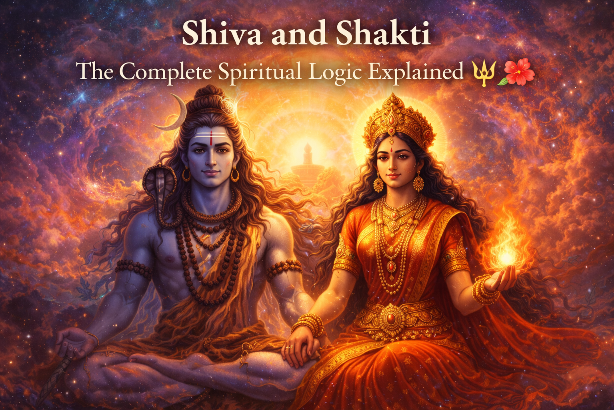
Shiva and Shakti: The Complete Spiritual Logic Explained 🔱🌺
In Sanatan Dharma, nothing exists in isolation. Every force, every form, and every principle operates in relationship. At the very heart of this worldview lies the eternal union of Shiva and Shakti. This is not merely a divine pairing or a mythological concept—it is the foundational spiritual logic through which existence itself is understood. 🔱🌺
Shiva and Shakti are not two competing powers. They are two aspects of the same ultimate reality. One represents awareness, stillness, and consciousness. The other represents movement, energy, and expression. Together, they explain how the universe comes into being, sustains itself, transforms, and eventually dissolves.
This guide is written to clearly explain the Shiva–Shakti philosophy in a way that is accessible to beginners yet meaningful for advanced seekers. We will explore mythology, symbolism, metaphysics, and modern relevance—using responsible, belief-based explanations without exaggeration or superstition.
What Do Shiva and Shakti Represent? (Simple Explanation) 🕉️
At the most fundamental level, Shiva represents consciousness—pure awareness without form, desire, or action. He is the witness. The silent observer. The unchanging reality behind all experiences.
Shakti represents energy—the power that moves, creates, sustains, and transforms. She is action, expression, vibration, and manifestation.
Without Shakti, Shiva remains inactive—pure consciousness without experience. Without Shiva, Shakti becomes directionless—energy without awareness. Creation exists only because consciousness and energy function together.
This is why Shiva and Shakti are never truly separate in spiritual philosophy, even when depicted as distinct forms.
Why Shiva Is Called Incomplete Without Shakti 🌺
One of the most important ideas in Hindu philosophy is that Shiva without Shakti is Shava—a lifeless state. This does not diminish Shiva. Instead, it highlights a profound truth: awareness alone does nothing unless activated by energy.
Shiva represents potential consciousness. Shakti activates that potential. When consciousness expresses itself through energy, life emerges.
This is why every Shaiva tradition acknowledges Shakti, and every Shakta tradition acknowledges Shiva. Their relationship is not hierarchical—it is complementary.
In spiritual practice, this concept teaches balance. Awareness without action leads to stagnation. Action without awareness leads to chaos. Growth requires both.
The Mythological Union of Shiva and Shakti 📖
Mythology communicates philosophy through stories. The union of Shiva and Shakti appears in countless narratives—not as romance, but as cosmic necessity.
Whether it is Parvati performing tapasya to unite with Shiva, or Shakti manifesting to awaken Shiva from stillness, the message remains the same: creation begins when awareness and energy meet.
These stories are symbolic. Parvati’s tapasya represents disciplined energy aligning with consciousness. Shiva’s acceptance represents awareness recognizing its own expressive power.
Seen this way, mythology becomes a spiritual psychology—guiding inner transformation rather than external belief.
Shiva as Consciousness, Shakti as Energy: The Core Logic ⚡
In yogic and philosophical language, Shiva is often described as Purusha (pure awareness), while Shakti is Prakriti (dynamic nature). Together, they explain all experience.
Every thought arises because awareness is energized. Every action happens because energy is guided by awareness. Even silence exists because awareness is present.
This logic applies not just cosmically, but personally. In an individual, awareness without motivation leads to passivity. Motivation without awareness leads to impulsiveness. Harmony comes when both are integrated.
This is why Shiva–Shakti philosophy remains relevant beyond religion—it is a model of psychological and existential balance.
Why Shiva Is Still and Shakti Is Active 🕉️
Shiva is depicted as still because consciousness itself does not act—it witnesses. Shakti is depicted as dynamic because energy is always in motion.
This does not mean Shiva is passive or weak. Stillness is not inactivity—it is stability. Without a stable base, movement becomes destructive.
Shakti’s movement is meaningful only because Shiva provides grounding. This explains why Shakti is often shown surrounding or activating Shiva—never replacing him.
The spiritual lesson is clear: stillness gives direction to movement.
Ardhanarishvara: The Perfect Expression of Shiva–Shakti Unity 🌓
The form of Ardhanarishvara—half Shiva, half Shakti—is one of the most powerful visual representations of this philosophy.
It does not symbolize gender balance alone. It symbolizes existential wholeness. The idea that awareness and energy are not two realities, but two expressions of one truth.
Ardhanarishvara teaches that division is artificial. Completeness comes from integration.
This symbolism directly challenges extremes—whether spiritual detachment without engagement, or action without reflection.
Shiva–Shakti and the Structure of the Universe 🌌
In cosmology, Shiva represents the unchanging background of existence, while Shakti represents the ever-changing universe.
Time, space, matter, and energy are expressions of Shakti operating within Shiva’s awareness. Nothing moves outside this framework.
This is why Shiva is associated with dissolution—not destruction, but return to stillness. And Shakti is associated with creation—not chaos, but expression.
The universe breathes through their rhythm.
Shiva–Shakti in Daily Life: Why This Philosophy Still Matters 🧠
Modern life often pushes people toward imbalance—either constant action without reflection, or excessive introspection without movement.
Shiva–Shakti philosophy offers a corrective lens. It teaches that awareness must guide action, and action must express awareness.
In belief-based spiritual practice, this understanding helps individuals live consciously—acting with clarity rather than compulsion.
This is why the Shiva–Shakti model continues to resonate across cultures and generations.
Bhairav: The Guardian Who Maintains Shiva–Shakti Balance 🖤
Within the Shiva–Shakti framework, Bhairav represents discipline, boundaries, and conscious restraint. If Shiva is awareness and Shakti is energy, Bhairav is the regulating force that ensures energy does not become chaotic and awareness does not become detached.
This is why Bhairav appears as the guardian of Shakti Peeths. His presence is not violent by nature; it is corrective. Bhairav symbolizes the rules that protect power from misuse and the seriousness required to handle Shakti responsibly.
Philosophically, Bhairav teaches that intensity must be accompanied by accountability. Power without structure destroys itself.
Why Shakti Peeths Exist: The Practical Expression of Shiva–Shakti Logic 🌺
Shakti Peeths are not random sacred locations. They represent points where Shakti becomes accessible while remaining anchored in Shiva’s awareness. Mythologically linked to Sati and Shiva, these Peeths translate cosmic philosophy into lived devotion.
Each Shakti Peeth expresses a different aspect of energy—transformation, protection, nourishment, restraint—but all remain incomplete without Shiva’s grounding presence.
This explains why Shakti Peeth worship always implies Shiva, even when he is not the central deity of the shrine. The philosophy remains intact beneath ritual diversity.
Shiva–Shakti in the Human Mind: A Psychological Perspective ⚖️
From a modern psychological viewpoint, Shiva–Shakti can be understood as the balance between awareness and motivation. Awareness without motivation leads to passivity. Motivation without awareness leads to impulsive behavior.
Healthy mental functioning requires both. Reflection (Shiva) helps one pause, observe, and understand. Action (Shakti) allows one to engage, respond, and transform circumstances.
Practices inspired by this balance—such as mindful action—are known to support emotional regulation and clarity. Without making exaggerated claims, this framework aligns naturally with modern mental well-being principles.
Why Extremes Fail: The Danger of Ignoring Shiva or Shakti ⚠️
One-sided spirituality often leads to imbalance. Excessive detachment can result in apathy. Excessive action can result in burnout.
Shiva–Shakti philosophy warns against both extremes. True growth lies in integration, not rejection. Awareness must guide action, and action must refine awareness.
This is why Hindu philosophy emphasizes balance rather than absolutes.
Frequently Asked Questions (FAQs) ❓
1) What is the main meaning of Shiva and Shakti?
Shiva represents pure consciousness, while Shakti represents dynamic energy. Together, they explain how existence functions.
2) Is Shiva incomplete without Shakti?
Philosophically, yes. Awareness without energy cannot express itself.
3) Is Shakti powerful without Shiva?
Energy without awareness lacks direction and balance.
4) What does Ardhanarishvara symbolize?
It symbolizes the unity of consciousness and energy as one complete reality.
5) Why is Shiva depicted as still?
Because consciousness witnesses but does not act on its own.
6) Why is Shakti depicted as active?
Because energy manifests movement, creation, and change.
7) What is Bhairav’s role in this philosophy?
Bhairav represents discipline and structure that regulate Shakti.
8) How does Shiva–Shakti apply to daily life?
It teaches balance between reflection and action.
9) Is Shiva–Shakti only a religious concept?
No. It is a universal model of awareness and energy.
10) Why are Shakti Peeths important?
They represent accessible centers of divine energy anchored in awareness.
11) Does this philosophy reject material life?
No. It encourages conscious engagement, not withdrawal.
12) Why is balance emphasized so much?
Because imbalance leads to stagnation or chaos.
13) Can beginners understand Shiva–Shakti philosophy?
Yes. At its core, it is about awareness and action.
14) Is this philosophy still relevant today?
Yes. It directly addresses modern stress, imbalance, and burnout.
15) What is the ultimate teaching of Shiva–Shakti?
Wholeness comes through integration, not division.
⏳ Conclusion 🌼
Shiva and Shakti Are One Reality Expressed in Two Ways
Shiva and Shakti are not separate beings competing for dominance. They are two expressions of the same ultimate truth—one still, one dynamic; one aware, one expressive.
This philosophy teaches that life functions best when awareness guides energy and energy expresses awareness. In spiritual practice, psychological health, and daily living, this balance remains timeless.
By understanding Shiva–Shakti as a living logic rather than distant mythology, one begins to see harmony not as an ideal—but as a natural outcome of integration.
🙏 हर हर महादेव 🙏





Leave a comment