


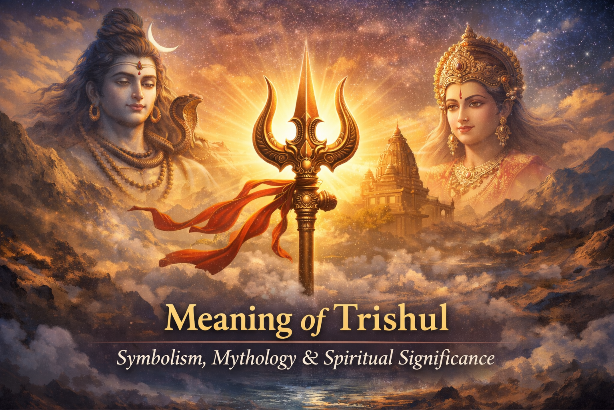
Meaning of Trishul – Symbolism, Mythology & Spiritual Significance of Lord Shiva’s Trident 🔱
Among the many symbols associated with Lord Shiva, the Trishul stands as one of the most powerful and instantly recognizable. Whether seen in temples, sacred paintings, spiritual artwork, or held in the hands of ascetics, the Trishul represents far more than a weapon. It is a deeply philosophical symbol rooted in mythology, spirituality, and ancient Indian metaphysics.
In Sanatan Dharma, symbols are never random. Every object associated with a deity carries layers of meaning that guide spiritual understanding. The Trishul is no exception. For thousands of years, sages and devotees have reflected on its meaning, seeing it not only as a symbol of divine power but also as a representation of cosmic balance and inner transformation.
This detailed guide explores the Trishul through mythology, symbolism, spiritual philosophy, and its relevance in modern spiritual life.
🕉️ What is the Trishul?
The word “Trishul” comes from two Sanskrit words: “Tri,” meaning three, and “Shul,” meaning spear or prong. The Trishul is a trident — a three-pronged spear carried by Lord Shiva.
While it appears as a weapon, the Trishul is primarily a symbol. It represents divine authority, cosmic balance, and the power to remove ignorance.
📜 Mythological Origins of the Trishul
Ancient scriptures describe the Trishul as a divine weapon created by the gods and gifted to Lord Shiva. In mythology, it is said to possess immense power and the ability to destroy negative forces.
🌌 Symbolism of the Three Prongs
The three prongs of the Trishul carry deep symbolic meaning. They represent creation, preservation, and transformation — the three fundamental forces of the universe.
🌌 The Deeper Symbolism of the Three Prongs
The Trishul is often the first symbol people associate with Lord Shiva. At a glance it appears as a weapon, yet within Sanatan Dharma its meaning is profoundly philosophical. The three prongs represent fundamental truths about the nature of existence and the human experience.
Ancient sages frequently expressed complex ideas through symbolic imagery. The Trishul became a visual language that communicated spiritual wisdom in a simple yet powerful form.
Creation, Preservation and Transformation
The three prongs are commonly interpreted as representing the cosmic cycle of creation, preservation, and transformation. These three forces govern everything in the universe — from the birth of stars to the growth of plants and the evolution of human life.
In this interpretation, the Trishul represents balance. It reminds devotees that creation and destruction are not opposites but parts of the same cosmic rhythm.
Past, Present and Future
Another interpretation sees the three prongs as the three dimensions of time — past, present, and future. Lord Shiva is often described as Mahakal, the lord of time. The Trishul symbolizes mastery over time and the understanding that all moments exist within a larger continuum.
Body, Mind and Soul
In yogic philosophy, the Trishul is also understood as representing the body, mind, and soul. Spiritual growth involves bringing harmony between these three aspects of human existence.
🔥 The Trishul in Mythological Stories
Mythology describes the Trishul as a divine weapon used by Lord Shiva to restore balance when negative forces disrupt cosmic harmony. These stories are symbolic narratives that highlight the importance of courage, awareness, and transformation.
🧘 The Trishul as a Symbol of Inner Transformation
Beyond mythology, the Trishul carries a powerful message for personal growth. It represents the ability to overcome ignorance, fear, and attachment.
🌿 The Trishul and the Three Gunas of Nature
Another profound interpretation of the Trishul comes from the concept of the three gunas — the fundamental qualities of nature described in ancient Indian philosophy. These three gunas are Sattva (balance and clarity), Rajas (activity and passion), and Tamas (inertia and rest).
Every human mind and every aspect of the universe contains these three qualities in varying proportions. The Trishul symbolizes the balance of these forces. Lord Shiva holding the Trishul represents mastery over these natural tendencies and the ability to remain centered amidst life’s fluctuations.
🌍 The Trishul in Temple Architecture
The Trishul is commonly seen atop temples and sacred places. Its placement is not merely decorative; it carries symbolic meaning. Positioned high above the temple, it represents protection and the presence of divine awareness.
🛕 Why Devotees Keep a Trishul at Home
Many households place a Trishul at the entrance of their homes or near their home altar. This practice reflects the belief that the Trishul symbolizes protection and spiritual awareness.
🌙 The Trishul in Meditation and Yoga
In yogic traditions, the Trishul is associated with the awakening of awareness and the balance of inner energies.
✨ The Trishul in Modern Spiritual Life
Today, the Trishul continues to inspire millions as a symbol of courage, awareness, and transformation.
⚡ Trishul as a Symbol of Spiritual Discipline and Responsibility
Beyond mythology and symbolism, the Trishul also represents responsibility. In spiritual philosophy, power is always paired with discipline. Lord Shiva is often described as both powerful and deeply meditative, demonstrating that true strength arises from inner balance.
The Trishul reflects this balance between power and responsibility. It reminds devotees that strength should be guided by wisdom and awareness rather than impulsive action.
🌄 The Trishul and the Concept of Detachment
One of the key teachings associated with Lord Shiva is detachment. Detachment does not mean indifference; it means remaining steady despite changing circumstances.
The Trishul symbolizes the ability to remain balanced through life’s highs and lows.
🌍 Cultural Presence of the Trishul Across India
The Trishul is not confined to temples. It appears in festivals, processions, art, and sacred spaces across India.
🔥 Festivals Where the Trishul Plays a Central Role
During festivals such as Maha Shivaratri and Shravan month, the Trishul becomes a prominent symbol in rituals and celebrations.
🧠 The Trishul as a Psychological Symbol
From a modern perspective, the Trishul can also be seen as a psychological symbol representing balance between thoughts, emotions, and actions.
🌟 The Timeless Relevance of the Trishul
For thousands of years, the Trishul has remained a symbol of balance, awareness, and strength.
🕉️ The Trishul and the Concept of Dharma
In Sanatan Dharma, the concept of Dharma refers to the natural order that sustains harmony in the universe. Dharma is not simply duty or morality; it is the principle that keeps life balanced and meaningful. The Trishul is often interpreted as a symbol of this universal balance.
The three prongs can be seen as representing thought, word, and action — the three dimensions through which individuals express themselves in the world. Living in alignment with Dharma means maintaining harmony between these aspects of life.
🌿 The Trishul and the Journey of Self-Mastery
Spiritual teachings often emphasize self-mastery as a lifelong journey. This journey involves understanding the mind, regulating emotions, and acting with awareness. The Trishul symbolizes this process of inner growth.
🌌 The Trishul as a Symbol of Fearlessness
Lord Shiva is often depicted as fearless and calm even in challenging circumstances. The Trishul represents courage and the ability to face life’s uncertainties with clarity and strength.
🌍 Why the Trishul Continues to Inspire Modern Seekers
In today’s fast-changing world, the symbolism of the Trishul remains deeply relevant.
Frequently Asked Questions (FAQs) ❓
1. What does the Trishul symbolize?
The Trishul symbolizes balance, awareness, and the three fundamental forces of the universe. It represents creation, preservation, and transformation, as well as harmony between body, mind, and soul.
2. Why does Lord Shiva carry a Trishul?
Lord Shiva carries the Trishul as a symbol of divine power and cosmic balance. It represents the ability to remove negativity and restore harmony.
3. What do the three prongs of the Trishul represent?
The three prongs symbolize multiple triads such as creation–preservation–transformation, past–present–future, and body–mind–soul.
4. Is the Trishul a weapon or a symbol?
While mythology describes it as a weapon, spiritually it is primarily a symbol representing awareness, balance, and self-mastery.
5. Why is the Trishul placed on temples?
The Trishul symbolizes protection and divine presence, which is why it is placed atop temples and sacred spaces.
6. Can a Trishul be kept at home?
Yes, many devotees keep a Trishul at home as a symbol of spiritual protection and awareness.
7. What is the connection between Trishul and meditation?
The Trishul symbolizes balance and self-mastery, which are essential goals of meditation.
🔱 Conclusion 🕉️
The Symbol of Balance, Strength & Awareness
The Trishul is far more than a mythological weapon. It is a timeless symbol of balance, courage, and inner transformation. Through mythology, philosophy, and spiritual practice, the Trishul continues to inspire millions of devotees and seekers.
🙏 हर हर महादेव 🙏





Leave a comment