













Dwarka Temple – Complete Spiritual, Mythological & Historical Guide to the Sacred Kingdom of Lord Krishna 🌅
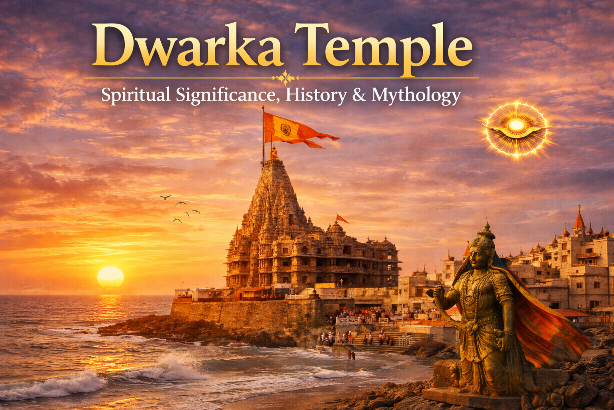
Dwarka Temple stands as one of the most sacred pilgrimage destinations in Sanatan Dharma and represents the western spiritual gateway of India in the Char Dham pilgrimage circuit. Dedicated to Lord Krishna in his royal form as Dwarkadhish, this temple symbolizes dharma, detachment, divine kingship, and the balance between spiritual wisdom and worldly responsibility.
Unlike other temples that emphasize meditation or devotion alone, Dwarka represents the integration of spirituality into worldly life. It teaches that spiritual growth does not require abandoning responsibilities but performing them with wisdom, compassion, and righteousness.
For centuries, Dwarka has inspired saints, devotees, and spiritual seekers as the legendary kingdom of Lord Krishna and a timeless symbol of divine leadership and righteous living.
✨ What is Dwarka Temple?
Dwarka Temple, also known as Dwarkadhish Temple, is dedicated to Lord Krishna, who ruled the ancient city of Dwarka. The temple represents Krishna’s role as a divine king, protector of dharma, and guide of humanity.
In spiritual symbolism, Dwarka represents the final stage of spiritual maturity — living in the world while remaining detached from it.
🌇 The Spiritual Symbolism of the Western Direction
In Hindu sacred geography, the western direction symbolizes completion, wisdom, and detachment. Just as the sun sets in the west, Dwarka represents the stage of life where individuals reflect on wisdom gained through experience.
This symbolism reflects the teaching that life ultimately leads toward understanding, balance, and detachment.
📜 Mythological Origin of Dwarka
According to ancient scriptures, Lord Krishna established the city of Dwarka after leaving Mathura to protect his people. The city is described as a magnificent kingdom built on the western coast of India.
Dwarka symbolizes divine leadership and the establishment of righteousness in society.
👑 Krishna as Dwarkadhish – The Divine King
In Dwarka, Lord Krishna is worshipped as Dwarkadhish, meaning “King of Dwarka.” This form represents responsibility, wisdom, and compassionate leadership.
The temple teaches that true leadership is rooted in humility, justice, and service.
🌊 The Ocean & Spiritual Symbolism
The Arabian Sea surrounding Dwarka symbolizes the vastness of life and the impermanence of material existence. According to tradition, the ancient city of Dwarka eventually submerged into the ocean, reminding devotees of the temporary nature of worldly achievements.
👳 Adi Shankaracharya & Char Dham Connection
Dwarka was included in the Char Dham pilgrimage by Adi Shankaracharya to represent the western spiritual gateway of India and the path of wisdom and detachment.
📖 Why Lord Krishna Left Mathura
The story of Dwarka begins with one of the most significant events in the life of Lord Krishna. After defeating the tyrant King Kansa in Mathura, Krishna faced repeated attacks from powerful enemies who threatened the safety of his people. To protect his kingdom and prevent unnecessary conflict, Krishna decided to move his people to a new city on the western coast of India.
This decision reflects Krishna’s wisdom as a leader. Rather than seeking constant warfare, he chose protection, strategy, and long-term peace. This story symbolizes intelligent action guided by compassion and responsibility.
🏰 Creation of the Golden City of Dwarka
Ancient scriptures describe Dwarka as a magnificent city built by divine architect Vishwakarma. The city was said to be filled with grand palaces, beautiful gardens, and advanced infrastructure. Dwarka symbolized prosperity, harmony, and righteous governance.
Spiritually, the city represents the ideal society built on dharma, compassion, and wisdom.
👑 Krishna as the Ideal King & Statesman
In Dwarka, Krishna ruled as a wise and compassionate king. His leadership reflected fairness, humility, and service to his people. Unlike rulers driven by power or ambition, Krishna emphasized justice and harmony.
This aspect of Krishna’s life teaches that spirituality can guide leadership and governance.
⚔️ Dwarka in the Mahabharata
Dwarka played an important role in the Mahabharata. Krishna acted as a guide, strategist, and spiritual teacher during the great war. His teachings emphasized righteousness, duty, and detachment.
These teachings continue to inspire individuals seeking balance and wisdom in life.
🌊 The Submergence of Dwarka
According to ancient traditions, the city of Dwarka eventually submerged into the ocean after Krishna’s departure from Earth. This story carries deep spiritual symbolism.
The submergence reminds devotees that material achievements are temporary. Even the most magnificent kingdoms fade, but spiritual wisdom remains eternal.
🕉️ Krishna as the Teacher of Dharma
Lord Krishna’s teachings in the Bhagavad Gita emphasize duty, wisdom, and detachment. Dwarka represents the stage of life where individuals balance spiritual understanding with worldly responsibilities.
🏛️ Architecture of Dwarkadhish Temple
The temple’s towering structure symbolizes the connection between the earthly and the divine. Temple architecture in Sanatan Dharma reflects cosmic symbolism and spiritual journeys.
🚩 The Sacred Flag Tradition
The temple flag represents devotion and divine protection. The tradition symbolizes faith and surrender.
🌍 Relevance of Dwarka Today
Dwarka continues to inspire individuals seeking wisdom, balance, and spiritual growth in modern life.
🧭 Dwarka as the Path of Dharma & Detachment
Among the four Char Dham temples, Dwarka represents the culmination of spiritual maturity. If Badrinath symbolizes knowledge, Rameswaram symbolizes devotion in action, and Jagannath symbolizes surrender, Dwarka represents the stage of wisdom and detachment. It teaches that spirituality is not separate from worldly life; rather, it is the art of living in the world with awareness, balance, and responsibility.
Lord Krishna’s life in Dwarka reflects this philosophy beautifully. He lived as a king, strategist, friend, guide, and teacher while remaining spiritually detached. This teaching is deeply relevant for modern life, where individuals seek to balance personal responsibilities with inner peace.
📜 Raj Dharma – The Duty of Leadership
Dwarka symbolizes Raj Dharma, the principles of righteous leadership. In ancient Indian philosophy, kings were expected to rule with compassion, justice, and wisdom. Krishna’s leadership exemplified these values, emphasizing service and responsibility over power.
This symbolism teaches that leadership, whether in families, communities, or workplaces, should be guided by fairness and integrity.
🌊 The Gomti River & Spiritual Purification
The sacred Gomti River flowing near Dwarka carries deep spiritual symbolism. Rivers in Hindu philosophy represent the flow of life and the continuous journey of the soul. The presence of the river reminds devotees of purification, renewal, and spiritual continuity.
🕉️ Sudarshan Chakra & Cosmic Order
The Sudarshan Chakra associated with Lord Krishna symbolizes cosmic order and divine protection. It represents the idea that righteousness ultimately prevails and that the universe operates according to divine law.
🎉 Festivals & Sacred Traditions of Dwarka
Festivals dedicated to Lord Krishna celebrate devotion, joy, and spiritual renewal. These traditions connect communities and preserve ancient cultural practices.
📿 Devotional Practices & Spiritual Discipline
Devotees often engage in prayer, meditation, and chanting as part of their spiritual routine. These practices encourage mindfulness, gratitude, and emotional balance.
🌍 Dwarka’s Influence Across Generations
Dwarka has inspired spiritual traditions, literature, and art for centuries. Its teachings continue to guide individuals seeking wisdom and balance.
🧠 Spiritual Psychology of Detachment
One of the most profound teachings associated with Dwarka is the concept of detachment. In Sanatan Dharma, detachment does not mean abandoning responsibilities or emotions. Instead, it means performing duties with sincerity while remaining free from excessive attachment to outcomes.
Lord Krishna’s life as Dwarkadhish reflects this balance. He fulfilled his responsibilities as a king, friend, and guide while remaining rooted in spiritual wisdom. This teaching continues to inspire individuals seeking emotional balance and clarity in modern life.
📖 Dwarka & the End of Dwapar Yuga
According to ancient traditions, the departure of Lord Krishna marked the end of Dwapar Yuga and the beginning of Kali Yuga. This transition symbolizes the cyclical nature of time in Hindu philosophy. The submergence of Dwarka after Krishna’s departure represents the impermanence of worldly achievements and the eternal nature of spiritual truth.
🌊 The Ocean as a Reminder of Impermanence
The Arabian Sea surrounding Dwarka holds deep symbolic meaning. The ocean represents the vastness of existence and the temporary nature of material life. This symbolism encourages humility and spiritual reflection.
🌿 Balancing Material Life & Spiritual Wisdom
Dwarka teaches that spiritual growth does not require withdrawal from society. Instead, it encourages balance between material responsibilities and spiritual awareness. This teaching remains highly relevant in the modern world.
🌍 Dwarka in Modern Spiritual Life
In today’s fast-paced world, many individuals seek guidance on balancing career, family, and spirituality. The teachings associated with Dwarka continue to inspire mindfulness, responsibility, and emotional balance.
Dwarka stands as a timeless reminder that spiritual wisdom can guide every aspect of life.
For practical guidance on balancing career, responsibilities, and spiritual discipline, you may also read our blog Rudraksha for Students & Professionals
Frequently Asked Questions (FAQs) ❓
1. Why is Dwarka Temple important in Hinduism?
Dwarka Temple is one of the Char Dham pilgrimage sites and is associated with Lord Krishna’s kingdom. It symbolizes dharma, wisdom, and detachment.
2. Who built the ancient city of Dwarka?
According to scriptures, the divine architect Vishwakarma built the city under Lord Krishna’s guidance.
3. Why did Krishna move to Dwarka?
Krishna moved to Dwarka to protect his people from repeated attacks and establish a peaceful kingdom.
4. What does Dwarkadhish mean?
Dwarkadhish means “King of Dwarka,” representing Krishna as a wise and compassionate ruler.
5. Why did the city of Dwarka submerge?
The submergence symbolizes the temporary nature of material achievements and the eternal nature of spiritual truth.
6. What spiritual path does Dwarka represent?
Dwarka represents the path of dharma, wisdom, and detachment.
7. What is Raj Dharma?
Raj Dharma refers to righteous leadership guided by compassion, justice, and responsibility.
8. Why is Dwarka part of Char Dham?
It represents the western spiritual gateway and the stage of wisdom and detachment.
9. How does Dwarka inspire modern life?
Dwarka teaches balance between material responsibilities and spiritual awareness.
10. What does the ocean symbolize in Dwarka?
The ocean symbolizes the vastness of life and the impermanence of worldly achievements.
11. Why is the temple flag important?
The temple flag symbolizes devotion, faith, and divine protection.
12. What role does the Bhagavad Gita play in Dwarka’s philosophy?
The Bhagavad Gita emphasizes duty, wisdom, and detachment — key teachings represented by Dwarka.
13. Why is Krishna worshipped as a king in Dwarka?
This form represents leadership, responsibility, and righteous governance.
14. Why is Dwarka considered timeless?
Its teachings continue to inspire balance, wisdom, and spiritual growth.
📌 Conclusion ✨
The Eternal Wisdom of Dwarka
Dwarka Temple stands as a timeless symbol of wisdom, leadership, and spiritual maturity. Its mythology, philosophy, and traditions continue to inspire seekers across generations. The temple represents the path of dharma and detachment, reminding humanity that spiritual wisdom can guide every aspect of life.
In a world filled with responsibilities and distractions, the teachings of Dwarka remain deeply relevant. By reflecting on these timeless values, individuals can cultivate balance, clarity, and inner peace.
Dwarka is not merely a sacred city; it is a symbol of the human journey toward wisdom, responsibility, and spiritual fulfillment.
🙏 हर हर महादेव 🙏





Leave a comment