
























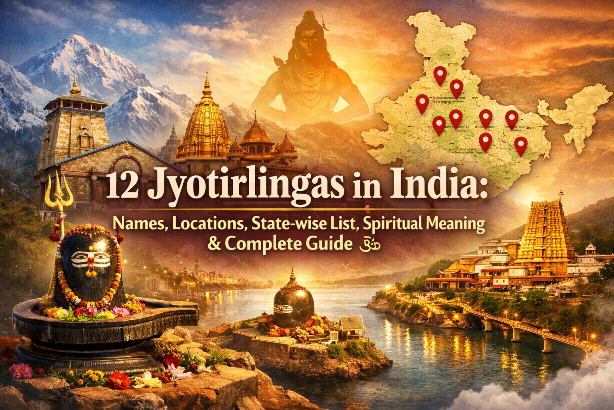
12 Jyotirlinga in India: Names, Places, State-wise List, Spiritual Meaning & Complete Guide 🕉️
The 12 Jyotirlinga in India are among the most sacred spiritual landmarks in the Hindu tradition, revered as divine centres where Lord Shiva is worshipped in the form of an eternal, self-manifested pillar of light. For devotees, these temples are not only places of worship, but deeply powerful spiritual spaces that symbolize protection, transformation, inner strength, and the timeless presence of Mahadev. 🙏
Many people search for the 12 Jyotirlinga names and places when they feel drawn to Shiva worship, are planning a pilgrimage, or want to understand why these temples are considered uniquely significant compared to other Shiva temples. Some seek answers for life’s uncertainties, some feel a deep devotional pull during Shravan or Mahashivratri, and some simply want to explore India’s spiritual geography with meaning and clarity. Whatever your reason, understanding the Jyotirlingas from beginner to advanced level helps you connect with them in a more respectful, aware, and spiritually meaningful way.
In this complete guide, you will learn what Jyotirlingas are, why there are exactly twelve of them, their history, mythology, spiritual symbolism, and how to plan a Jyotirlinga yatra intelligently. You will also get a clean state-wise list and practical worship tips—written responsibly, without exaggerated claims, and aligned with a sincere devotional tone. 🌿
What Are the 12 Jyotirlinga? (Meaning & Definition) ✨
The word Jyotirlinga comes from two Sanskrit roots: “Jyoti” meaning light, and “Linga” meaning the symbolic form of Shiva. Together, Jyotirlinga refers to the Shiva Linga as a radiant pillar of divine light, representing Shiva’s unlimited, eternal nature beyond human form and boundaries. 🕉️
In spiritual understanding, a Jyotirlinga is not merely a temple idol or a religious symbol. It represents a cosmic truth: that the divine cannot be measured by physical shape, yet it can be experienced through faith, devotion, and inner awareness. The Jyotirlingas are traditionally described as self-manifested or spiritually special manifestations of Shiva’s presence. This is why the 12 Jyotirlinga temples are considered among the most important Shiva shrines in India.
For beginners, the simplest way to understand this is: India has countless Shiva temples, but these twelve are regarded as the most spiritually significant and widely revered across traditions. For advanced seekers, the Jyotirlinga concept also symbolizes the experience of Shiva as pure consciousness—beyond name, beyond form, and beyond limitations.
12 Jyotirlinga Names and Places (State-wise List) 🗺️
If you are searching for a quick and clear list of the 12 Jyotirlinga in India, here is the state-wise guide that most pilgrims and devotees refer to for planning their yatra. ✅
1) Somnath Jyotirlinga – Gujarat (Somnath / Veraval)
2) Mallikarjuna Jyotirlinga – Andhra Pradesh (Srisailam)
3) Mahakaleshwar Jyotirlinga – Madhya Pradesh (Ujjain)
4) Omkareshwar Jyotirlinga – Madhya Pradesh (Khandwa / Mandhata Island)
5) Kedarnath Jyotirlinga – Uttarakhand (Kedarnath)
6) Bhimashankar Jyotirlinga – Maharashtra (Near Pune)
7) Kashi Vishwanath Jyotirlinga – Uttar Pradesh (Varanasi)
8) Trimbakeshwar Jyotirlinga – Maharashtra (Nashik)
9) Vaidyanath Jyotirlinga – Jharkhand (Deoghar)
10) Nageshwar Jyotirlinga – Gujarat (Near Dwarka)
11) Rameshwaram Jyotirlinga – Tamil Nadu (Rameshwaram)
12) Grishneshwar Jyotirlinga – Maharashtra (Near Ellora, Aurangabad)
Each of these Jyotirlingas has its own unique story, spiritual symbolism, and temple tradition. Some are easily accessible, while others require deeper planning, physical preparation, and seasonal timing. The beauty of this yatra is that it offers a complete experience of India’s sacred landscape—from the shores of Gujarat to the Himalayas of Kedarnath, from the ghats of Kashi to the spiritual waters of Rameshwaram. 🌊🏔️
History & Cultural Significance of Jyotirlingas 🏛️
The cultural significance of the Jyotirlingas goes far beyond temple architecture. Over centuries, these shrines became spiritual capitals of their regions and influenced the devotional identity of millions. Historically, Jyotirlinga worship became a powerful unifying thread that connected India through Shiva devotion. Even in times of political change, regional rule, and shifting social structures, Jyotirlinga temples continued to serve as centres of prayer, pilgrimage, learning, and spiritual discipline.
From a cultural lens, the Jyotirlingas represent something rare: a sacred tradition that is simultaneously personal and collective. A devotee may visit Jyotirlingas for personal reasons—inner peace, clarity, gratitude, or emotional healing through devotion—but the pilgrimage itself is part of a much larger spiritual culture that has been carried across generations.
In ancient and medieval India, Jyotirlinga pilgrimage journeys were also important because they shaped the idea of tirtha yatra as a path of spiritual growth. The journey, the discipline, the surrender, and the temple experience together create what devotees consider a spiritual upgrade—not because life becomes perfect, but because the inner state becomes stronger. 🌿
Mythology & The Divine Story Behind Jyotirlinga 🔥
One of the most famous spiritual narratives connected to Jyotirlingas is the story of Shiva appearing as a boundless pillar of light. In many traditional tellings, this event occurs when Lord Brahma and Lord Vishnu have a dispute over superiority. Shiva appears as an endless Jyoti Stambha (pillar of light) and challenges them to find its beginning and end—teaching that the divine reality is infinite and cannot be defined by ego or competition.
As the story progresses, Vishnu accepts that the pillar has no end, demonstrating humility and truth. Brahma, however, is said to return with a false claim. Through this narrative, the Jyotirlinga becomes a symbol of a deeper spiritual message: truth, humility, and surrender lead to higher spiritual alignment, while ego creates distance from divine grace.
For beginners, mythology helps create emotional connection and remembrance. For advanced devotees, the story becomes a spiritual teaching about consciousness, identity, and the need to dissolve ego in the presence of the Infinite. ✨
Spiritual Meaning & Symbolism of 12 Jyotirlinga 🕉️
The spiritual meaning of Jyotirlingas is deeply connected to the nature of Shiva as the force of transformation. Shiva is not only worshipped as a deity who blesses devotees, but also as the divine principle that destroys inner ignorance, ego-based attachment, and fear. This is why devotees often feel that Jyotirlinga pilgrimage is not just external travel, but a form of inner purification.
Symbolically, the Jyotirlinga represents light—not the ordinary light of the sun or a lamp, but the light of awareness. Many seekers feel that when they stand in front of a Jyotirlinga, they are reminded of what truly matters: discipline, truth, devotion, and spiritual strength.
Each Jyotirlinga has its own spiritual vibe. Mahakaleshwar is often associated with time, fearlessness, and deep surrender. Kashi Vishwanath is connected with moksha and spiritual liberation. Kedarnath is the silent devotion of the Himalayas. Somnath symbolizes resilience through time. Rameshwaram speaks of devotion and dharma. Together, the twelve Jyotirlingas create a complete spectrum of spiritual symbolism for devotees. 🌿🙏
Best Time to Visit the 12 Jyotirlinga 🗓️
One of the most practical questions devotees ask is: What is the best time to visit 12 Jyotirlingas? The ideal time depends on your travel comfort, weather conditions, and festival seasons. Many pilgrims prefer to plan around Shravan month because Shiva devotion becomes naturally strong during that period. Mondays, Mahashivratri, Pradosh Vrat, and special temple festivals also create powerful spiritual energy—though crowds are also higher then.
For smoother travel planning, many people choose winter months for most Jyotirlingas, while Kedarnath requires special attention due to seasonal closure. If you want a peaceful darshan experience, choosing off-peak weekdays can be wiser than major holiday dates. The key is to plan with respect, patience, and awareness that Jyotirlinga pilgrimage is not meant to be rushed like a checklist. It is a spiritual journey meant to be absorbed with calmness. 🕯️
How to Worship at Jyotirlinga Temples (Beginner Friendly Guide) 🌸
If you are visiting a Jyotirlinga temple for the first time, the worship process can feel overwhelming because of rituals, queues, temple rules, and regional traditions. The good news is that the simplest form of worship is also the most respected: pure devotion and humility. A devotee does not need complex rituals to connect with Shiva. Even a sincere “Om Namah Shivaya” can be enough to create an inner shift.
Most devotees offer water, milk, flowers, bilva leaves, and prayers. However, temple customs differ, and some temples restrict certain types of offerings. It is always wise to follow local guidance respectfully. Many temples have dedicated pandits for formal pujas, but personal prayer is equally valuable. The real worship is not only outside the temple—true worship continues in your behaviour, your discipline, and your inner sincerity after darshan. 🌿
Tip: If your mind is distracted, simply sit for a few minutes near the temple area and repeat your Shiva mantra slowly. Many people notice that in sacred spaces, the mind naturally becomes calmer with a little patience.
12 Jyotirlinga Yatra Planning Guide (Beginner to Advanced) 🚩
Planning a 12 Jyotirlinga yatra can be one of the most rewarding spiritual decisions you make, but it needs to be planned wisely. Some pilgrims attempt to finish all twelve in one rushed schedule, but the deeper experience comes when you allow each temple to be felt, not just visited. A balanced approach is to plan region-wise routes, take rest days, and maintain a devotional routine during travel.
For beginners, the easiest route strategy is to cover accessible Jyotirlingas first, such as Mahakaleshwar, Omkareshwar, Trimbakeshwar, Bhimashankar, and Grishneshwar, then plan Kashi, Somnath, Nageshwar, Vaidyanath, Rameshwaram, Mallikarjuna, and finally Kedarnath based on season. Advanced pilgrims may also align their yatra with fasting discipline, mantra japa, or Mondays to deepen the spiritual impact.
One of the most overlooked aspects of yatra planning is mindset. A Jyotirlinga journey is not only about travel; it is about controlling ego, staying respectful in crowds, accepting delays, and continuing devotion even in discomfort. Many devotees say the true blessings come when you remain patient and spiritually disciplined throughout the pilgrimage. 🙏
Short Spiritual Overview of Each Jyotirlinga 🌟
Below is a brief spiritual overview of all the 12 Jyotirlinga in India.
1) Somnath Jyotirlinga (Gujarat) 🌊
Somnath is often seen as a symbol of resilience, devotion, and the timeless nature of Shiva worship. Located near the sea, its spiritual atmosphere feels both powerful and calming.
2) Mallikarjuna Jyotirlinga (Srisailam) ⛰️
Mallikarjuna is associated with sacred energy, intense devotion, and deep temple tradition. Many pilgrims feel the area holds a strong spiritual vibration rooted in ancient worship.
3) Mahakaleshwar Jyotirlinga (Ujjain) ⏳
Mahakaleshwar is among the most spiritually powerful Jyotirlingas, often connected with time, fearlessness, and deep surrender. The temple’s energy feels intense and unforgettable.
4) Omkareshwar Jyotirlinga (Madhya Pradesh) 🌿
Omkareshwar, located on Mandhata island in the Narmada river, is loved for its peaceful yet divine aura. Many seekers connect it with inner balance and devotion.
5) Kedarnath Jyotirlinga (Uttarakhand) 🏔️
Kedarnath is the Jyotirlinga of Himalayan silence, discipline, and spiritual intensity. The journey itself is considered a devotion practice.
6) Bhimashankar Jyotirlinga (Maharashtra) 🌲
Bhimashankar is surrounded by nature and is often associated with spiritual strength and steady devotion. The temple experience feels grounded and powerful.
7) Kashi Vishwanath Jyotirlinga (Varanasi) 🛕
Kashi Vishwanath is considered one of the most spiritually significant Shiva temples, deeply connected with liberation and the sacred identity of Varanasi.
8) Trimbakeshwar Jyotirlinga (Nashik) 🌊
Trimbakeshwar is connected with sacred river traditions and devotional discipline. Many pilgrims visit with a deep sense of ritual and respect.
9) Vaidyanath Jyotirlinga (Deoghar) 🚩
Vaidyanath is famous for its intense devotion culture, especially during Kanwar Yatra. It is strongly associated with spiritual healing symbolism.
10) Nageshwar Jyotirlinga (Gujarat) 🐍
Nageshwar represents protection and devotion. Many devotees feel it carries a spiritually safeguarding energy.
11) Rameshwaram Jyotirlinga (Tamil Nadu) 🌊
Rameshwaram is connected with dharma, devotion, and purification rituals. Its sacred water traditions are widely known.
12) Grishneshwar Jyotirlinga (Maharashtra) 🕯️
Grishneshwar is often seen as a temple of gentle devotion and completion. Many people visit it along with Ellora, making it a spiritually rich region.
Scientific & Modern Perspective (Respectful & Practical) 🧠
From a modern perspective, the Jyotirlinga pilgrimage can be understood in multiple ways. Spiritually, devotees see it as a sacred alignment with Shiva’s energy. Psychologically, pilgrimage can create powerful effects through focus, intention, discipline, and emotional release. The act of travelling with devotion often strengthens mindset, improves patience, and enhances inner stability—especially when it is done with sincerity rather than pressure.
It is also important to stay responsible in interpretation. Temples are sacred spaces that can deeply influence a person’s emotional state, but they should not be treated as instant solutions for life’s problems. Many devotees describe that the true gift of Shiva worship is not “miracles,” but inner strength, clarity, and courage to face life with faith and discipline. This is a balanced way to respect tradition while staying aligned with modern understanding. ✅
Frequently Asked Questions (FAQs) ❓
1) What are the 12 Jyotirlinga in India?
The 12 Jyotirlingas are the twelve most sacred Shiva temples where Lord Shiva is worshipped as Jyotirlinga (divine pillar of light). They include Somnath, Mallikarjuna, Mahakaleshwar, Omkareshwar, Kedarnath, Bhimashankar, Kashi Vishwanath, Trimbakeshwar, Vaidyanath, Nageshwar, Rameshwaram, and Grishneshwar.
2) Why are there only 12 Jyotirlingas?
The number twelve is based on traditional scriptures and devotional history that describe these as the primary Jyotirlinga manifestations of Shiva. Over time, these twelve became the most widely recognized across Bharat and remain the core Jyotirlinga pilgrimage route.
3) Which is the most powerful Jyotirlinga?
Devotees may feel different temples are powerful in different ways. Some consider Mahakaleshwar extremely intense, while others feel Kedarnath or Kashi Vishwanath holds unmatched spiritual depth. Ultimately, the “most powerful” temple is often the one your devotion connects with most sincerely.
4) Which Jyotirlinga is easiest to visit?
Mahakaleshwar (Ujjain), Omkareshwar, Trimbakeshwar, and Grishneshwar are considered easier for many pilgrims because of good connectivity and relatively manageable travel planning compared to Himalayan routes.
5) Which Jyotirlinga is hardest to reach?
Kedarnath is often considered the most challenging due to high altitude, weather conditions, and seasonal accessibility. Planning carefully, following guidelines, and travelling responsibly helps ensure a smooth pilgrimage.
6) Can I complete 12 Jyotirlinga in one trip?
Yes, some pilgrims do complete all twelve in a single long trip, but it requires serious planning and time. Many devotees prefer a gradual approach, covering them region-wise over multiple journeys for a deeper spiritual experience.
7) What is the best time to visit Jyotirlingas?
Shravan month, Mahashivratri season, and winter months are popular for Jyotirlinga visits. However, the best time depends on crowd preference, temple accessibility, and weather. Kedarnath requires seasonal planning.
8) What should I offer to Lord Shiva at Jyotirlinga temples?
Common offerings include water, bilva leaves, flowers, and prayers. Temple customs can vary, so it is best to follow local traditions respectfully and avoid forcing any offering that is not permitted.
9) Do I need a priest to worship at Jyotirlinga temples?
No. A priest is helpful for formal rituals, but personal prayer is equally respected. Many devotees simply do darshan, chant “Om Namah Shivaya,” and offer devotion quietly.
10) Is Jyotirlinga yatra only for religious people?
No. Many people visit Jyotirlingas for cultural learning, spiritual curiosity, or personal devotion. The key is to maintain respect, humility, and a sincere mindset during the journey.
11) Is Kashi Vishwanath a Jyotirlinga?
Yes. Kashi Vishwanath temple in Varanasi is one of the most important Jyotirlingas and is widely revered for its spiritual significance.
12) Is Mahakaleshwar Jyotirlinga in Ujjain?
Yes. Mahakaleshwar Jyotirlinga is located in Ujjain, Madhya Pradesh, and is among the most famous Shiva temples in India.
13) Can I visit Jyotirlingas with family?
Yes, many families travel together for Jyotirlinga darshan. Planning travel comfort, senior citizen support, and temple queue management can improve the experience.
14) What is the meaning of Jyotirlinga spiritually?
Spiritually, Jyotirlinga symbolizes Shiva as infinite divine light—beyond physical form. It reminds devotees of inner awareness, surrender, truth, and the power of transformation.
15) What should I read next after this blog?
You can explore dedicated temple guides for each Jyotirlinga and also deepen your devotional practice by learning about japa mala counts, Shiva mantras, and belief-based spiritual discipline.
Conclusion: Why the 12 Jyotirlingas Matter Even Today 🌙
The 12 Jyotirlinga in India are not only a list of temples, but a sacred spiritual map that continues to guide devotees through faith, discipline, and inner transformation. Whether you visit one Jyotirlinga in your lifetime or complete the full yatra, the core essence remains the same: Shiva worship teaches strength without arrogance, surrender without weakness, and devotion without fear. 🕉️
If you are planning your journey, start simple, travel respectfully, and allow the experience to unfold naturally. A Jyotirlinga pilgrimage becomes truly powerful when it is approached not as a race, but as a spiritual journey where every step is a prayer.
🙏 हर हर महादेव 🙏





Leave a comment