
























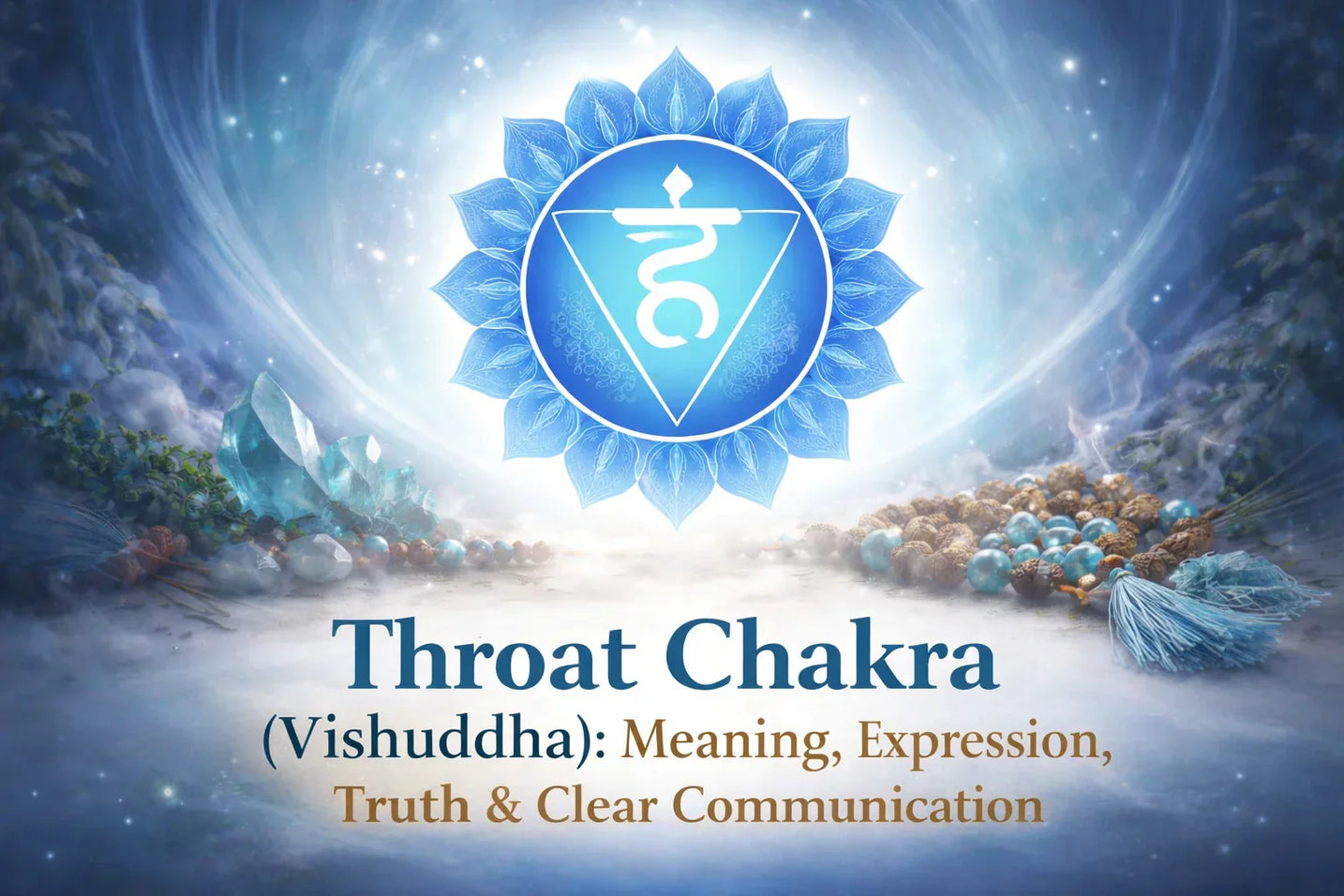
🔵 Throat Chakra (Vishuddha): Expression, Truth & Inner Alignment
The Throat Chakra, known as Vishuddha in traditional systems, governs expression in its most complete form. It is not limited to speech alone, but extends to how thoughts are organized, how truth is perceived, and how inner understanding is translated into the outer world. Positioned above the Heart Chakra, Vishuddha reflects the ability to give voice to what has already been clarified emotionally.
When this chakra functions in balance, communication feels natural rather than performative. Words arise with purpose, silence is respected as much as speech, and expression aligns with intention. Traditional teachings describe this state as purity of expression — not meaning moral purity, but coherence between thought, feeling, and articulation.
This is why Vishuddha is often associated with refinement rather than volume. Speaking less but more accurately, listening without defensiveness, and allowing space before response are all signs of a steady Throat Chakra. In classical practice, clarity-oriented supports such as Sphatik (Quartz) have been symbolically associated with this chakra, reflecting the idea of transparent expression rather than emotional projection.
💯 Truth, Silence, and the Discipline of Expression
One of the most overlooked aspects of the Throat Chakra is its relationship with silence. Vishuddha does not demand constant expression; instead, it governs discernment around when and how expression is appropriate. Silence, in this context, is not suppression but containment — a space where understanding matures before being communicated.
Imbalance in this chakra often reveals itself through extremes. Overactivity may appear as compulsive speaking, defensiveness, or the urge to constantly explain oneself. Underactivity may manifest as fear of expression, difficulty articulating thoughts, or habitual self-censorship. In both cases, the issue lies not in communication skills, but in internal alignment.
Traditional systems emphasize restraint as a form of strength. Practices that cultivate measured speech and attentive listening are considered foundational. In some contemplative traditions, tools such as a Rudraksha Bracelet are worn during daily activity as tactile reminders to remain mindful of one’s words, encouraging pause and awareness rather than reaction.
🧘♀️ Expression Without Distortion: Aligning Thought and Voice
A balanced Throat Chakra allows individuals to express themselves without distortion from fear, emotional charge, or the need for approval. Communication becomes measured and intentional rather than reactive. There is less urgency to convince and more willingness to convey, allowing dialogue to remain clear, respectful, and grounded. This alignment strengthens trust because words arise from understanding instead of impulse.
When Vishuddha is stable, disagreement does not threaten identity. Expression no longer seeks validation or control, and silence is used as consciously as speech. Traditional teachings describe this state as communication guided by awareness, where words serve clarity rather than ego. In such alignment, even complex or difficult truths can be communicated without friction.
Within reflective practices, expression is viewed as an extension of inner discipline. This is why some practitioners associate steadiness in speech with consistent contemplative routines, often accompanied by simple aids such as a Rudraksha Mala used during quiet recitation. In this context, the mala is not a corrective tool for speech, but a reminder that clarity is cultivated internally before it ever reaches the voice.
👂 Listening, Inner Dialogue, and the Quality of Awareness
The Throat Chakra does not govern expression alone; it also shapes the quality of listening. Listening, in this context, extends beyond hearing others and includes the capacity to notice one’s own inner dialogue without distortion. Vishuddha influences how thoughts are organized before they become words, determining whether communication emerges from clarity or from reaction.
When this chakra is balanced, inner dialogue slows and gains structure. Thoughts are observed rather than rushed into expression, and emotional responses are allowed to settle before they take verbal form. This internal pause is what gives communication its precision. Listening becomes receptive rather than defensive, creating space for understanding to deepen without the pressure to respond immediately. In contemplative routines, this quality of attentive awareness is sometimes supported by quiet, repetitive practices—such as holding a Sphatik (Quartz) Bracelet during reflection—traditionally associated with mental transparency and calm observation rather than outward expression.
Imbalance often reveals itself through inner noise. Overactivity may appear as constant mental narration, rehearsed conversations, or repetitive replaying of past exchanges. Underactivity, by contrast, can manifest as difficulty forming thoughts internally, leading to hesitation or confusion when expression is required. In traditional understanding, both patterns point to disturbance in awareness itself, not to lack of intelligence or confidence.
🗣️ Authenticity, Integrity, and the Courage to Speak Clearly
Authentic expression is a central function of the Throat Chakra. Vishuddha governs the ability to speak in alignment with one’s values, even when doing so requires restraint or courage. Authenticity here does not imply bluntness; it reflects coherence between belief, intention, and expression. Words arise from inner alignment rather than emotional urgency or the need for approval.
When this chakra is balanced, individuals are able to communicate truthfully without aggression and remain composed even during disagreement. Integrity replaces the impulse to impress or persuade. Speech becomes deliberate, silence gains dignity, and expression serves understanding rather than control. This steadiness allows difficult truths to be conveyed without creating resistance or confusion.
In reflective traditions, authenticity is cultivated through consistency rather than confrontation. Clear expression is seen as a byproduct of disciplined thinking and self-awareness. For this reason, traditions often associate refined speech and intellectual clarity with tools like the 4 Mukhi Rudraksha, traditionally linked with knowledge, articulation, and thoughtful communication—serving as a symbolic reminder to let words emerge from understanding rather than impulse.
😨 Fear of Expression and the Roots of Suppressed Voice
Fear of expression is often rooted not in lack of ability, but in earlier experiences where speaking led to misunderstanding, conflict, or dismissal. The Throat Chakra governs how these impressions are integrated over time. When left unresolved, they may gradually shape communication patterns, leading to habitual self-censorship or reluctance to share thoughts openly, even when clarity is present internally.
A balanced Vishuddha allows expression to emerge without urgency or self-judgment. There is no pressure to speak perfectly or to be immediately understood. Communication becomes exploratory rather than performative, easing the anxiety associated with being heard or accepted. This gradual unfolding of voice reflects inner safety rather than external confidence.
Traditional systems emphasize patience when restoring expressive balance. Quiet recitation, reflective pauses, and disciplined observation of inner dialogue are considered more effective than forcing speech. In this context, steadiness is often associated with inner confidence rather than articulation itself. This is why practices aimed at overcoming expressive fear have traditionally been linked with supports such as the 11 Mukhi Rudraksha, symbolically connected with courage and mental composure, reinforcing stability while allowing expression to return naturally.
🗓️ Integrating Vishuddha into Daily Communication
Throat Chakra alignment is sustained through everyday communication rather than isolated practices. How one speaks in routine interactions, listens during disagreement, and responds under pressure reflects the stability of Vishuddha more accurately than occasional moments of eloquence. It is in ordinary exchanges, not heightened conversations, that clarity of expression is most consistently tested.
When Vishuddha is integrated, communication becomes economical and intentional. Words are chosen for clarity rather than volume, and listening shifts from anticipation of response to genuine presence. This steadiness reduces reactive speech and allows dialogue to unfold with respect, even when perspectives differ. Over time, such communication builds trust because it remains consistent across situations rather than fluctuating with emotion.
In daily life, reminders of mindful expression are often subtle rather than deliberate. Some individuals maintain this steadiness through quiet personal disciplines that support clarity of thought throughout the day. This is why traditions often associate everyday composure with tools like the 6 Mukhi Rudraksha, traditionally linked with mental balance and thoughtful decision-making, reinforcing the principle that clear expression begins with a settled mind rather than prepared words.
❓ Frequently Asked Questions (FAQs)
What is the primary role of the Throat Chakra?
The Throat Chakra governs authentic expression, clarity of communication, and alignment between thought, intention, and speech. It influences how truth is conveyed, not how loudly it is spoken.
Does the Throat Chakra only relate to speaking?
No. Vishuddha also governs listening, internal dialogue, and how information is processed before expression. Silence and restraint are equally important aspects of this chakra.
How can I tell if my Throat Chakra is imbalanced?
Imbalance may appear as difficulty expressing thoughts, fear of speaking, excessive talking, defensiveness, or mental clutter. These patterns reflect misalignment rather than lack of ability.
Is honesty the same as bluntness in Throat Chakra work?
No. Balanced Vishuddha emphasizes clarity and responsibility. Truth is expressed with awareness of timing, impact, and intention rather than impulse.
Why is silence emphasized in Throat Chakra traditions?
Silence allows understanding to mature before expression. Traditional systems regard silence as a form of disciplined communication, not suppression.
Can fear block the Throat Chakra?
Fear does not block expression directly, but unresolved experiences associated with speaking may lead to hesitation or self-censorship. Awareness helps restore balance gradually.
How does Vishuddha affect relationships?
Balanced expression supports clarity, trust, and healthy boundaries. Communication becomes transparent rather than reactive, reducing misunderstanding.
Is expressive confidence linked to ego?
True expressive confidence arises from alignment, not ego. When Vishuddha is balanced, there is less need to dominate conversations or seek validation.
Does Throat Chakra work require constant speaking practice?
No. Quality of expression matters more than quantity. Listening, reflection, and mindful pauses are equally effective practices.
How long does it take to balance the Throat Chakra?
There is no fixed timeline. Balance develops through consistent awareness, ethical communication, and patience rather than force.
✨ Conclusion 🪷
Expression Rooted in Awareness
The Throat Chakra teaches that true expression is an outcome of clarity rather than effort. Vishuddha aligns communication with understanding, allowing words to emerge from awareness instead of reaction. When balanced, expression becomes measured, silence gains meaning, and communication supports connection rather than conflict.
Traditional teachings emphasize that expression matures naturally when listening, restraint, and integrity are practiced consistently. Speaking less but more accurately reflects inner alignment far more than constant articulation. In this way, the Throat Chakra supports honesty without aggression and confidence without force.
As Vishuddha stabilizes, communication transforms into a conscious act rather than a habitual response. Words carry intention, listening becomes presence, and silence becomes clarity. This integration allows expression to serve understanding, reinforcing balance across both personal and relational dimensions.
🙏 हर हर महादेव 🙏





Leave a comment