






🌳 Why Quality Begins Before Anyone Talks About Certification
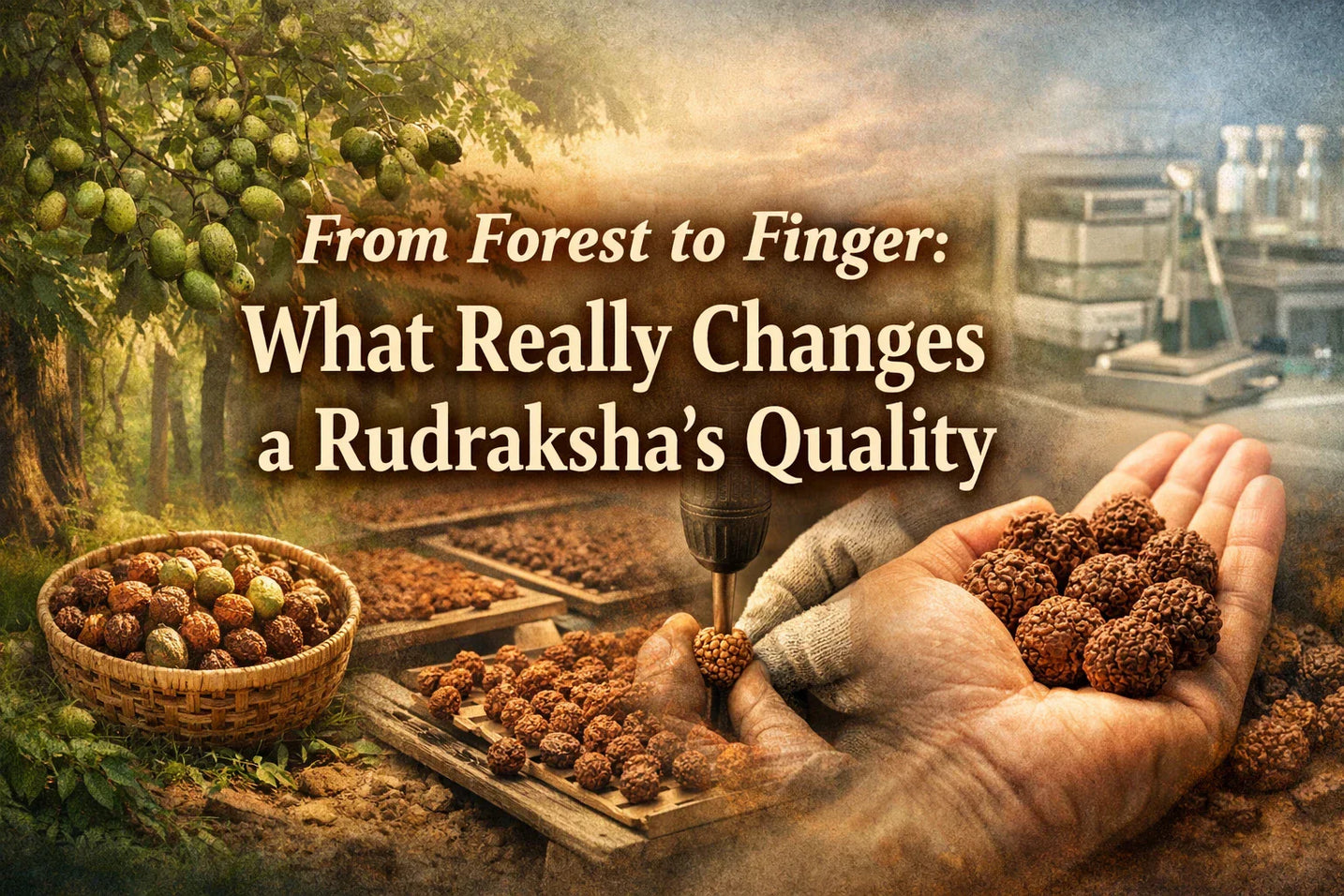
When people speak about Rudraksha quality, the conversation often begins at the point of testing or certification. In reality, quality begins much earlier—long before a bead is drilled, examined, or documented. It begins at the moment the seed matures on the tree and continues through a series of decisions that quietly shape its integrity. These early stages are rarely discussed because they are invisible to the final wearer, yet they determine how stable, resilient, and consistent a Rudraksha will feel over time.
Two beads can come from the same region, the same harvest season, and even the same tree, yet differ noticeably in durability and response. This difference is not mystical; it is procedural. Each stage between harvest and wearing introduces variables that either preserve or weaken the bead’s natural structure. Understanding these variables reframes quality as a process rather than a label.
🪵 Maturity at Harvest: The First Quiet Divider
Harvest maturity is the earliest and most decisive factor. Seeds collected before full maturation may look acceptable on the surface but lack internal density. This internal incompleteness often reveals itself later as cracking, excessive dryness, or instability. Fully matured seeds, on the other hand, have completed their natural hardening cycle, giving them a stronger core and better resistance to environmental stress.
Because early harvesting increases yield and speeds supply, it is tempting within commercial chains. The visual difference between early and fully matured seeds is subtle, which makes this stage easy to overlook. Yet once maturity is compromised, no later process can restore what was never formed.
☀️ Drying Pace: Why Speed Changes Structure
After harvest, drying becomes the next critical phase. Natural, gradual drying allows moisture to leave the seed evenly, maintaining structural balance. Accelerated drying—whether through excessive heat, forced airflow, or chemical assistance—removes moisture unevenly. This creates internal stress points that may not be visible immediately.
These stress points often manifest much later, sometimes after the bead has already reached the wearer. What appears as a sudden crack or surface weakness is often the delayed result of rushed drying. Quality here is not about dryness alone; it is about how evenly that dryness was achieved.
🧽 Cleaning Methods That Either Protect or Disturb
Cleaning is commonly assumed to be harmless, yet it plays a significant role in preserving natural oils and surface integrity. Gentle cleaning removes external residue without disturbing the bead’s organic balance. Aggressive methods—strong chemicals, prolonged soaking, or abrasive tools—strip away protective layers that evolved to stabilize the seed.
Once these layers are disturbed, the bead becomes more reactive to humidity and handling. The loss is subtle and often unnoticed during early stages, but it alters how the bead ages. Quality, in this sense, is closely tied to restraint: how little interference is applied rather than how much.
🛠️ Drilling Precision: The Most Underestimated Step
Drilling transforms a seed into a wearable bead, but it also introduces risk. Precision drilling respects the bead’s internal symmetry, maintaining balance around the central axis. Poor alignment, excessive force, or improper tools create micro-fractures that weaken the structure from within.
These fractures may not affect appearance, but they influence longevity. Over time, stress concentrates around the drilled channel, especially during daily wear. A well-drilled bead ages gracefully; a poorly drilled one slowly deteriorates. This difference is rarely visible at purchase but becomes evident with time.
🌬️ Storage Before Sale: The Silent Influencer
Before a Rudraksha reaches the wearer, it often spends months in storage. Conditions during this period—humidity, airflow, temperature stability—either preserve or compromise the bead. Inconsistent environments cause repeated expansion and contraction, which fatigues the structure.
Because storage happens out of sight, it is rarely discussed. Yet it is during this phase that many beads lose long-term stability. Quality here is passive; it depends on patience and environmental control rather than active intervention.
🧩 Why Two Beads From the Same Origin Age Differently
It often surprises people to learn that two Rudraksha beads sourced from the same region—and even the same harvest—can behave very differently over time. This difference is not random. It is the cumulative outcome of small variations introduced at each handling stage. Minor differences in maturity, drying rhythm, or drilling alignment compound slowly, revealing themselves months or years later rather than immediately.
Quality, in this sense, is not a snapshot taken at the moment of sale. It is a trajectory. A bead that feels stable early on may degrade if internal stresses were introduced earlier, while another bead that seems ordinary at first may prove resilient because its structure was respected throughout the process. Understanding quality as a long-term trajectory helps explain why identical-looking beads do not age identically.
🪨 Density and Internal Balance: What the Eye Cannot See
Visual inspection can only reveal surface conditions. Internal density, however, plays a decisive role in how a Rudraksha responds to wear, climate, and handling. Beads with balanced internal density distribute stress evenly, while beads with uneven density concentrate stress in weak zones. These zones become the first points of fatigue over time.
Internal balance is influenced early—during maturation and drying—and preserved or disturbed during drilling and storage. Once disturbed, it cannot be corrected later. This is why some beads remain structurally sound across years of daily use while others begin to show signs of wear far sooner, even under similar conditions.
🌡️ Environmental Transitions and Structural Fatigue
Between forest and finger, Rudraksha often moves through multiple environments: humid regions, dry storage rooms, transport containers, and finally the wearer’s local climate. Each transition introduces expansion and contraction. When these shifts occur gradually, the bead adapts. When they occur abruptly or repeatedly, structural fatigue develops.
Fatigue does not announce itself immediately. It accumulates quietly. Over time, repeated environmental shocks weaken internal bonds, making the bead more vulnerable to cracking or surface instability. Quality here is less about strength and more about adaptability—how gently the bead was allowed to adjust to change.
🪞 Why Surface Appearance Can Be Misleading
A polished, dark, or visually striking bead can easily be mistaken for a high-quality one. Surface appearance, however, often reflects cosmetic treatment rather than structural integrity. In some cases, visual enhancement masks underlying weakness rather than indicating strength.
True quality reveals itself over time, not at first glance. Beads that retain natural texture and subtle variation often age more gracefully because their structure has not been overly manipulated. This distinction highlights why immediate visual appeal is a poor substitute for long-term stability.
🔄 Irreversible vs. Manageable Quality Changes
Not all quality changes are equal. Some are irreversible—such as compromised maturity, internal fractures from poor drilling, or uneven drying. Once these occur, no later care can fully restore integrity of the bead. Other changes, such as surface dryness or minor environmental stress, are manageable with patience and proper handling.
The challenge for buyers is that irreversible changes often remain invisible at the time of purchase, while manageable ones are more noticeable. This inversion leads to misplaced confidence. Understanding which stages introduce permanent change reframes how quality should be evaluated.
🌱 Why Quality Is Preserved Through Restraint, Not Intervention
Across every stage, a consistent pattern emerges: the best outcomes come from restraint. Minimal interference, patient transitions, and respect for natural processes preserve integrity more effectively than aggressive optimization. Many quality losses occur not from neglect, but from over-handling.
This principle explains why some beads maintain stability despite modest appearance, while others deteriorate despite careful ownership. Quality is cumulative. It is built through a series of restrained choices rather than dramatic enhancements.
❓ Frequently Asked Questions (FAQs)
Can two Rudraksha from the same tree still differ in quality?
Yes. Even when beads originate from the same tree, differences in maturity at harvest, drying pace, drilling precision, and storage conditions can lead to noticeable variation over time. Quality is shaped by cumulative handling decisions rather than origin alone.
Why don’t lab tests reveal these quality differences?
Lab tests confirm species and structural authenticity, but they cannot detect internal stress, uneven density, or fatigue introduced during drying, drilling, or storage. These factors influence longevity and stability but fall outside laboratory measurement.
Is surface appearance a reliable indicator of quality?
Surface appearance can be misleading. Polishing or cosmetic treatments may enhance visual appeal without improving structural integrity. True quality reveals itself gradually through stability and resilience over time.
Can quality damage be fixed later with proper care?
Some surface-related issues are manageable, but foundational problems—such as compromised maturity or internal fractures—are irreversible. Early-stage handling has a permanent influence that later care cannot fully undo.
Why does restraint matter more than intervention?
Across every stage, minimal interference preserves natural balance. Over-handling, aggressive cleaning, or rushed processing often introduce weaknesses rather than improvements. Quality is protected through patience, not enhancement.
🧭 Final Conclusion 🌟
Quality Is a Journey of Decisions, Not a Label
Rudraksha quality does not begin at certification, testing, or purchase. It begins much earlier, shaped quietly by how the seed is allowed to mature, dry, be cleaned, drilled, stored, and transitioned across environments. Each stage introduces choices that either preserve natural balance or compromise it. These choices accumulate, defining how the bead behaves not just at first glance, but over years of use.
Understanding quality as a journey rather than a label changes how Rudraksha is perceived. Visual appeal, origin claims, or documentation alone cannot capture the internal story written by handling decisions. Two beads may look identical at the moment of sale, yet their futures can diverge dramatically because of differences introduced long before they reached the wearer.
When quality is viewed through this process-based lens, patience replaces assumption and awareness replaces marketing language. The most resilient Rudraksha are often those that were interfered with the least, allowed to complete their natural cycles without haste. In this sense, true quality is not manufactured—it is preserved.
🙏 हर हर महादेव 🙏





Leave a comment