

🔬 Why Lab Certification Became the Gold Standard
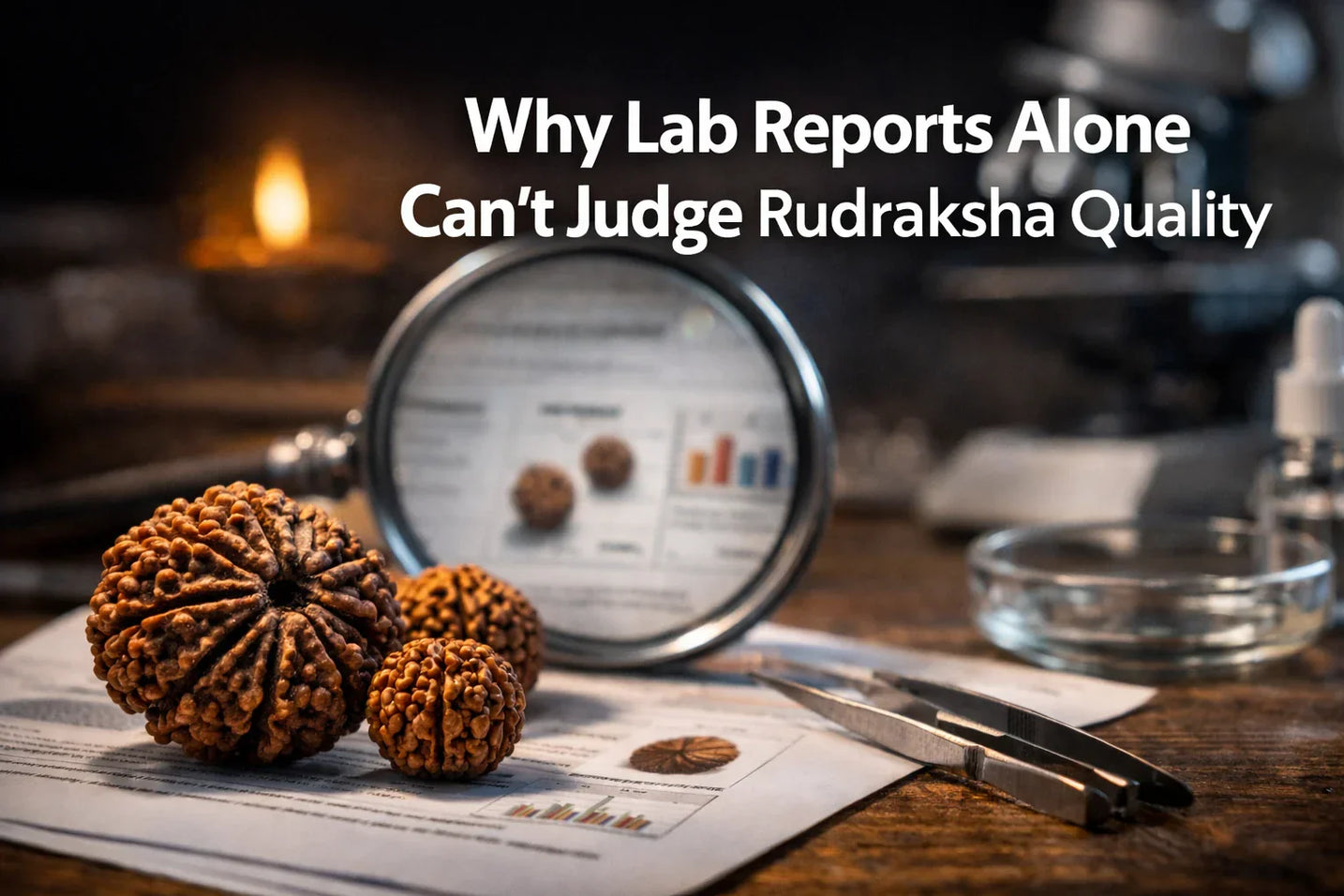
In today’s Rudraksha market, lab certification has become a symbol of trust. Buyers actively look for the words “lab certified” before making a purchase, believing that a certificate guarantees authenticity, quality, and suitability. This reliance did not emerge without reason. As the global demand for Rudraksha increased, so did adulteration, artificial carving, and misrepresentation. Lab certification entered the picture as a necessary corrective, offering a scientific method to identify genuine Rudraksha and distinguish it from fakes.
A laboratory report primarily serves one function: verification. It confirms whether a bead is botanically a Rudraksha seed, identifies the number of mukhis, and checks for artificial modifications. This role is important and should not be undermined. Certification protects buyers from obvious fraud and establishes a baseline of authenticity. However, over time, this baseline began to be misunderstood as a complete assessment rather than a limited verification tool.
🧠 What a Lab Report Can — and Cannot — See
Laboratories operate through measurable parameters. They examine physical structure, surface patterns, and internal formations using imaging and botanical references. These methods are effective for confirming identity, but they do not assess how a Rudraksha has been handled, stored, or aged. A lab report does not evaluate maturity, internal moisture balance, or long-term structural resilience. These aspects lie outside the scope of laboratory testing.
This distinction is crucial because Rudraksha is a natural, organic seed. Like any organic material, its condition evolves based on how it has been harvested, dried, stored, and transported. Two beads may receive identical lab certificates yet differ significantly in stability and longevity. Certification confirms what the bead is, not how it has lived its journey from tree to wearer.
🔍 Why “Certified” Is Often Misread as “Perfect”
The misconception begins when certification is treated as a quality seal rather than an identity confirmation. Buyers often assume that a certified Rudraksha is automatically superior, balanced, and suitable for long-term wear. This assumption shifts responsibility entirely onto the certificate, removing the need for further understanding. When expectations are built solely on documentation, disappointment becomes likely.
Quality in Rudraksha is multi-dimensional. It includes structural strength, proper drilling, surface integrity, and the bead’s ability to withstand daily wear. None of these qualities are guaranteed by certification alone. When buyers experience cracking, discomfort, or dissatisfaction despite owning a certified bead, confusion arises. The problem is not the certificate; it is the misunderstanding of what certification represents.
🧩 Identity v/s Suitability
One of the most overlooked distinctions in Rudraksha selection is the difference between identity and suitability. Identity answers the question: “Is this a genuine Rudraksha of a specific mukhi?” Suitability answers a far more personal and practical question: “Is this bead right for this wearer, lifestyle, and long-term use?” Lab certification addresses the first question, not the second.
Suitability depends on factors that cannot be standardized into a report. Lifestyle, climate, daily activity, sensitivity, and wearing habits all influence how a Rudraksha performs over time. Ignoring these factors in favor of documentation alone reduces Rudraksha to a checklist item rather than a living object that interacts continuously with its environment and wearer.
🔬 Why Two Certified Rudraksha Can Behave Differently
One of the most confusing experiences for buyers occurs when two Rudraksha beads, both lab certified and identical in mukhi count, perform very differently over time. One may remain stable and comfortable for years, while the other may develop cracks, discomfort, or structural issues. This difference often leads people to question the credibility of certification itself, when in reality the issue lies in what certification does not evaluate. Laboratories confirm identity, but they do not assess the lived condition of the bead.
Rudraksha is a natural seed, and like all organic materials, it carries a history. Factors such as how long the bead was dried, whether it was rushed through artificial processes, and how it was stored before reaching the buyer significantly affect its long-term stability. These variables exist outside the scope of laboratory testing. As a result, two beads can pass identical tests while possessing very different internal resilience. Certification verifies origin and structure, not the journey.
🛠️ Drilling Quality and Structural Stress
Drilling is one of the most critical yet least discussed aspects of Rudraksha quality. A lab report does not evaluate how a bead has been drilled, whether internal stress points were created, or if the drilling compromised the bead’s natural fiber alignment. Improper drilling introduces tension that may not be visible immediately but can surface months later as cracks or weakness.
Certified beads can still suffer from poor drilling practices because certification focuses on authenticity rather than craftsmanship. The quality of drilling directly affects how the bead responds to movement, temperature changes, and daily wear. This is one of the clearest examples of why certification alone cannot predict long-term performance.
📦 Storage, Handling, and the Invisible Variables
Between harvesting and wearing, Rudraksha often passes through multiple stages of storage and handling. Exposure to excessive heat, prolonged moisture, or abrupt drying can compromise the bead internally. These conditions leave no obvious surface marks and therefore escape laboratory detection. Yet they significantly influence how the bead ages once worn.
This is why two certified Rudraksha sourced from different suppliers can feel entirely different in quality. One may have been stored patiently and responsibly, while the other may have been rushed to market. Certification does not capture these invisible variables, but they matter deeply in real-world use.
🧠 Why Buyer Confusion Persists
Buyer confusion arises when certification is treated as a guarantee rather than a filter. Certification filters out obvious inauthenticity, but it does not guarantee excellence, suitability, or longevity. When buyers expect more from a certificate than it is designed to provide, dissatisfaction becomes inevitable.
Understanding this distinction reduces frustration and restores clarity. Certification is a starting point, not the destination. It confirms that the bead is genuine, but it does not absolve the buyer or seller from deeper evaluation, guidance, and responsibility.
🏷️ Market Practices That Certification Does Not Reveal
In the commercial ecosystem surrounding Rudraksha, lab certification has gradually become a shorthand for trust. Sellers often rely on certificates as definitive proof, sometimes presenting them as the final word on quality. However, certification does not reveal how a bead was sourced, whether it was selected from a mature harvest, or if it was part of a rushed batch processed to meet demand. These market practices significantly influence the long-term integrity of Rudraksha, yet they remain invisible within a laboratory report.
The pressure to supply certified beads at scale can lead to compromises that are difficult to detect. Rapid drying methods, aggressive cleaning, or hurried drilling may not invalidate authenticity, but they can weaken structural resilience. Certification confirms genuineness at a point in time; it does not audit the commercial shortcuts that may have preceded that moment. Understanding this gap helps buyers interpret certificates with clarity rather than blind confidence.
🧠 Why Sellers Lean Heavily on Certificates
Certificates simplify communication. They offer a tangible document that appears objective and authoritative, reducing the need for detailed explanation. For sellers operating in competitive markets, certification becomes an efficient way to establish baseline trust quickly. However, when certificates are used as substitutes for guidance, education, and transparency, they inadvertently create misinformation.
This reliance is rarely malicious; it is structural. Explaining maturity, handling, drilling quality, and suitability requires time, expertise, and accountability. Certificates, by contrast, are easily transferable and widely understood. The risk arises when both sellers and buyers treat certification as a comprehensive endorsement rather than a limited verification tool.
👤 The Buyer’s Role in Holistic Evaluation
A more informed approach begins with redefining the buyer’s role. Instead of viewing certification as the end of inquiry, it should be treated as the beginning. Buyers benefit from asking questions about sourcing, storage conditions, drilling methods, and suitability for their lifestyle. These questions cannot be answered by a report alone; they require dialogue and trust.
Holistic evaluation recognizes that Rudraksha is not a standardized industrial product. It is a natural object with variability. When buyers engage beyond documentation, they reduce the risk of mismatch between expectation and experience. This shift transforms the purchasing process from transaction to informed selection.
🧭 Moving from Documentation to Understanding
The most sustainable relationship with Rudraksha emerges when documentation supports understanding rather than replacing it. Certification establishes authenticity, but understanding establishes suitability. When these two elements work together, confusion diminishes and long-term satisfaction increases.
By acknowledging the limits of lab reports, buyers and sellers alike can foster a more transparent ecosystem. Certification retains its value as a protective filter, while deeper knowledge fills the gaps it cannot address. This balanced perspective honors both science and lived reality.
We at rrudraksha.com provide not only genuine Rudraksha With Lab Certificate, But also ensures best premium quality in best reasonable prices
❓ Frequently Asked Questions (FAQs)
Does this mean lab certification is useless for Rudraksha?
No. Lab certification is important and necessary, but it serves a specific purpose. It verifies authenticity and basic identity. What this blog explains is that certification should be treated as a starting point, not a complete evaluation of quality, suitability, or long-term reliability.
Why do some certified Rudraksha still crack or feel uncomfortable over time?
Cracking or discomfort usually relates to factors like improper drying, poor drilling, storage conditions, or lifestyle mismatch. These aspects are not measured in lab reports, which is why certification alone cannot predict long-term performance.
Can two Rudraksha with identical lab reports behave differently?
Yes. Rudraksha is a natural seed, and each bead has a unique physical history. Differences in maturity, internal structure, handling, and drilling quality can result in different outcomes, even when lab reports are identical.
What should buyers look for beyond lab certification?
Buyers should consider sourcing transparency, storage practices, drilling quality, bead maturity, and suitability for their lifestyle and environment. Guidance from an experienced seller is often more valuable than relying on documentation alone.
Is it wrong to trust lab reports while buying Rudraksha?
It is not wrong to trust lab reports, but it is incomplete to trust only the report. Certification confirms authenticity; informed understanding completes the selection process.
🧭 Final Conclusion 🔬
Certification Is a Filter, Not the Finish Line
Lab certification plays an important role in protecting buyers from obvious fraud, but it was never designed to be a complete measure of Rudraksha quality. It confirms what a bead is, not how it has been treated, stored, or prepared for long-term use. When certification is misunderstood as a guarantee, expectations become misaligned with reality.
A meaningful relationship with Rudraksha begins when certification is paired with understanding. Factors such as maturity, drilling quality, storage history, and personal suitability shape the real experience far more than documentation alone. Recognizing these limits does not weaken trust in certification; it restores clarity to its true purpose.
By moving beyond blind dependence on lab reports, buyers make more informed choices and develop realistic expectations. This shift transforms Rudraksha from a certified object into a consciously selected companion—chosen with awareness rather than assumption.
🙏 हर हर महादेव 🙏





Leave a comment